The Schrödinger equation is non-relativistic. We obtain the non-relativistic version of the electromagnetic action differential,

by expanding the root and ignoring all but the first two terms:

This is obviously justified if  which defines the non-relativistic regime.
Writing the potential part of  as
as ![{\displaystyle q\,[-V+\mathbf {A} (t,\mathbf {r} )\cdot (\mathbf {v} /c)]\,dt}](https://wikimedia.org/api/rest_v1/media/math/render/svg/20e8b24d546fe887ebe07274865fbd8c475ab464) makes it clear that in most non-relativistic situations the effects represented by the vector potential
makes it clear that in most non-relativistic situations the effects represented by the vector potential  are small compared to those represented by the scalar potential
  If we ignore them (or assume that vanishes), and if we include the charge
  in the definition of
  (or assume that
  ), we obtain
![{\displaystyle S[{\mathcal {C}}]=-mc^{2}(t_{B}-t_{A})+\int _{\mathcal {C}}dt\left[{\textstyle {m \over 2}}v^{2}-V(t,\mathbf {r} )\right]}](https://wikimedia.org/api/rest_v1/media/math/render/svg/b4499cc5df31a2145f1587b9f3fcb45f903aa2f7)
for the action associated with a spacetime path 
Because the first term is the same for all paths from  to
to  it has no effect on the differences between the phases of the amplitudes associated with different paths. By dropping it we change neither the classical phenomena (inasmuch as the extremal path remains the same) nor the quantum phenomena (inasmuch as interference effects only depend on those differences). Thus
![{\displaystyle \langle B|A\rangle =\int {\mathcal {DC}}e^{(i/\hbar )\int _{\mathcal {C}}dt[(m/2)v^{2}-V]}.}](https://wikimedia.org/api/rest_v1/media/math/render/svg/10b995d212329a44f0dfdd682f340c4fcc14237f)
We now introduce the so-called wave function  as the amplitude of finding our particle at
  if the appropriate measurement is made at time
 accordingly, is the amplitude of finding the particle first at
  (at time
  ) and then at (at time
  ). Integrating over
  we obtain the amplitude of finding the particle at (at time ), provided that Rule B applies. The wave function thus satisfies the equation

We again simplify our task by pretending that space is one-dimensional. We further assume that and differ by an infinitesimal interval  Since
Since  is infinitesimal, there is only one path leading from
  to
to  We can therefore forget about the path integral except for a normalization factor
  implicit in the integration measure
  and make the following substitutions:

This gives us

We obtain a further simplification if we introduce  and integrate over
  instead of
  (The integration "boundaries"
  and
and  are the same for both and
  ) We now have that

Since we are interested in the limit  we expand all terms to first order in To which power in should we expand? As increases, the phase
  increases at an infinite rate (in the limit
  ) unless
  is of the same order as In this limit, higher-order contributions to the integral cancel out. Thus the left-hand side expands to
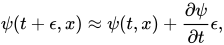
while  expands to
![{\displaystyle \left[1-{i\epsilon \over \hbar }V(t,x)\right]\left[\psi (t,x)+{\partial \psi \over \partial x}\eta +{\frac {1}{2}}{\partial ^{2}\psi \over \partial x^{2}}\eta ^{2}\right]=\left[1-{i\epsilon \over \hbar }V(t,x)\right]\!\psi (t,x)+{\partial \psi \over \partial x}\eta +{\partial ^{2}\psi \over \partial x^{2}}{\eta ^{2} \over 2}.}](https://wikimedia.org/api/rest_v1/media/math/render/svg/a3b2d776e71c82d9145f8fca7963e4ce1a3c639c)
The following integrals need to be evaluated:

The results are

Putting Humpty Dumpty back together again yields

The factor of  must be the same on both sides, so
 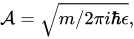 which reduces Humpty Dumpty to
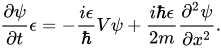
Multiplying by  and taking the limit (which is trivial since has dropped out), we arrive at the Schrödinger equation for a particle with one degree of freedom subject to a potential
  :
:
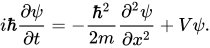
Trumpets please! The transition to three dimensions is straightforward:

|