The Landau notation is an amazing tool applicable in all of real analysis. The reason it is so convenient and widely used is because it underlines a key principle of real analysis, namely estimation. Loosely speaking, the Landau notation introduces two operators which can be called the "order of magnitude" operators, which essentially compare the magnitude of two given functions.
The little-o provides a function that is of lower order of magnitude than a given function, that is the function  is of a lower order than the function
  . Formally,
Let  and let
Let 
If 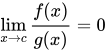 then we say that
"As  ,
,  "
"
- As
 , (and
  )
) 
- As , (and
 )
) 
- As
 ,
, 
The Big-O provides a function that is at most the same order as that of a given function, that is the function  is at most the same order as the function . Formally,
Let and let
Let
If there exists  such that
 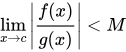 then we say that
"As ,  "
"
- As ,
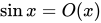
- As
 ,
, 
We will now consider few examples which demonstrate the power of this notation.
Let  and
and  .
.
Then  is differentiable at
  if and only if
There exists a  such that as
  ,
,  .
.
Let ![{\displaystyle f:[a,x]\to \mathbb {R} }](https://wikimedia.org/api/rest_v1/media/math/render/svg/67687ad801319b06b03b1b94cbf95dec40c82076) be differentiable on
be differentiable on ![{\displaystyle [a,b]}](https://wikimedia.org/api/rest_v1/media/math/render/svg/9c4b788fc5c637e26ee98b45f89a5c08c85f7935) . Then,
. Then,
As  ,
, 
Let be n-times differentiable on . Then,
As , 


