


IB Mathematics SL/Functions and Equations
Topic 2 - Functions and Equations
[edit | edit source]Introduction
[edit | edit source]The general aim of this section is to explore the notion of function as a unifying theme. Additionally, candidates should be able to apply functional methods to a variety of situations. Use of a GDC (Graphing Display Calculator) is expected.
Concept of a Function
[edit | edit source]Composite Functions
[edit | edit source]A composite function is a function made up of multiple parts, or steps. Before encountering composite functions, you will have seen functions of the form f(x), g(x) and so on. A composite function has another function inside it, and could for example be written as f(g(x)), or g(f(x)). These are said, "f of g of x" and "g of f of x". f(g(x)) means that the function 'g' is applied to 'x', and then following this, the function 'f' is applied to the output of the function 'g'. For example, if g(x)=2x+3, and f(x)=x^2, and the composite function was f(g(x)), 'x' would have 'g' applied, and become '2x+3'. '2x+3' subsequently has 'f' applied, and becomes (2x+3)^2.
f(g(x)) does NOT equal g(f(x)).
Inverse Function
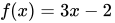
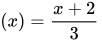
[edit | edit source]The inverse function, is as its name signifies, the inverse of a function, shown as (f(x)^-1). This is accomplished by substituting and for one another within the equation, and evaluating the function to where you aim to get the variable alone, again.


Examples:
Ex.1


Ex.2




The Graph of a Function
[edit | edit source]Horizontal and Vertical Asymptotes
[edit | edit source]An asymptote can be described as a line that represents the end behavior of a function. While they may be crossed, they may not be crossed at an infinite number of points. They can be horizontal, vertical, or oblique (diagonal).
For instance, if you look at a visual representation of you will see that while the graph approaches the x-axis, the line it will never touch the line.


Exponents of the Variables
[edit | edit source]When dealing with a function, it s always a good idea to take a look at the highest power the variable(s) are to, among other things. For example, for the equations of and the behaviors of these functions differ greatly. With the function extends from negative infinity from Quadrant III to positive infinity in Quadrant I. While with the function of the function extends from Quadrant II to Quadrant I.


Transformations of Graphs
[edit | edit source]The Reciprocal Function
[edit | edit source]X ----> 1/x, i.e. f(x) = 1/x is defined as the reciprocal function.
Notice that:
- f(x) = 1/x is meaningless when x = 0 - the graph of f(x) = 1/x exists in the first and third quadrants only - f(x) = 1/x is symmetric about y = x and y = -x - f(x) = 1/x is asymptotic (approaches) to the x-axis and to the y-axis
(Source: Mathematics for the international student, Mathematics SL, International Baccalaureate Diploma Programme by John Owen, Robert Haese, Sandra Haese, Mark Bruce)
The Quadratic Function
[edit | edit source]Standard Form

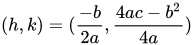
Vertex or Turning Point Form
, where (h,k) is the vertex

Axis of Symmetry
[edit | edit source]-b/(2a)
Roots of the equation
[edit | edit source]
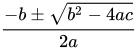
Where b2-4ac is the discriminant. It can also be written as Δ.
When Δ>0, the equation has 2 distinct, real roots.
When Δ=0, the equation has 2 repeated real roots.
When Δ<0, the equation has no real roots (only imaginary roots).
Exponential Function
[edit | edit source]In mathematics, the exponential function is the function ex, where e is the number (approximately 2.718281828) such that the function ex equals its own derivative. The exponential function is used to model phenomena when a constant change in the independent variable gives the same proportional change (increase or decrease) in the dependent variable. The exponential function is also often written as exp(x), especially when x is an expression complicated enough to make typesetting it as an exponent unwieldy.
The graph of y = ex is upward-sloping, and increases faster as x increases. The graph always lies above the x-axis but can get arbitrarily close to it for negative x; thus, the x-axis is a horizontal asymptote. The slope of the graph at each point is equal to its y coordinate at that point. The inverse function is the natural logarithm ln(x); because of this, some older sources refer to the exponential function as the anti-logarithm.
Sometimes the term exponential function is used more generally for functions of the form cbx, where the base b is any positive real number, not necessarily e.