IB Mathematics SL/Algebra
Topic 1 - Algebra[edit | edit source]
Introduction[edit | edit source]
The aim of this section is to introduce candidates to some basic algebraic concepts and applications. Number systems are now in the presumed knowledge section.
Sequences and Series[edit | edit source]
A series is a sum of numbers. For example,

A sequence is a list of numbers, usually separated by a comma. The order in which the numbers are listed is important, so for instance,

Finite and Infinite Sequences[edit | edit source]
A more formal definition of a finite sequence with terms in a set S is a function from {1,2,...,n} to for some n ≥ 0.

An infinite sequence in S is a function from {1,2,...} (the set of natural numbers)
Arithmetic[edit | edit source]
Arithmetic series or sequences simply involve addition.
1, 2, 3, 4, 5, ...
Is an example of addition, where 1 is added each time to the prior term.
The formula for finding the nth term of an arithmetic sequence is:

Where is the nth term, is the first term, d is the difference, and n is the number of terms


Sum of Infinite and Finite Arithmetic Series[edit | edit source]
An infinite arithmetic series is an infinite series whose terms are in an arithmetic progression. Examples are 1 + 1 + 1 + 1 + · · · and 1 + 2 + 3 + 4 + · · ·.
The sum (Sn) of a finite series is:
.

Geometric Sequences and Series[edit | edit source]
Sum of Finite and Infinite Geometric Series[edit | edit source]
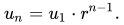
A geometric series is a series with a constant ratio between successive terms. Each successive term can be obtained by multiplying the previous term by 'r'
The nth term of a geometric sequence:
.

The sum of all terms (an infinite geometric sequence): If -1 < r < 1, then

Exponents[edit | edit source]
is the same as


Laws of Exponents[edit | edit source]
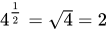
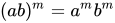
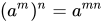
The algebra section requires an understanding of exponents and manipulating numbers of exponents. An example of an exponential function is where a is being raised to the power. An exponent is evaluated by multiplying the lower number by itself the amount of times as the upper number. For example, . If the exponent is fractional, this implies a root. For example, . Following are laws of exponents that should be memorized:




![{\displaystyle a^{m/n}={\sqrt[{n}]{a^{m}}}}](https://wikimedia.org/api/rest_v1/media/math/render/svg/115928a49fb745ef9cbabfb02be297c1523d2168)
Logarithms[edit | edit source]
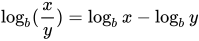
Laws of Logarithms[edit | edit source]


Change of Base formula:
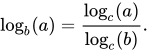
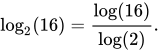
Moreover, this result implies that all logarithm functions (whatever the base) are similar to each other. So to calculate the log with base 2 of the number 16 with a calculator:
Binomial Theorem[edit | edit source]
The Binomial Expansion Theorem is used to expand functions like without having to go through the tedious work it takes to expand it through normal means


For this equation, essentially one would go through the exponents that would occur with the final product of the function (). From this comes in as the coefficient, where equals the row number of the row from Pascal's Triangle, and is the specific number from that row.



Ex.

Pascal's Triangle[edit | edit source]
                  1                      =Row 0
                1   1                    =Row 1
              1   2   1                  =Row 2
            1   3   3   1                =Row 3
          1   4   6   4   1              =Row 4
        1   5  10  10   5   1            =Row 5
      1   6  15  20  15   6   1          =Row 6
    1   7  21  35  35  21   7   1        =Row 7
  1   8  28  56  70  56  28   8   1      =Row 8
1   9   36 84 126 126  84  36   9   1    =Row 9