 (May 28, 2008)
A vector space endowed by a topology that makes translations (i.e.,  ) and dilations (i.e.,
  ) continuous is called a topological vector space or TVS for short.
A subset  of a TVS is said to be:
- bounded if for every neighborhood
 of
of  there exist
  such that
  for every
- balanced if
 for every scalar
  with
with 
- convex if
 for any
  and any
  with
with  .
.
1 Corollary  for any
  if and only if is convex.
Proof: Supposing  we obtain
  for all . Conversely, if is convex,
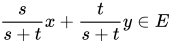 , or
, or  for any .
Since  holds in general, the proof is complete.
Define 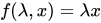 for scalars , vectors
  . If is a balanced set, for any , by continuity,
 .
.
Hence, the closure of a balanced set is again balanced. In the similar manner, if is convex, for
 ,
,
meaning the closure of a convex set is again convex. Here the first equality holds since  is injective if
  . Moreover, the interior of , denoted by
  , is also convex. Indeed, for with
 ,
,
and since the left-hand side is open it is contained in . Finally, a subspace of a TVS is a subset that is simultaneously a linear subspace and a topological subspace. Let  be a subspace of a TVS. Then
  is a topological subspace, and it is stable under scalar multiplication, as shown by the argument similar to the above. Let
  . If is a subspace of a TVS, by continuity and linearity,
 .
.
Hence, is a linear subspace. We conclude that the closure of a subspace is a subspace.
Let be a neighborhood of . By continuity there exists a  and a neighborhood
  of such that:

It follows that the set 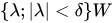 is a union of open sets, contained in and is balanced. In other words, every TVS admits a local base consisting of balanced sets.
1 Theorem Let  be a TVS, and
  . The following are equivalent.
- (i) is bounded.
- (ii) Every countable subset of is bounded.
- (iii) for every balanced neighborhood of there exists a
 such that .
Proof: That (i) implies (ii) is clear. If (iii) is false, there exists a balanced neighborhood such that  for every
  . That is, there is a unbounded sequence
  in . Finally, to show that (iii) implies (i), let
  be a neighborhood of 0, and be a balanced open set with
  . Choose
  so that , using the hypothesis. Then for any
  , we have:

1 Corollary Every Cauchy sequence and every compact set in a TVS are bounded.
Proof: If the set is not bounded, it contains a sequence that is not Cauchy and does not have a convergent subsequence.
1 Lemma Let  be a linear operator between TVSs. If
  is bounded for some neighborhood of , then is continuous.
6 Theorem Let be a linear functional on a TVS .
- (i) has either closed or dense kernel.
- (ii) is continuous if and only if
 is closed.
Proof: To show (i), suppose the kernel of is not closed. That means: there is a  which is in the closure of but
  . For any
  ,
,  is in the kernel of . This is to say, every element of is a linear combination of and some other element in
  . Thus, is dense. (ii) If is continuous,
  is closed. Conversely, suppose is closed. Since is continuous when is identically zero, suppose there is a point with
  . Then there is a balanced neighborhood of such that
  . It then follows that
  . Indeed, suppose
  . Then
 if
if  , which is a contradiction.
The continuity of now follows from the lemma.
6 Theorem Let be a TVS and  its subspace. Suppose:
- is dense

 in implies
  in .
in .
(Note this is the conclusion of Corollary 2.something) Then every continuous linear function on a subspace of extends to an element of  .
.
Proof: We essentially repeat the proof of Theorem 3.8. So, let be the kernel of , which is closed, and we may assume  . Thus, by hypothesis, we can find
  such that:
 in
in  , but
, but  for some point
  outside . By Lemma 1.6,
  for some scalar . Since both and
  do not vanish at ,
 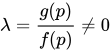 .
.
Lemma Let  be a sequence of subsets of a a linear space containing such that
  for every
  . If
. If  and
and  , then
  .
.
Proof: We shall prove the lemma by induction over  . The basic case
  holds since
  for every
  . Thus, assume that the lemma has been proven until
  . First, suppose
  are not all distinct. By permutation, we may then assume that
  . It then follows:
 and
and  .
.
The inductive hypothesis now gives: . Next, suppose are all distinct. Again by permutation, we may assume that  . Since no carry-over occurs then and
  ,
,  and so:
 .
.
Hence, by inductive hypothesis,  .
.
1 Theorem Let be a TVS.
- (i) If is Hausdorff and has a countable local base, is metrizable with the metric
 such that
 and
and  for every
- (ii) For every neighborhood
 of , there is a continuous function such that
 ,
,  on
on  and
and  for any
  .
.
Proof: To show (ii), let be a sequence of neighborhoods of satisfying the condition in the lemma and  . Define on and
  for every . To show the triangular inequality, we may assume that
  and
and  are both
  , and thus suppose and
  . Then

Thus,  . Taking inf over all such we obtain:

and do the same for the rest we conclude . This proves (ii) since is continuous at and it is then continuous everywhere by the triangular inequality. Now, to show (i), choose a sequence of balanced sets that is a local base, satisfies the condition in the lemma and is such that  . As above, define
  for each . For the same reason as before, the triangular inequality holds. Clearly,
  . If
. If  , then there are such that and . Thus, by the lemma. In particular, if for "every"
  , then
  since is Hausdorff. Since
  are balanced, if ,
 for every with .
That means 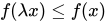 , and in particular
  . Defining
  will complete the proof of (i). In fact, the properties of we have collected shows the function is a metric with the desired properties. The lemma then shows that given any ,
  for some
  . That is, the sets
 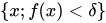 over forms a local base for the original topology.
The second property of in (i) implies that open ball about the origin in terms of this is balanced, and when has a countable local base consisting of convex sets it can be strengthened to: , which implies open balls about the origin are convex. Indeed, if
  , and if
  and
and  with
with  , then

since the sum of convex sets is again convex. This is to say,

and by iteration and continuity it can be shown that  for every .
Corollary For every neighborhood of some point , there is a neighborhood of with 
Proof: Since we may assume that , take  .
.
Corollary If every finite set of a TVS is closed, is Hausdorff.
Proof: Let be given. By the preceding corollary we find an open set 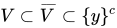 containing .
A TVS with a local base consisting of convex sets is said to be locally convex. Since in this book we will never study non-Hausdorff locally convex spaces, we shall assume tacitly that every finite subset of every locally convex is closed, hence Hausdorff in view of Theorem something.
Lemma Let be locally convex. The convex hull of a bounded set is bounded.
Given a sequence  of semi-norms, define:
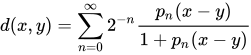 .
.
then becomes a metric. In fact,
Since  for any seminorm ,
  .
.
