Computer Programming/Physics/Position of an accelerating body function
Jump to navigation
Jump to search
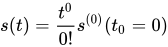
The position of an accelerating body can be described by a mathematical function . The generalized function can be attained by using the Taylor series

- ,
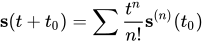
where is the derivative of :


- etc.
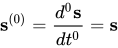

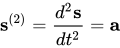
The accuracy of this function depends on the number of terms used as decreases rapidly. Additionally, the time can be synchronized such that (Maclaurin series).


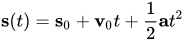
Note that for a constant acceleration most of the terms become zero and we're left with

or
C++[edit | edit source]
template<class Vector,class Number>
Vector PositionAcceleratingBody(Vector *s0,Number t,size_t Accuracy)
{
     Vector s(0);     //set to zero if int, float, etc. or invoke the
                      //     "set to zero" constructor for a class
     Number factor(1);//0!==1 and t^0==1
     for(size_t n(0);n<Accuracy;n++)
     {
          if(n)factor*=(t/n);//0!==1 and t^0==1
          s+=(factor*s0[n]); //s0 is the array of nth derivatives of s
                             //     at t=t0=0
     }
     return s;
}
Justification for Using the Taylor Series[edit | edit source]
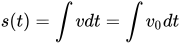
The Taylor series can be derived by systematically selecting which of our variables is a constant and then extrapolating that to the infinite limit.
- Constant Position
- or

- Constant Velocity
- or



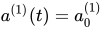
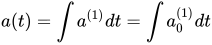
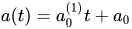
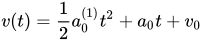
- Constant Acceleration
- or

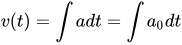


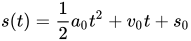

- Constant Rate of Change of Acceleration
- or




- etc.