We say  is a pre-sheaf on a topological space
  if
if
- (i)
 is an abelian group for every open subset
- (ii) For each inclusion
 , we have the group morphism
  such that
 is the identity and
  for any inclusion
A pre-sheaf is called a sheaf if the following "gluing axiom" holds:
- For each open subset
 and its open cover
  , if
, if  are such that
  in
in  , then there exists a unique
  such that
  for all
  .
.
Note that the uniqueness implies that if  and
and  for all , then
  . In particular,
  for all implies
  .
.
4 Example: Let  be a topological group (e.g.,
  ). Let be the set of all continuous maps from open subsets to . Then forms a sheaf. In particular, suppose the topology for is discrete. Then is called a constant sheaf.
Given sheaves and  , a sheaf morphism
  is a collection of group morphisms
  satisfying: for every open subset
  ,
,

where the first  is one that comes with and the second .
Define  for each open subset .
  is then a sheaf. In fact, suppose
  . Then there is such that . But since

for all , we have  . Unfortunately,
  does not turn out to be a sheaf if it is defined in the same way. We thus define
  to be the set of all
  such that there is an open cover of such that
  is in the image of
  . This is a sheaf. In fact, as before, let be such that
 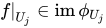 . Then we have an open cover of such that
  restricted to each member
  of the cover is in the image of
  .
.
Let  be sheaves on the same topological space.
A sheaf on is said to be flabby if  is surjective. Let
 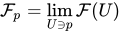 , and, for each , define
  .
.  is closed since
  implies
  has a neighborhood of such that
  for every
  . Define
  . In particular, if
  is a closed subset and
  , then the natural map
 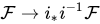 is an isomorphism.
4 Theorem Suppose

is exact. Then, for every open subset

is exact. Furthermore,  is surjective if
  is flabby.
Proof: That the kernel of  is trivial means that
  has trivial kernel for any . Thus the first map is clear. Next, denoting
  by
by  , suppose
  with
with  . Then there exists an open cover of and
  such that
  . Since
  in and
  is injective by the early part of the proof, we have
  in and so we get
  such that
  . Finally, to show that the last map is surjective, let
  , and
, and  . If
. If  is totally ordered, then let
  . Since
  agree on overlaps by totally ordered-ness, there is with
  . Thus,
  is an upper bound of the collection
  . By Zorn's Lemma, we then find a maximal element
  . We claim
  . Suppose not. Then there exists
  with
with  . Since
  in
in  , by the early part of the proof, there exists
  with
with  . Then
  (so
(so  ) while
  in . This contradicts the maximality of . Hence, we conclude and so
  .
. 
4 Corollary
is exact if and only if

is exact for every  .
.
Suppose  is a continuous map. The sheaf
  (called the pushforward of by ) is defined by
  for an open subset
  . Suppose
  is a continuous map. The sheaf
  is then defined by
  the sheafification of the presheaf
 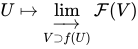 where is an open subset of . The two are related in the following way. Let be an open subset. Then
  consists of elements in
  where
where  . Since
  , we find a map
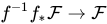
by sending to  . The map is well-defined for it doesn't depend on the choice of .