Algebra/Chapter 2/Real Numbers
2.4: Properties of Real Numbers
Types of Numbers[edit | edit source]
We have already talked about the different types of numbers in Chapter 1. However, in this section, we will be using more sophisticated lanuage to refer to them, and take a look at each of their unique properties.
In mathematics there are names for many different types of numbers and you've encountered lots of these types already and some of these types contain the others. For instance we can start with the whole numbers such as 0, 1, 2, 3, etc. Using subtraction we can build negative numbers by subtracting a bigger number from a smaller giving us an answer in the set {... -3, -2, -1, 0}.
Using division we can identify fractions between 0 and 1 by dividing a smaller number by a bigger e.g. {1/2, 2/3, 3/4, ...} or {-1/-2, -2/-3, -3/-4, ....} We can also identify negative fractions between -1 and 0 by dividing a negative number by a positive or a positive number by a negative {-1/2, -2/3, -3/4, ...} or {1/-2, 2/-3, 3/-4, ...}. Every whole number can be written as a fraction, such as . The rational numbers are exactly those numbers which can be written as fractions.

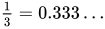
Rational numbers are a subset of numbers we call real numbers. Some calculators allow you to differentiate between rational numbers and real numbers by representing the rational number as a fraction. If you use decimal notation the decimals in your rational number may go on forever, for example . The real numbers include all of the types of numbers mentioned before (whole numbers, negative numbers, fractions, etc.) and others that require special operations such as roots to represent. These other numbers may not have any recognizable pattern to their digits, such as . But, at the end of the day, the real numbers act just like the rational numbers that you're already familiar with. For those readers that are geometrically inclined, one may think of the real numbers as a line (or ruler), where every point on the line corresponds to exactly one number, as in the picture below.


Real numbers consist of zero (0), the positive and negative integers (-3, -1, 2, 4), and all the fractional and decimal values in between (0.4, 3.1415927, 1/2). Real numbers are divided into rational and irrational numbers. The set of real numbers is denoted by ℝ.
Rational numbers are numbers that can be expressed as a ratio (that is, a division) of two integers (, , , , ). If a number has a terminating decimal, or a decimal that ends (, ) or repeats (), it is rational. The set of rational numbers is denoted by ℚ.


Irrational numbers have decimal parts that do not terminate or repeat (, ) and cannot be expressed as a fractional equivalent. For example, the number does not have an equivalent ratio or division of two numbers. There are several other different "sets" of rational numbers. The set of irrational numbers is denoted by 𝕀.



Natural numbers, also known as "counting numbers", are the first numbers you learn. The natural numbers include all of the positive whole numbers (1, 24, 6, 2, 357). Note that zero is not included, and fractions or decimals are not included. The set of natural numbers is denoted by ℕ.
Whole numbers are the natural numbers, plus zero. The set of whole numbers is denoted by 𝕎.
Integers are all positive and negative numbers without a decimal part (3, -1, 15, -42). The set of integers is denoted by ℤ.
Practice Problems[edit | edit source]
Problem 2.52 (Relating Types of Numbers) Create a Venn Diagram which shows how each of the number types above are related to each other.

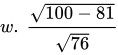
Problem 2.53 (Classifying Numbers) Identify the set(s) of numbers each number belongs to.








b. Real, Rational, Integer
c. Real, Rational, Integer, Whole
d. Real, Rational
e. Real, Rational
f. Real, Rational
g. Real, Rational
h. Real, Irrational
i. Real, Rational, Integer, Whole, Natural
j. Real, Rational
k. Real, Rational
l. Real, Rational
m. Real, Irrational
n. None
o. Real, Irrational
p. Real, Rational, Integer, Whole, Natural
q. Real, Rational
r. Real, Rational, Integer
s. Real, Rational, Integer
t. Real, Irrational
u. Real, Rational, Integer, Whole
v. Real, Irrational
w. Real, Rational
x. Real, Rational
Properties Of Real Numbers[edit | edit source]
We begin this section with a review of the fundamental properties of arithmetic. It may seem unusual to give so much emphasis to the few properties listed below, but there is a good reason. Roughly speaking, all of algebra follows from the 5 properties listed in the table below. In the table below, a, b and c can be any number unless stated otherwise. So let's take a look:
| Property Name | Addition | Subtraction | Multiplication | Division |
|---|---|---|---|---|
| Commutative | Doesn't work: This does: |
Doesn't work: This does: | ||
| Associative | Doesn't work: This does: |
Doesn't work: This does: | ||
| Identity | ||||
| Inverse | as long as a ≠ 0. | as long as a ≠ 0. | ||
| Distributive | But wait: |


















But what does all this mean?
The commutative property is that you can exchange two numbers and still get the same answer.
The associative property is that you can change the grouping (i.e., change the position of the parenthesis) and still get the same answer.
The identity property is that there is a certain number that when operated with a number doesn't change it.
The inverse property is something that results to the identity number.
The distributive property means that you can distribute the operation.
Out of all of those properties, the distributive property is the one you'll probably use the most, because it is the only one that mentions both addition and multiplication at the same time.
To give an example: these properties even imply fundamental things such as: "multiplication is repeated addition". This book is not going to prove many things, but it would be useful for us to take a look at how this works.
We apply the distributive property for a = 7, b = 1 and c = 1.
- 7 · 1 + 7 · 1 = 7 + 7
Though it may seem obvious, this is identity property for multiplication listed above. Now let's try to do the same thing with 7 · 3.
- 7 · 3 = 7 · (1 + 1 + 1)
Just like before, this is just the fact that 3 = 1 + 1 + 1 together with substitution.
- 7 · (1 + 1 + 1) = 7 · 1 + 7 · 1 + 7 · 1
Once again, we apply the distributive property. Note that we can apply it to expressions with more than two numbers being added in parentheses. The proof is below. While 7 · (1 + 1 + 1) = 7 · 1 + 7 · 1 + 7 · 1 is not covered by the distributive property alone, this problem is solved by grouping the last two 1s with parentheses. Rather than writing this as 7 · (1 + 1 + 1), we could write it as 7 · (1 + (1 + 1)), then used the distributive property with a = 7, b = 1 and c = (1 + 1). Then: 7 · (1 + (1 + 1)) = 7 · 1 + 7 · (1 + 1). Now we apply the distributive property just to the second (taking a = 7, b = 1, and c = 1. Then (looking just at the second term) we have 7 · (1 + 1) = 7 · 1 + 7 · 1. Finally we can substitute this expression for the second term back into the equation to get: 7 · (1 + 1 + 1) = 7 · 1 + 7 · 1 + 7 · 1.
This looks like a lot of mindless parenthesis juggling, but the point is that the distributive property applies to arbitrarily long sums and products. It is also true that
- a · (b + c + d + e) = a · b + a · c + a · d + a · e
Or we could make it even longer! We could have as many terms in the sum as we like; as long as "a · " appears in front of each term on the right hand side we will have a true statement. We will use this fact without justification (that is, without proof). Let's remind ourselves what these properties tell us about arithmetic. Commutativity and Associativity together imply that it doesn't matter what order we add things up in. Let's see why. Associativity says that a + (b + c) = (a + b) + c. This should be thought of as a statement about the sum a + b + c. Why? Because usually addition is just defined between two things, so someone writes down something like a + b + c some people may first add b and c first then add in a, and other people might add a and b first and then add in c. This property says (using a formula) that it doesn't matter which way you do it. What about those people who add a and c together first? Well, that is where commutativity comes in. It tells us that we don't have add things up in exactly the order people write things down. You can switch things around and still get the same answer. Let's do one more example of using these properties to "juggle parentheses" to see that commutativity says you really can add a and c first and get the same answer.
| b + c = c + b | This is the commutativity of addition applied to b + c |
| a + (b + c) = a + (c + b) | This follows from substitution |
| a + (b + c) = (a + c) + b | This is just using associativity on the right side of the line above. |
Commutativity and associativity tell you that it doesn't matter in which order you add up a + b + c. You will get the same answer regardless of order. The rule holds even if there are more than three terms: There may be 4, 12, or several thousand. These properties would still tell us that it doesn't matter how we add things up.
The same properties for multiplication tell us it doesn't matter in what order we multiply things together. We are free to change the order to anything that we find easier. Does it ever really make things easier? Sure! For example if you were asked to calculate 4 · 3 · 5 · (1/4), then I would personally think it would be easier to calculate 4 · (1/4) · 3 · 5
The identity and inverse properties really capture what it means to say that "addition and subtraction are opposites" and "multiplication and division are opposites, as long as it isn't zero that we multiply by." We shall leave it as an exercise to the interested reader to think about why this is.
You can often simplify expressions using the Distributive Property. This is one of the reasons it is so important. For example, consider the expression 2(x − 7) + 14. What happens if we use the distributive property on the first term in this expression? Let's work it out. According to the Distributive Property
- 2(x − 7) = 2x − 2 · 7 = 2x − 14
Plugging this into the expression above we get 2(x − 7) + 14 = 2x − 14 + 14 = 2x. Clearly 2x is a lot easier to evaluate than 2(x − 7) + 14!
Commutative properties of Division[edit | edit source]
Division is not commutative. That means usually a ÷ b is not equal to b ÷ a, and can be demonstrated simply by example.

While division itself is not commutative, there are two special cases where the answer is the same if you reverse the order of operation. These cases occur when the answer (quotient) is 1 or when the answer is -1:






Basic Laws In Algebra[edit | edit source]
There are several basic laws in algebra. Understanding these will help you to manipulate and solve equations, and to understand algebraic relationships.
1. Commutative Law[edit | edit source]
In general, the order of the items can be changed without affecting the results.
For addition, indicates that changing the order of the items added does not affect the sum.

For multiplication, indicating that the changing of the order of the items multiplied does not affect the product.

Note that the commutative law does not apply to subtraction or division.
2. Associative Law[edit | edit source]
In general, the grouping of the items can be changed without affecting the results. (Seems to be an extension of the commutative law).
For addition, indicates that changing the grouping of the items added does not affect the sum.

For multiplication, indicates that changing the grouping of the items multiplied does not affect the product.

As with the commutative law, the associative law does not apply to subtraction or division.
3. Distributive Law[edit | edit source]
Indicates that common terms can be factored, or that factors can be distributed. (A + B) X = (A X) + (B X) (The "X" terms on the right are combined into a factor on the left side; the factor "X" on the left is distributed on the right side).
Consider the substitution of X = (Y + Z) into the above equation yields (A + B) (Y + Z) = A (Y + Z) + B (Y + Z). Apply the distributive law to each term on the right yields A Y + A Z + B Y + B Z. We can skip the intermediate step if we multiply the terms identified by “F O I L” in the following expression (A + B) (Y + Z) =
| Letter | Description | terms |
|---|---|---|
| F | First terms | A Y + |
| O | Outside terms | A Z + |
| I | Inside terms | B Y + |
| L | Last terms | B Z |
4. Law of Identity[edit | edit source]
For addition and subtraction the law of identity indicates that the addition and subtraction of a given term or quantity results in the zero, 0, the identity element for addition and subtraction. Alternately, adding the identity element results in no change to the original value or quantity.

Adding A to both sides of the first equation we get (A - A) + A = 0 + A. Re-arranging or substituting gives 0 + A = A
- Note the special case(s) where A = A + 0 = A + 0 + 0
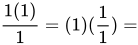
For multiplication and division the law of identity indicates that the multiplication and division of a given term or quantity results in "one," 1, the identity element for multiplication and division. Alternately, multipling or dividing by the identity element results in no change to the original value or quantity.
, or

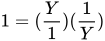
- Note that dividing 1 by a term or quantity gives the reciprocal of the term or quantity. Multiplying by the reciprocal is the same as dividing by the term or quantity. In the above equation on the right (Y / 1), and (1 / Y) are reciprocals of each other
- Note the special case where , Multiplying this equation by “1” gives , and then dividing by one gives .
- Simplify this by substititing the first special case equation to get , and , . . .

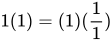


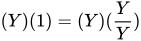
By multiplying both sides of the first equation by “Y” we get , which simplifies and becomes (Y) = (1) Y.
Practice Problems[edit | edit source]
Problem 2.54 (Determining Properties of Real Numbers) Determine if the following statements are always, sometimes, or never true. If the statement is always true, explain your reasoning. If the statement is not always true, provide a counterexample.







b. Sometimes true. The number 0 is a whole number, but it is not natural.
c. Never true. Integers include all of the negative and whole numbers that are not fractions.
d. Always true. The set of Real numbers in part consists of the Natural numbers.
Problem 2.55 (Identifying Properties of Real Numbers) Identify the following properties being expressed.





b. Identity Property of Addition
c. Associative Property of Addition
d. Identity Property of Multiplication
Problem 2.56 (Product Pattern) Use the Associative Law to explain why the products in each rule are equal.






Problem 2.57 (Gauss's Trick) In the late 1700s, the kindergarten class of the mathematician Carl Fredrich Gauss was asked to find the sum of all of the natural numbers between 1 and 100. While most of the class had struggled with this seemingly impossible task, Gauss was able to determine the solution to this problem rather quickly. How was he able to do this?
Problem 2.58 (Manipulating Gauss's Trick) We can use techniques similar to the one we used in Problem 2.55 to find the sum of several numbers. Can you find the following?
a.
b.
c.
d.




Problem 2.59 (Inverses of Numbers) The Additive Inverse Property states that if you add a number and its opposite, or its additive inverse together, you get zero. Likewise, the Multiplicative Inverse Property states that if you multiple a number by its recipricol, or its multiplicative inverse together, you get one. Find the additive and multiplicative inverses of the following numbers.


Problem 2.60 (Using the Distributive Property) Use the Distributive Property to simplify these expressions.


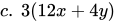









Problem 2.61 (Distribution with Three Terms) What is the coefficient of y in the expansion of the expression below?

Problem 2.62 (Rewriting Expressions) Evaluate the following expression without using a calculator:
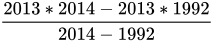
Problem 2.63 (Multiplication and the Distributive Law) Point out in what sense the usual arrangement of the multiplication of 365 and 392 is an instance of the Distributive Law.
Problem 2.64 (Suare of Sum/Difference) For two numbers and , find the following:


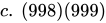
Problem 2.65 (Tricky Products) Evaluate the following expressions without using a calculator:




b. 9025
c. 997002
d. 3951
Problem 2.66 (Secret of 1001) A boy claims that he can figure out the product of any three digit number and 1001. A student in his arithmetic class challenges him to find the product of 1001 and 865, and he gets the correct answer immediately. Compute the answer, and determine the boy's secret.
Problem 2.67 (ABCD) Prove that the following expression can be written as a product between and







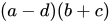
Rewrite the above as follows:
Using the Communative Property of Addition, the expression can be rewritten as:
Using the Distributie Property, it can be further written as:
Problem 2.68 (Density Property of Real Numbers) The Density Property of Real Numbers states that between any two real numbers, there is another real number. Use this property to prove that there are infinitly many real numbers between 0 and 1.


Closure[edit | edit source]
Closure is a property that is defined for a set of real numbers and an operation. This Wikipedia article gives a description of the closure property with examples from various areas in math. As an Algebra student being aware of the closure property can help you solve a problem. For instance a problem might state "The sum of two whole numbers is 24." With practice you will be able to see that the possible set of numbers will be either all odd (e.g. (1,23),(3,21), ... etc.) or all even (e.g. (2,22), (4,20), ... etc.). The problem might not explicitly state the idea of whole numbers. It might state that two sides of a square sum to 24. If you remember working a problem like this before you know that the sides of a square need to be equal and you divide by two. The author of the problem might want to be trickier and say that two sides of an equilateral triangle sum to 24 and then ask for the perimeter of the triangle. In this case you might want to write the equation for the perimeter of an equilateral triangle. This might make it easier for you to see that again you just need to divide 24 by 2 to find the length of one side and plug it into the equation.

Practice Problems[edit | edit source]
Problem 2.69 (Closure of Operators) Complete the following table which represents the closure properties of operations with different types of numbers. Use a check mark to represent closure, and a cross to represent no closure.
| Addition | Subtraction | Multiplcation | Division | Exponentiation | Root | |
|---|---|---|---|---|---|---|
| ℕ | ||||||
| 𝕎 | ||||||
| ℤ | ||||||
| ℚ | ||||||
| 𝕀 | ||||||
| ℝ |
Problem 2.70 (Closure of a Set) Two letters from the set are chosen and multiplied together. The results after doing this are as follows:

| * | a | b | c | d | e |
|---|---|---|---|---|---|
| a | b | c | e | a | d |
| b | d | a | c | b | e |
| c | c | d | b | e | a |
| d | a | e | d | c | b |
| e | e | b | a | d | c |
Is the set closed under multiplication?
Order and Absolute Value[edit | edit source]
The absolute value (or modulus) of a real number , denoted by refers to its distance from zero on the real number line. This value is always taken to be nonnegative. For example, the illustration on the left shows the following:


The absolute value of -5 is 5 because it is 5 away from zero, and the absolute value of 3 is 3 because it is 3 away from zero. The absolute value of a positive number or zero is always itself. Conversely, the absolute value of a negative number is its opposite.
Likewise, the distance between two numbers on the number line can be thought of as the absolute value of the difference between them.
Absolute Value and PEMDAS[edit | edit source]
Practice Problems[edit | edit source]
Problem 2.71 (Ordering Numbers I) Order the following set of numbers from: (a) least to greatest (b) greatest to least.



Problem 2.72 (Ordering Numbers II) Order the absolute values of the numbers from Problem 2.68 from: (a) least to greatest (b) greatest to least.


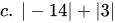
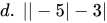
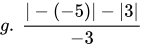
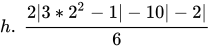
Problem 2.73 (Absolute Value Expressions) Evaluate the following expressions that involve absolute values.




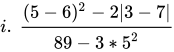


b. 13
c. 17
d. 2
e. 1
f. -2
g.
h.
Problem 2.74 (Absolute Ratio) Simplify the following expression given that


Problem 2.75 (Range of Values I) If , what is the value of the following expression?


Problem 2.76 (Range of Values II) If , what is the value of the following expression?


Problem 2.77 (Range of Values III) If , what is the value of the following expression?


Problem 2.78 (Least Possible Absolute Value) If n is an integer, what is the smallest possible value of the following expression?

Problem 2.79 (The Triangle Inequality) For any triangle, the sum of the lengths of any two of its sides must be greater than or equal to the length of the third. This relation is represented as follows:

a. Use this relation to determine if a triangle with the side lengths of 6, 9, and 14 exists.
b. Use this relation to determine if a triangle with the side lengths of 5, 10, and 15 exists.
c. Outside of geometric applications, the above inequality also states that the absolute value of the sum of two numbers a and b are less than or equal to the sum of the absolute value of a and the absolute value of b. Prove that this relation is true.
Lesson Review[edit | edit source]
All numbers that we will be working with for the majority of Algebra are called Real Numbers. They consist of Rational and Irrational Numbers. Irrational Numbers are numbers that have infinite, non-repeating decimals, such as pi. Rational Numbers are all numbers that can be expressed as a fraction of integers, which include Natural Numbers, Whole Numbers, Integers, and Rational Numbers. For all Real Numbers, there are a few properties of addition and multiplication: Commutative, Associative, Identity, Inverse, and Distribution. The Distribution will come in handy for the rest of the course.
Lesson Quiz[edit | edit source]