Waves/Light
< Waves
Waves : 1 Dimensional Waves
1 - 2 - 3 - 4 - 5 - 6 - 7 - 8 - 9 - 10 - 11 - 12 - 13
Examples - Problems - Solutions - Terminology
Light[edit | edit source]
Light moves in a vacuum at a speed of . In transparent materials it moves at a speed less than by a factor which is called the refractive index of the material:



Often the refractive index takes the form
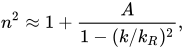
where is the wavenumber and and are constants characteristic of the material. The angular frequency of light in a transparent medium is thus



so the frequency increases slightly with increasing k. Typically, when k is near kR, the material becomes opaque.
Ultimately, this is due to resonance between the light and the atoms of the materials.