|
Let  be a harmonic function on be a harmonic function on  and suppose that and suppose that

Show that  is a constant function. is a constant function.
|
Let 
If is harmonic (i.e.  ) then so must
  (surely,
  ). Then since the absolute value as an operator is convex, we have that
  is a subharmonic function on .
Then by the mean value property of subharmonic functions, for any  we have
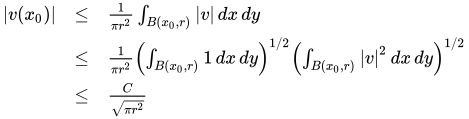
where the second inequality is due to Cauchy-Schwarz (Hölder) inequality.
This estimate hold for all  . Therefore if we send
  we see that for all
 which gives us that is constant.
|
Let  be a piecewise smooth weak solution of the conservation law be a piecewise smooth weak solution of the conservation law

a) Derive the Rankine-Hugoniot conditions at a discontinuity of the solution.
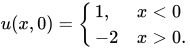
b)Find a piecewise smooth solution to the IVP

|
When we solve the PDE by methods of characteristics, the characteristic curves can cross, causing a shock, or discontinuity. The task at hand, is to find the curve of discontinuity, call it  .
Multiply the PDE by
.
Multiply the PDE by  , a smooth test function with compact support in
  . Then by an integration by parts:
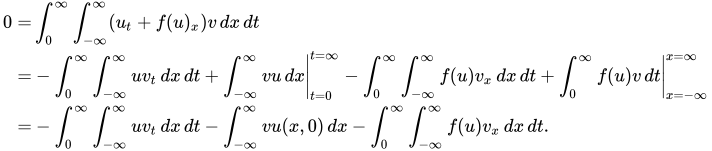
Let  denote the open region in to the left of and similarly
  denotes the region to the right of . If the support of lies entirely in either of these two regions, then all of the above boundary terms vanish and we get
Now suppose the support of intersects the discontinuity .
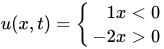
We can calculate  . Therefore, the shock wave extends vertically from the origin. That is,
|
Consider the evolution equation with initial data


a) What energy quantity is appropriate for this equation? Is it conserved or dissipated?
b) Show that  solutions of this problem are unique. solutions of this problem are unique.
|
Consider the energy 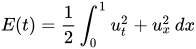 . Then
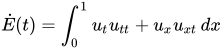 . Integrate by parts to get
 .
The boundary terms vanish since
.
The boundary terms vanish since  implies
  (similarly at
  ). Then by the original PDE we get
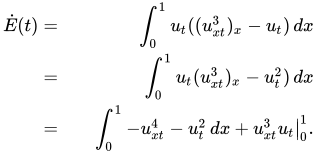
where the last equality is another integration by parts. The boundary terms vanish again by the same argument. Therefore,  for all
  ; that is, energy is dissipated.
Suppose  are two distinct solutions to the system. Then
  is a solution to


This tells us that at  ,
,  . Therefore,
  . Since
  then
then  for all . This implies
  . That is,
  .
.
|
Let  be a bounded open set with smooth boundary be a bounded open set with smooth boundary  . Consider the initial boundary value problem for : . Consider the initial boundary value problem for :

where  is the exterior normal derivative. Assume that is the exterior normal derivative. Assume that 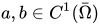 and that and that  for for  . Show that smooth solutions of this problem are unique. . Show that smooth solutions of this problem are unique.
|
Suppose are two distinct solutions. Then is a smooth solution to

Consider the energy  . It is easy to verify that . Then
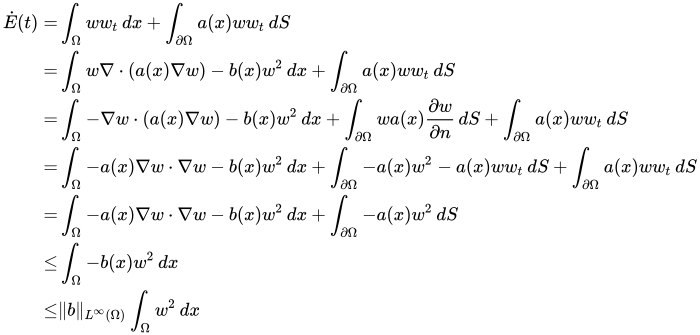
Therefore  implies
  for all . Thus, for all which implies
 Suppose minimizes
  , i.e.
 ![{\displaystyle I[u]\leq I[w]\,\forall w\in K}](https://wikimedia.org/api/rest_v1/media/math/render/svg/92e5c0cf0c967769b1030539c80f32a97076fa28) . Then for any fixed
. Then for any fixed  , if we let
  then
then ![{\displaystyle I[g(0)]\leq I[g(t)]\,\forall 0\leq t\leq 1}](https://wikimedia.org/api/rest_v1/media/math/render/svg/3a464389e085520e05daf65d6a0589067d8ca5ea) . Let
. Let ![{\displaystyle i(t)=I[g(t)]}](https://wikimedia.org/api/rest_v1/media/math/render/svg/d1c9760c2cc305a61b9f4e0856170c0370aa19d1) ; then we can say that
; then we can say that  . Now we must compute
  . We have



Since we know then
 as desired.
 Conversely suppose

Then

Therefore,  for all
  .
That is,
.
That is, ![{\displaystyle I[u]\leq I[v]}](https://wikimedia.org/api/rest_v1/media/math/render/svg/4d79237622892cd4aee2a37fca77795598bbbbb5) for all , as desired.
for all , as desired.





