Trigonometry/Double-Angle Formulas
Double angle formulae for cos and sine:


What Are the Double-Angle Formulae?[edit | edit source]
The Double-Angle formulas express the cosine and sine of twice an angle in terms of the cosine and sine of the original angle. We are going to derive them from the addition formulas for sine and cosine. The formulae are:
and
It is well worth practising the derivation so that you can do it quickly and easily. Then you will not need to remember the formulae, since you can get them quickly from the addition formulas for sine and cosine. It is also good to practice the derivation because being more fluent with the algebra will make you better at other algebra used with trigonometry.
|
Exercise: Check these Make Sense Did we make a typo in these formulae? Check they at least make sense.
|




|
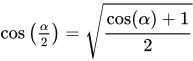
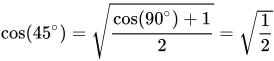
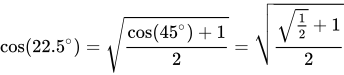
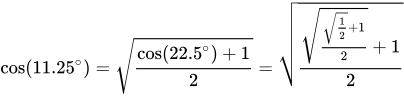
Example: Half Angle formula for Cosine If we put we immediately get Check it. Do you agree? Or rearranging: So, if we know the cosine of (we do, it is zero), we can compute the cosine of and and and so on. |




Proofs for Double Angle Formulae[edit | edit source]
We'll prove the double angle formulae from the addition formulae. Recall that:

Putting in the above formula yields:


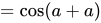


So:

Compare this with the "Pythagorean Theorem" expressed in terms of sine and cosine. Notice the double angle formula above has a minus not a plus, otherwise it would be saying , which would mean cos was 1 for all values of t, which we know is not true.

In terms of just cosine or just sine[edit | edit source]
The formula
isn't yet quite where we want it. We want to get rid of the sine term and express it all in terms of cosine. To do that we use the disguised "Pythagorean Theorem".

which is the same as:

so

so
which is what we wanted.
We could, if we had preferred, have used the disguised Pythagorean theorem to replace the in terms of


|
Exercise: Double angle cosine formula in terms of sine. Do that now, in other words express: in terms of
|

Double angle formula for sine[edit | edit source]
Now we will get the double angle formula for sine, this time using the addition formula for sine.

Check that we've quoted the addition formula correctly, and then put in the above




So:
Unlike the formula for cosine the substitutions to get just in terms of would involve square roots, so we're not going to do that. The above formula is usually the nicest form to work with.
Treble and Higher Angles[edit | edit source]
Using the above procedures twice, and the Pythagorean theorem where appropriate, we find


By repeating the procedure, we can find formulae for and for any integer n. The formulas do however get rather long.


It is not really worthwhile remembering these formulae. They are not used often, and can either be looked up in tables of formulae or calculated when you need them. It is quite good for practising algebra to derive them yourself, so....
|
Exercise: Treble angle formulas for sine and cosine Derive the formulas for and yourself. |


Double and Treble Angles for Tangents[edit | edit source]
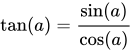
By using , it can be worked out that:
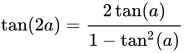
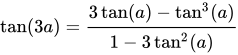
Like the formulas for and , these formulae aren't often useful, but again it is good to be able to work them out yourself.
|
Exercise: Multiple angle formulae for tan Derive the formulas for and yourself.
|


