Simple harmonic motion. Notice that the position of the dot matches that of the sine wave. Simple harmonic motion (SHM) is the motion of an object which can be modeled by the following function:
x
=
A
sin
(
ω
t
+
ϕ
)
{\displaystyle x=A\sin \left(\omega t+\phi \right)}
or
x
=
c
1
cos
(
ω
t
)
+
c
2
sin
(
ω
t
)
{\displaystyle x=c_{1}\cos \left(\omega t\right)+c_{2}\sin \left(\omega t\right)}
where c 1 = A sin φ and c 2 = A cos φ. In the above functions, A is the amplitude of the motion, ω is the angular velocity, and φ is the phase.
The velocity of an object in SHM is
v
=
A
ω
cos
(
ω
t
+
ϕ
)
{\displaystyle v=A\omega \cos \left(\omega t+\phi \right)}
The acceleration is
a
=
−
A
ω
2
sin
(
ω
t
+
ϕ
)
=
−
ω
2
x
{\displaystyle a=-A\omega ^{2}\sin \left(\omega t+\phi \right)=-\omega ^{2}x}
An alternative definition of harmonic motion is motion such that
a
=
−
ω
2
x
{\displaystyle \displaystyle a=-\omega ^{2}x}
An application of this is the motion of a weight hanging on a spring. The motion of a spring can be modeled approximately by Hooke's law :
F = -kx where F is the force the spring exerts, x is the extension in meters of the spring, and k is a constant characterizing the spring's 'stiffness' hence the name 'stiffness constant'.
From Newton's laws we know that F = ma where m is the mass of the weight, and a is its acceleration. Substituting this into Hooke's Law, we get
ma = -kx Dividing through by m :
a
=
−
k
m
x
{\displaystyle a=-{\frac {k}{m}}x}
The calculus definition of acceleration gives us
x
″
=
−
k
m
x
{\displaystyle x''=-{\frac {k}{m}}x}
x
″
+
k
m
x
=
0
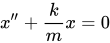
{\displaystyle x''+{\frac {k}{m}}x=0}
Thus we have a second-order differential equation. Solving it gives us
x
=
c
1
cos
(
k
m
t
)
+
c
2
sin
(
k
m
t
)
{\displaystyle x=c_{1}\cos \left({\sqrt {\frac {k}{m}}}t\right)+c_{2}\sin \left({\sqrt {\frac {k}{m}}}t\right)}
(2) with an independent variable t for time.
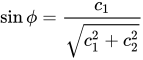
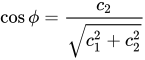
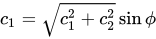
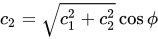
c 1 and c 2 be the legs of a right triangle, with angle φ adjacent to c 2 , we get
sin
ϕ
=
c
1
c
1
2
+
c
2
2
{\displaystyle \sin \phi ={\frac {c_{1}}{\sqrt {c_{1}^{2}+c_{2}^{2}}}}}
cos
ϕ
=
c
2
c
1
2
+
c
2
2
{\displaystyle \cos \phi ={\frac {c_{2}}{\sqrt {c_{1}^{2}+c_{2}^{2}}}}}
and
c
1
=
c
1
2
+
c
2
2
sin
ϕ
{\displaystyle c_{1}={\sqrt {c_{1}^{2}+c_{2}^{2}}}\sin \phi }
c
2
=
c
1
2
+
c
2
2
cos
ϕ
{\displaystyle c_{2}={\sqrt {c_{1}^{2}+c_{2}^{2}}}\cos \phi }
Substituting into (2), we get
x
=
c
1
2
+
c
2
2
sin
ϕ
cos
(
k
m
t
)
+
c
1
2
+
c
2
2
cos
ϕ
sin
(
k
m
t
)
{\displaystyle x={\sqrt {c_{1}^{2}+c_{2}^{2}}}\sin \phi \cos \left({\sqrt {\frac {k}{m}}}t\right)+{\sqrt {c_{1}^{2}+c_{2}^{2}}}\cos \phi \sin \left({\sqrt {\frac {k}{m}}}t\right)}
Using a trigonometric identity, we get:
x
=
c
1
2
+
c
2
2
[
sin
(
ϕ
+
k
m
t
)
+
sin
(
ϕ
−
k
m
t
)
]
+
c
1
2
+
c
2
2
[
sin
(
k
m
t
+
ϕ
)
+
sin
(
k
m
t
−
ϕ
)
]
{\displaystyle x={\sqrt {c_{1}^{2}+c_{2}^{2}}}\left[\sin \left(\phi +{\sqrt {\frac {k}{m}}}t\right)+\sin \left(\phi -{\sqrt {\frac {k}{m}}}t\right)\right]+{\sqrt {c_{1}^{2}+c_{2}^{2}}}\left[\sin \left({\sqrt {\frac {k}{m}}}t+\phi \right)+\sin \left({\sqrt {\frac {k}{m}}}t-\phi \right)\right]}
x
=
c
1
2
+
c
2
2
sin
(
k
m
t
+
ϕ
)
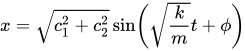
{\displaystyle x={\sqrt {c_{1}^{2}+c_{2}^{2}}}\sin \left({\sqrt {\frac {k}{m}}}t+\phi \right)}
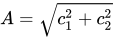
(3) Let
A
=
c
1
2
+
c
2
2
{\displaystyle A={\sqrt {c_{1}^{2}+c_{2}^{2}}}}
ω
2
=
k
m
{\displaystyle \omega ^{2}={\frac {k}{m}}}
x
=
A
sin
(
ω
t
+
ϕ
)
{\displaystyle x=A\sin \left(\omega t+\phi \right)}
Next Page: Using Fundamental Identities Previous Page: Inverse Trigonometric Functions
Home: Trigonometry









![{\displaystyle x={\sqrt {c_{1}^{2}+c_{2}^{2}}}\left[\sin \left(\phi +{\sqrt {\frac {k}{m}}}t\right)+\sin \left(\phi -{\sqrt {\frac {k}{m}}}t\right)\right]+{\sqrt {c_{1}^{2}+c_{2}^{2}}}\left[\sin \left({\sqrt {\frac {k}{m}}}t+\phi \right)+\sin \left({\sqrt {\frac {k}{m}}}t-\phi \right)\right]}](https://wikimedia.org/api/rest_v1/media/math/render/svg/4cee4fb916123b6b6544e972abb150125aeee0c5)