This Quantum World/Implications and applications/A quantum bouncing ball
A quantum bouncing ball[edit | edit source]
As a specific example, consider the following potential:

is the gravitational acceleration at the floor. For the Schrödinger equation as given in the previous section tells us that unless The only sensible solution for negative is therefore The requirement that for ensures that our perfectly elastic, frictionless quantum bouncer won't be found below the floor.





Since a picture is worth more than a thousand words, we won't solve the time-independent Schrödinger equation for this particular potential but merely plot its first eight solutions:

Where would a classical bouncing ball subject to the same potential reverse its direction of motion? Observe the correlation between position and momentum (wavenumber).
All of these states are stationary; the probability of finding the quantum bouncer in any particular interval of the axis is independent of time. So how do we get it to move?
Recall that any linear combination of solutions of the Schrödinger equation is another solution. Consider this linear combination of two stationary states:

Assuming that the coefficients and the wave functions are real, we calculate the mean position of a particle associated with :




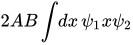
The first two integrals are the (time-independent) mean positions of a particle associated with and respectively. The last term equals


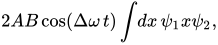
and this tells us that the particle's mean position oscillates with frequency and amplitude about the sum of the first two terms.

Visit this site to watch the time-dependence of the probability distribution associated with a quantum bouncer that is initially associated with a Gaussian distribution.