Structural Biochemistry/Free energy
General Information[edit | edit source]
American scientist Josiah Willard Gibbs (1839-1903) created the theory of available energy, known as Gibbs Free Energy, in 1873. The theory relates the energy changes within the chemical reaction and how they depend upon the following quantities: enthalpy, temperature, reagents concentration and entropy of the system. In other words, these quantities will determine whether the reaction is favorable (exergonic) or not (endergonic).
The free energy change of a reaction (delta G) can tell us whether or not a reaction occurs spontaneously. Reactions that occur spontaneously have a negative delta G value, and such reactions are called exergonic. When delta G is positive, the reaction does not occur spontaneously, and the input of free energy is required for the reaction to proceed, thus it is called an endergonic reaction. When a system is at equilibrium where no net change occurs, then delta G is zero. The delta G of a reaction is the free energy of the final state minus the free energy of the initial state, making it is independent of the reaction pathway. However, the value of delta G provides no information on the rate of a reaction.
Gibbs Free Energy Equation[edit | edit source]

We often focus on the use of the Gibbs free energy equation instead of its derivation. The most commonly-used equations for calculations are:
- (for constant temperature) - equation(1)

- (for equilibrium constant that depends on temperature) - equation(2)

Where ΔH is change in enthalpy, T is the temperature of the system (in kelvin (K)), ΔS is change in entropy of the system, R is gas constant, K is equilibrium constant.
Numerical Meaning of ΔG[edit | edit source]
If ΔG < 0 (negative), then the reaction will proceed spontaneously, meaning the reaction is favorable (exergonic).
If ΔG > 0 (positive), then the reaction will not proceed spontaneously, meaning the reaction is unfavorable (endergonic).
If ΔG = 0 (equal to zero), then the reaction is at equilibrium.
In general, every system wants to achieve a minimum of free energy. Therefore, the more negative the Gibbs free energy, the more favorable the reaction.
Meaning of work to free energy[edit | edit source]
The sign of entropy (S) can determine whether a reaction is spontaneous or not. However, the sign of work (Delta H) cannot determine the spontaneous process. For instance, the exothermic reaction become spontaneous under certain conditions. And the endothermic reaction can also become spontaneous under different conditions. Silberberg used[1] water as an example to explain such conditions.
"H2O (l) ---> H2O (s) Delta H of the reaction = -6.02 KJ (an exothermic reaction; spontaneous when T<00C)
H2O (s) ---> H2O (l) Delta H of the reaction = +6.02 KJ (an endothermic reaction; spontaneous when T>00C)"
In both reactions,the sign of enthalpy has no effect on the spontaneous change. Therefore, one cannot use enthalpy as a factor to determine the direction of a spontaneous reaction.
Standard Gibbs Free Energy of Formation[edit | edit source]
When we have to consider the relationship between Gibbs free energy and the standard-state free energy of a reaction, we use this equation:

to calculate Gibbs free energy at that of time under a specific circumstances. Where ΔGo is the standard-states - reactants (or components) at 25oC (degrees Celsius) and 1 atm (atmospheric pressure, 1 atm same as 100 kilopascals), Q is the reaction quotient. The motivation behind it is that these elements, reactants, and substances, are thermodynamically stable at such atmosphere.
Chemical potential[edit | edit source]
From elementary thermodynamics, Gibbs free energy, G, is defined as,[2]
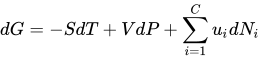
is the partial molar Gibbs free energy of species i.

The chemical potential is not favorable for phase-equilibria calculation when the pressure approaches zero. Then, fugacity is used instead:

is the partial fugacity of species i. C is a temperature-dependent constant.

Because fugacity has relationship with pressure, then fugacity coefficient of a pure species:

fugacity coefficient of a species in a mixture:

Free Energy of Enzymes[edit | edit source]
Free energy determines whether a conversion of reactants to products will occur spontaneously. In the case of an enzyme, ΔG determines the rate of a reaction. Enzymes cannot affect thermodynamics of a reaction, and hence do not affect the equilibrium; Additionally, enzymes accelerate the attainment of equilibria but do not shift their positions. The equilibrium position is a function only of the free-energy difference between reactants and products[3]. They are however, able to reach the equilibrium point at a far faster rate than without the presence of an enzyme.
For instance, in the presence of an enzyme, products could form within a second. On the other hand, products could take a as long as days to form without the presence of the catalyst. In both cases, concentration and amount of product formed remains entirely the same- it's equilibrium state. The amount of products it has formed has balanced with the amount of substrate.
Enzymes decrease only the free energy of activation- otherwise known as the activation energy. The Transition state between a substrate and the product is the point between a reaction where the substrates and products "meet in the middle". At this point, the highest free energy exists for the reaction. The activation energy is the energy it takes for a substrate to reach this transition state.
There are many competing theories of how enzymes actually bind their substrates, and each theory has a different graphic representation of the affect of the enzyme on the free energy of the reaction. In the lock and key mechanism theory, an enzyme has the pre-existing conformation to bind to a unique substrate. After binding and catalyzing the reaction, the enzyme will release the final products.
In the induced-fit mechanism theory, a similar approach is hypothesized. The only difference is that the pre-existing, unbound enzyme does not originally assume the exact conformation to bind the substrate; but rather assumes a slightly different structure prior to binding. Then, as the substrate binds to the enzyme, the structure of the active site conforms around the structure of the substrate to fit properly. Both of these mechanisms can be represented similarly in relation to their effect on the free energy of the reaction. Without really changing the pathway of the energy curve, these models serve to decrease the activation energy of a reaction, thereby increasing the rate of the reaction.
Another model has been suggested however, that appears slightly different on the free energy graph. This is the proposed transition-state model. This model suggests that an enzyme is not structurally adept to bind to the substrate itself, but that it is actually optimized to bind to the transition state of the reaction pathway. This produces a small stabilization of the transition state decreasing the overall activation energy as is characteristic of enzymes. The first increase in energy is due to the binding of the enzyme to the original substrate. The return to original free energy state is stabilization of the enzyme-substrate complex before reaction occurs. The next increase in energy comes from achieving the transition state, and the subsequent fall is the creation of the products. This theory is currently accepted as an alternative because the enzyme-substrate complex of the other theories acquires a very low free energy level due to stabilization. To achieve the transition state after this relatively low level of free energy is much more difficult than achieving the transition state from the relatively more energetically free enzyme-substrate complex suggested in this transition-state model. [1]
Formation of Double Helix[edit | edit source]

Double-stranded molecules of nucleic acids form the double helix structure such as DNA and RNA. Formation of double helix is one of biological process that the principles of thermodynamics are applied to it. In a solution containing single strands, all stands can easily move around, rotate, and disperse in the solution. In addition, forming conformation is easy in the single strands solution. However, when the double helix forms, it cannot displace as easy as two single strands could before. Moreover, it has less possible conformations. Thus, by forming double helix the randomness and entropy decrease.
Due to the Second Law of thermodynamics, significant heat has to be released to the surroundings for the process to be consistent with increasing the entropy of universe. Measuring the changing of temperature of a solution before and after formation of double helix reveals that approximately 250 kJ/mol (60 kcal/mol)heat is released. This large released energy is sufficient to overcome the effects of formation double helix - increase of order- and make universe more disorder. [4]
Electrostatic freeenergy of the DNA doublehelix in terms of the counterion condensation theory: The polyelectrolyte theory reveals the formation of the double helix. The secondary structure of DNA is similar to the secondary structure of proteins. The number of condensed counterions is the same as for a line charge with charge density equal to the axial charge density of the helix. The logarithmic salt dependence of the electrostatic free energy is equivalent in range of lower salt concentration, thus the limiting laws stays constant. The helical parameters have a large influence on the overall electrostatic free energy and on the internal free energy of the condensed layer of counterions. The free energies of the single and double helix are negative at a higher salt level. Being negative indicates of the stabilization of the helical charge lattices electrostatic, because of mixing entropy of the condensed counterions. On the other hand, when the salt level is low, the free energy of a single helix is higher than the free energy of a double helix. With B-DNA parameters imagined as single helixes, the salt dependence of the free energy of transition from double strand to single is greatest at about 0.2 M salt, which is very similar to the area of the feature of separation of the DNA strand.The electrostatic freeenergy for the transition of the DNA doublehelix from the B to the A conformation can also be calculated. The Bform is the most electrostatically stable over the salt range. The electrostatic freeenergy values are close to the experimental values of the overall (electrostatic plus non-electrostatic) transition freeenergies for A-philic base pair sequences. B-to-A transition for A-philic sequences around concentration of 1 M is watched over by the polyelectrolyte properties of these two orientations of the DNA double helix. On the other hand the effect of ethanol cannot be tied to the lowering of the dielectric constant.
Bond Energies[edit | edit source]
How is energy being used? Is energy being consumed or absorbed in a reaction?
1) Bonds formed = Energy is released because it forms a more stable state. ΔH < 0 heat is released.
2) Bonds broken = Energy is absorbed because breaking a stable state and moving towards a less stable state. ΔH > 0 heat is absorbed.
Bond Energy products > Bond Energy reactants : spontaneous
Bond Energy products < Bond Energy reactants : non-spontaneous

ΔG = G products - G reactants
Note: You cannot switch the equation to be G reactants - G products.
The key is to understand if energy is being overall released or absorbed in a reaction. This will give you the correct sign for your ΔG.

References[edit | edit source]
- ↑ Silberberg, Martin S.(2010). Principles of General Chemistry (2nd Edition).McGraw Hill Publishing Company. ISBN978-0-07-351108-05
- ↑ Invalid
<ref>tag; no text was provided for refs namedas, - ↑ Berg, Jeremy M., Tymoczko, John L., and Stryer, Lubert. Biochemistry. 6th ed. New York, N.Y.: W.H. Freeman and Company, 2007: 211.
- ↑ Berg, Jeremy M., Tymoczko, John L., and Stryer, Lubert. Biochemistry. 6th ed. New York, N.Y.: W.H. Freeman and Company, 2007: 211.
Reece, Jane (2011). Biology. Pearson. ISBN 978-0-321-55823-7. {{cite book}}: Text "coauthors+ Lisa A. Urry, Michael L. Cain, Steven A. Wasserman, Peter V. Minorsky, Robert B. Jackson" ignored (help)
Seader, J. D., and Ernest J. Henley. Separation Process Principles. Hoboken, NJ: Wiley, 2006. Print.