Mathematics of the Lorentz Transformation Equations[edit | edit source]
Consider two observers  and
and  , moving at velocity
  relative to each other who synchronise their clocks so that
  as they pass each other. They both observe the same event as a flash of light. How will the coordinates recorded by the observers of the event that produced the light be interrelated?
The relationship between the coordinates can be derived using linear algebra on the basis of the postulates of relativity and an extra homogeneity and isotropy assumption.
The homogeneity and isotropy assumption: space is uniform and homogeneous in all directions. If this were not the case then when comparing lengths between coordinate systems the lengths would depend upon the position of the measurement. For instance, if  the distance between two points would depend upon position.
The linear equations relating coordinates in the primed and unprimed frames are:




There is no relative motion in the  or
or  directions so, according to the 'relativity' postulate:


Hence:
 and
and 
 and
and 
So the following equations remain to be solved:
If space is isotropic (the same in all directions) then the motion of clocks should be independent of the y and z axes (otherwise clocks placed symmetrically around the x-axis would appear to disagree). Hence:

so:

Events satisfying  must also satisfy
  . So:
. So:

and

Given that the equations are linear then  and:
and:

and

Therefore the correct transformation equation for  is:
is:
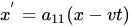
The analysis to date gives the following equations:
Assuming that the speed of light is constant, the coordinates of a flash of light that expands as a sphere will satisfy the following equations in each coordinate system:


Substituting the coordinate transformation equations into the second equation gives:

rearranging:

We demand that this is equivalent with
So we get:

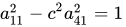

Solving these 3 simultaneous equations gives:
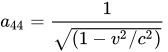
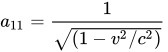
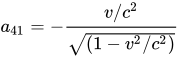
Substituting these values into:
gives:
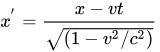
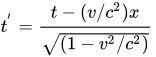
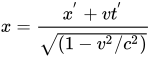
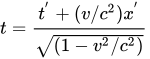
The inverse transformation is:


Einstein's original approach[edit | edit source]
How would two observers measure the position and timing of an event by using light rays if the speed of light were constant?
The modern analysis of this problem, exposing the assumptions involved, is given above but Einstein's original reasoning (Einstein 1905,1920) is as follows.
Light is transmitted along the positive x axis according to the equation  where
where  is the velocity of light. This can be rewritten as:

Another observer, moving relatively to the first may find different values for x and t but the same equation will apply:

A simple relationship between these formulae, which apply to the same event is:

Light is transmitted along the negative x axis according to the equation  where is the velocity of light. This can be rewritten as:


And:

Adding the equations and substituting  and
and  :
:
- (1)

- (2)

The origin of one set of coordinates can be set so that  hence:

If  is the velocity of one observer relative to the other then
  and:
and:
- (3)

At  :
:
- (4)

Therefore two points separated by unit distance in the primed frame of reference ie: when  have the following separation in the unprimed frame:
- (5)

Now  can be eliminated from equations (1) and (2) and combined with and (4) to give in the case where
  and
and  :
:
- (6)
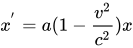
And, if  :
:
- (7)
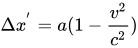
Now if the two moving systems are identical and the situation is symmetrical a measurement in the unprimed system of a division showing one metre on a measuring rod in the primed system is going to be identical to a measurement in the primed system of a division showing one metre on a measuring rod in the unprimed system. Thus (5) and (7) can be combined so that:
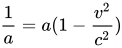
So:

Inserting this value for  into equations (1) and (2) and solving for
  gives:
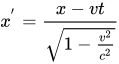

These are the Lorentz Transformation Equations for events on the x axis.
Einstein, A. (1920). Relativity. The Special and General Theory. Methuen & Co Ltd 1920. Written December, 1916. Robert W. Lawson (Authorised translation). http://www.bartleby.com/173/