Assume an N channel MESFET with uniform doping and sharp depletion
region shown in figure 1.
The depletion region  is given by the depletion width for a
diode. Where the voltage is the voltage from the gate to the
channel, where the channel voltage is given for a position x along
the channel as
is given by the depletion width for a
diode. Where the voltage is the voltage from the gate to the
channel, where the channel voltage is given for a position x along
the channel as  .
.

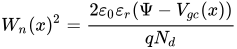
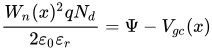
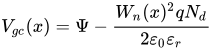
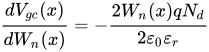 (1)
(1)
The current density in the channel is given by:



where:
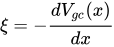
Therefore,



Substituting from equation 1:


![{\displaystyle I_{n}={\frac {2\sigma aWqN_{d}}{2\varepsilon _{0}\varepsilon _{r}L}}{\bigg [}{\frac {W_{n}^{2}(x)}{2}}-{\frac {W_{n}^{3}(x)}{3a}}{\bigg ]}_{W_{n}(0)}^{W_{n}(L)}}](https://wikimedia.org/api/rest_v1/media/math/render/svg/4210e417c8fa374b5aec036d232566c15881d378)
![{\displaystyle I_{n}={\frac {2\sigma aWqN_{d}}{2\varepsilon _{0}\varepsilon _{r}L}}{\bigg [}{\frac {W_{n}^{2}(L)-W_{n}^{2}(0)}{2}}-{\frac {W_{n}^{3}(L)-W_{n}^{3}(0)}{3a}}{\bigg ]}}](https://wikimedia.org/api/rest_v1/media/math/render/svg/6f75c8a3fbad1eb8f46d8050cd9990a7a73b901d)
![{\displaystyle I_{n}={\frac {2\sigma aWqN_{d}a^{2}}{6L\cdot 2\varepsilon _{0}\varepsilon _{r}}}{\bigg [}{\frac {3(W_{n}^{2}(L)-W_{n}^{2}(0))}{a^{2}}}-{\frac {2(W_{n}^{3}(L)-W_{n}^{3}(0))}{a^{3}}}{\bigg ]}}](https://wikimedia.org/api/rest_v1/media/math/render/svg/08eb7e4698c89a0a5a1d7d66f46648c99f6705c7)
One defines constant Β as the channel conductance with no
depletion. And the work function to deplete the channel
W00 [1]:
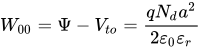

We now define Vto, the voltage such that the channel is pinched off. d is the ratio of channel depletion to maximum depletion for the drain. s the ratio of channel depletion to
maximum depletion for the source.
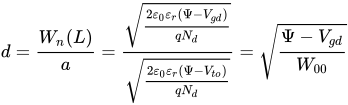
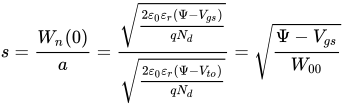
Substituting:
![{\displaystyle I_{n}=W\cdot {\frac {\sigma a\cdot W_{00}}{3L}}{\big [}3(d^{2}-s^{2})-2(d^{3}-s^{3}){\big ]}}](https://wikimedia.org/api/rest_v1/media/math/render/svg/417a332a4b763ae7926b36e06a51998a61a1ab39)
![{\displaystyle I_{n}=W\cdot \beta W_{00}^{2}{\big [}3(d^{2}-s^{2})-2(d^{3}-s^{3}){\big ]}}](https://wikimedia.org/api/rest_v1/media/math/render/svg/6a5348214d70d1a1bcea810d08321f3e09679c19) (2)
(2)
Equation 2 is Shockley's expression [2] for drain current in the linear region. When the device enters saturation, one end is pinched off(normally the drain). Thus $d=1$ and one may derive the equation for the saturation region:



![{\displaystyle I_{ds}={\frac {3}{2}}\beta W_{00}^{2}{\bigg [}{\frac {(V_{gs}-v_{to})^{2}}{W_{00}^{2}}}-{\frac {(V_{gd}-v_{to})^{2}}{W_{00}^{2}}}{\bigg ]}}](https://wikimedia.org/api/rest_v1/media/math/render/svg/c576c7ae1fc1a5cfe558fbc8e77dec2ff6c4d502)


It was found that a general power law provided a better fit for real devices [3].
![{\displaystyle I_{ds}=\beta {\big [}(V_{gs}-V_{to})^{Q}-(V_{gd}-V_{to})^{Q}{\big ]}}](https://wikimedia.org/api/rest_v1/media/math/render/svg/ebd8f44444879cc70985d90cbe8f8bd6f46a8d59)
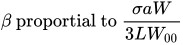
Where Q is dependent on the doping profile and a good fit is usually obtained for Q between 1.5 and 3. A general power law is approximately equal to Shockley's equation for Q = 2.4. Β is also empirically chosen and is proportion to the previous Β
Modelling the various regions is done though model binning. This however infers that a sharp transition exists from one region to another, which may not be accurate.
![{\displaystyle I_{ds}=\left\{{\begin{matrix}0&V_{gs}<V_{to}\\\beta {\big [}(V_{gs}-V_{to})^{Q}-(V_{gd}-V_{to})^{Q}{\big ]}&V_{gs}\leq V_{gd}\\\beta (V_{gs}-V_{to})^{Q}&V_{gs}>V_{gd}\end{matrix}}\right.}](https://wikimedia.org/api/rest_v1/media/math/render/svg/16f2b5a61ba07035e0eb13724bb5b217ab97a8ec)
[1] A. E. Parker. Design System for Locally Fabricated Gallium Arsenide Digital
Integrated Circuits. PhD thesis, Sydney University, 1990.
[2] W. Shockley. A unipolar field-effect transistor. IEEE Trans/ Electron Devices, 20(11):1365–1376, November 1952.
[3] I. Richer and R.D. Middlebrook. Power-law nature of field-effect transistor experimental characteristics. Proc. IEEE, 51(8):1145–1146, August 1963.