Real Analysis/Uniform Convergence
Jump to navigation
Jump to search
| ←Pointwise Convergence | Real Analysis Uniform Convergence |
Metric Spaces→ |
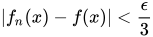
Definition: A sequence of real-valued functions is uniformly convergent if there is a function f(x) such that for every there is an such that when for every x in the domain of the functions f, then



Theorem (Uniform Convergence Theorem))[edit | edit source]
Let be a series of continuous functions that uniformly converges to a function . Then is continuous.


Proof[edit | edit source]
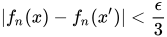
There exists an N such that for all n>N, for any x. Now let n>N, and consider the continuous function . Since it is continuous, there exists a such that if , then . Then so the function f(x) is continuous.