We will first revise some important concepts of Linear Algebra that are of importance in Multivariate Analysis. The reader with no background in Linear Algebra is advised to refer the book Linear Algebra.
A set  is said to be a Vector Space over a field
  if and only if operations addition and scalar multiplication are defined over it so as to satisfy for all
  and
and 
(i)Commutativity:
(ii)Associativity:
(iii)Identity:There exists  such that
(iv)Inverse:There exists  such that
(v):
(vi)
(vii)
Members of a vector space are called "Vectors" and those of the field are called "Scalars".  , the set of all polynomials etc. are examples of vector spaces
A set of linearly independant vectors that spans the vector space is said to be a Basis for the vector space.
Let  be vector spaces.
Let 
We say that  is a Linear transformation if and only if for all
  ,
,
(i)
(ii)
As we will see, there are two major ways to define a 'derivative' of a multivariable function. We first present the seemingly more straightforward way of using "Partial Derivatives".
Directional and Partial Derivatives[edit | edit source]
Let 
Let 
We say that  is differentiable at
  with respect to vector
  if and only if there exists
  that satisfies
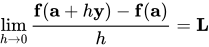
 is said to be the derivative of at
  with respect to and is written as
When is a unit vector, the derivative is said to be a partial derivative. Here we will explicitly define partial derivatives and see some of their properties.
Let  be a real multivariate function defined on an open subset
  of
of
 .
.
Then the partial derivative at some parameter  with respect to the coordinate
  is defined as the following limit
 .
.
is said to be differentiable at this parameter if
the difference  is
equivalent up to first order in h to a linear form L (of h), that is
is
equivalent up to first order in h to a linear form L (of h), that is

The linear form L is then said to be the differential of at , and is written as  or sometimes
 .
.
In this case, where is differentiable at  ,
by linearity we can write
,
by linearity we can write

is said to be continuously differentiable if its differential is defined at any
parameter in its domain, and if the differential is varying continuously relative
to the parameter , that is if it coordinates (as a
linear form)  are varying continuously.
In case partial derivatives exists but is not differentiable, and sometimes
not even continuous exempli gratia
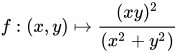
(and  ) we say that is separably differentiable.
The total derivative is important as it preserves some of the key properties of the single variable derivative, most notably the assertion differentiability implies continuity
Let 
We say that is differentiable at  if and only if there exists a linear transformation,
  , called the derivative or total derivative of at , such that

One should read  as the linear transformation
  applied to the vector
  . Sometimes it is customary to write this as
  .
.
Suppose  is an open set and
  is differentiable on A. Think of writing in components so
  . Then the partial derivatives
  exist, and the matrix representing the linear transformation
  with respect to the standard bases of and
  is given by the Jacobian Matrix:
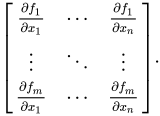
evaluated at  .
.
NOTE: This theorem requires the function to be differentiable to begin with. It is a common mistake to assume that if the partial derivatives exist then this would imply that the function is differentiable because we can construct the Jacobian matrix. This however is completely false. Which brings us to the next theorem:
Suppose is an open set and . Think of writing in components so . If exists and is continuous on  for all
  and for all
 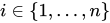 , then is differentiable on .
This theorem gives us a nice criteria for a function to be differentiable.