Radiation Oncology/Physics/Equations
|
Radiation Physics Equations
Diagnostic Radiology[edit | edit source]
- Film
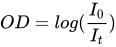
- , where OD is optical density, is amount of incident light, and is amount of transmitted (measured) light
- OD values are additive
- H and D curve (Hurter-Driffield) gives relationship between OD and absorbed dose. Sigmoid shape
- Flat region: OD independent of dose
- Toe region: OD increases rapidly
- Linear region: OD increases linearly with dose
- Saturation region: OD doesn't increase as function of dose



Photon Dosimetry[edit | edit source]
- Atomic coefficient dependence
Note: Probability of interation is not the same as mass attenuation coefficient Consult Page 36-39 of IAEA text (radiation oncology physics) Below are the Mass attenuation coefficient dependencies
- Coherent scattering ≈ Z
- Photoelectric absorption ≈ Z3/E3
- Compton scattering ≈ independent of Z, ≈ 1/E, ≈ electrons/gram
- Pair production ≈ Z
- Triple production ≈ Z2
- Hounsfield units
- HU = 1000* (μtissue - μwater) / μwater
- Heterogeneity corrections
- Lung: 10 cm of lung ≈ 3 cm of tissue = 3.3x
- Bone: 10 cm of bone ≈ 16 cm of tissue = 0.6x
- With higher energy, less correction necessary (since Compton effect is 1/E)
- With higher energy, slower build-up at lung/tumor interface, and thus possibly underdosing
- If no correction, higher dose at prescription point due to lower attenuation in lung
- LET
- Specific ionization: number of ion pairs formed per unit path length; depends on velocity and particle charge
- Energy transferred to medium per unit path length (energy gain)
- LET is proportionate to (Q2 * ρ) / (v2 * Z)
- LET = Specific ionization * W
- Stopping power
- Energy deposited by particle; depends on charge and density of medium
- Colisional: lost due to collisional processes (secondary electrons); predominates, especially at lower energies
- Radiative: lost due to radiative processes (photons, high energy secondary electrons)
- Restricted stopping power: energy lost by particle per unit length, locally absorbed
- Energy deposited by particle; depends on charge and density of medium
- Inverse square law: I2/I1 = (r1/r2)2
- Back scatter factor (SSD setup): BSF = Exposure at surface / Exposure in air
- Dose = Exposure (X) * f * BSF
- Only applies at low energies, dmax at surface
- Peak scatter factor (SSD setup): PSF = Dose at dmax / Dose in air
d_max[edit | edit source]
Photon d_max (cm)
- Co-60 0.5
- 4MV 1.0
- 6MV 1.5
- 10MV 2.5
- 15MV 3.0
- 18MV 3.2
- 20MV 3.5
- 25MV 4.0
In most centers, we have 6MV, 10MV and 18MV so
- 6MV : 1.5cm
- 10MV : 2.5cm
- 18MV : 3.2cm
Photon attenuation
- Co-60 ~4.0% per 1 cm depth
- 6MV ~3.5% per 1 cm depth
- 20MV ~2.0% per 1 cm depth
PDD[edit | edit source]
- Percent depth dose (SSD setup): PDD = Dose at depth / Dose at dmax
Two components: patient attenuation and inverse square dose fall-off
Factors that affect PDD:
- Energy ==> Increases
- Field size ==> Increases
- SSD ==> Increases
- Depth ==>Decreases
D2 = D1 * (PDD2 / PDD1)
By energy at 100 cm SSD, 10x10 field, and depth of 10cm
- Co-60 56%
- 4MV 61%
- 6MV 67%
- 10MV 73%
- 20MV 80%
- 25MV 83%
Equivalent squares[edit | edit source]
- Square area that has the same PDD as the rectangular field
- --- This is only true for W = L since


- Otherwise:
- .
- See, The Physics of Radiation Therapy by Khan, Chapter 9, p. 185.

- Equivalent Square for circular field (D=diameter)
- See reference [1].
- A square with side a will be equivalent to a circle with radius r when they have the same area, , so , or
- Elliptical fields:
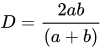
- Equivalent diameter of elliptical fields:
- -- see PMID 15507419



Skin dose[edit | edit source]
Factors that affect Skin dose:
- Energy ==> Decreases
- SSD ==> Decreases
- Field size ==> Increases
- Bolus ==> Increases
- Oblique incidence ==>Increases
Dose Ratios[edit | edit source]
- Mayneord F-factor:


Tissue air ratio (SAD setup): TAR = Dose at depth / Dose in air
Tissue phantom ratio (SAD setup): TPR = Dose at depth / Dose at reference depth
Tissue maximum ratio (SAD setup): TMR = Dose at depth / Dose at dmax
- via inverse square correction

MU Calculation[edit | edit source]
Treatment time or monitor units:

- where OF is the output factor, WF is the wedge factor, TF is the tray factor, and ISF is the inverse square factor.
Wedges[edit | edit source]
- Wedge angle: angle by which the isodose curve is turned by the wedge, typically at 10 cm
- Hinge angle: angle between the central axes of two incident beams
- Dose for arbitrary wedge field θ using flying wedge or dynamic wedge = W0*dose0 + W60*dose60, where W0 = 1-W60, and W60 = tan θ/tan 60

Penumbra[edit | edit source]
- P = s * (SSD + d - SDD) / SDD, where s is source width and SDD is source-diaphragm/collimator distance
Superficial energies[edit | edit source]
- HVL (in Al or Cu) specifies penetrability of low-energy photon beam. HVL is determined by the combination of kVp and filtration (different combinations can give same HVL)
- Typically short SSD is used
- Compared with electrons, superficial photons have sharper penumbra, deliver higher skin dose, but also higher dose to underlying tissues
Blocks[edit | edit source]
- Dose under 1.5 cm width block (5 HVL), in 15 x 15 cm field, 6 MV, 5 cm depth is ~15% of open field dose. Transmitted dose is ~3% (shielded by 5 HVL), scattered dose from open field contributes the rest
Scattered dose[edit | edit source]
- Patient with pacemaker, if dose to pacemaker to be <5%, need to be at least 2cm from 6 MV beam edge
- Patient with breast tangents, ovaries 20 cm from field: dose to ovaries ~0.5%
- Dose at 1 m laterally from treatment beam: ~0.1%
Treatment margins[edit | edit source]
- PTV margin
- PTV margin = 2.5 (quadratic sum of standard deviation of all preparation (systematic) errors) + 0.7 * (quadratic sum of standard deviation of all execution (random) errors) PMID 10863086 (2000: van Herk M, Int J Radiat Oncol Biol Phys. 2000 Jul 1;47(4):1121-35.)
- PTV margin = 2.5 sigma + 0.7 delta (cover CTV for 90% of patients with 95% isodose)
Electron Dosimetry[edit | edit source]
- Probability of bremsstrahlung interaction: Z2
- X-ray emission spectrum proportionate to kVp2 * mAs / d2, also depends on amount of filtration
- Lead block thickness to attenuate 95%: tPb (mm) = Electron energy / 2
- Cerrobend block thickness tCerr = 1.2 * tPb
- Range
- Practical range in water: Rp (cm) = Electron energy / 2
- R50: depth at which dose is 50% of maximum
- Depth of calibration
- I50: Find depth of 50% ionization in water
- R50: Calculate R50 = 1.029 * I50 - 0.06 if <10 cm depth, R50=1.059 * I50 - 0.37 if >10 cm depth
- dref = 0.6 * R50 - 0.1
- Energy is specified by the R50 parameter
- Typically treated as SSD setup
- No physical source in accelerator head; clinical beams appears to emerge from a "virtual source". Can be found by backprojecting beam profiles at different depths
- Virtual SSD shorter than actual (photon) SSD
- Inverse square corrections can be done on virtual SSD for large fields; for small fields effective SSD should be determined
- Output Dose rate = Applicator Dose rate * Back scatter factor(cutout)/Back scatter factor(Applicator)/ (SSD/SSD+SO)^2 (SSD= Source to surface distance & SO= Stand Off)
Radiation Quality[edit | edit source]
- Half Value Layer: HVL = ln 2 / μ
- Tenth Value Layer: 1 TVL = 3.32 HVL
- Attenuation: N = N0 * e-μx, where N is number of photons remaining, μ is linear attenuation coefficient, x is thickness of block
- Attenuation: N = N0 * (1/2)n, where n is number of HVLs
Brachytherapy[edit | edit source]
- 1 Ci = 37 x 109 Bq
- Activity: A = A0 * e-λt
- Activity: A = A0 * (1/2)n, where n is number of half-lives elapsed
- Specific activity: SA = A / m = λ * (Na / AW)
- Half-life: t1/2 = ln 2 / λ
- Mean (average) life: tavg = 1 / λ = 1.44 * t1/2
- Permanent implant: Dosetotal = Dose rate0 * tavg
- Temporary implant: Dosetotal = Dose rate0 * tavg * (1 - exp(-t/tavg) = Dose rate0 * tavg * (1 - exp(-λt))
- Exposure rate: X = Γ * Α / d2
- Where Γ is gamma constant, A is activity, and d is distance from source
- Dose rate: D = Sk * Λ * G * F * g
- Where Sk is air-kerma strength, Λ is dose-rate constant, G is geometry factor (see below), F is anisotropy factor, and g is radial dose function
- Geometry factor G(r,θ)
- Point source: 1/r2
- Line source: (θ2 - θ1)/Ly, where L is length of line, y is distance
- ICRU dose rate:
- Low 0.4 - 2.0 Gy/h
- Medium 2.0 - 12.0 Gy/h
- High >12.0 Gy/h
- Brachytherapy systems
- Paterson-Parker (Manchester): non-uniform needles (1/3, 1/2, 2/3 center vs periphery depending on plane size), uniform dose
- Quimby: uniform needles, non-uniform dose (higher in center)
Shielding[edit | edit source]
- Workload (W): Beam-on time (in Gy at 1 m from source)
- Use factor (U): Fraction of time beam aimed at particular target (dimensionless)
- Occupancy factor (T): Fraction of time area is occupied by an individual (dimensionless)
- Distance (d): from isocenter to area of interest (m)
- Barrier transmission factor (B): amount of radiation passing through barrier
- Permissible dose (P): maximum dose for an area of interest (Gy)
- Shielding equations
- Primary barrier dose equation:
- Primary barrier shielding equation:
- Secondary barrier scattering equation:


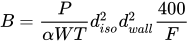
- where α is the scattered fraction, diso is the distance from the source to the isocenter, dwall is the distance from the isocenter to the wall, and F is the maximum field area in cm2.
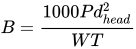
- Secondary barrier leakage equation:
- where dhead is the minimum distance from the linac head to the wall.
Internal Sources[edit | edit source]
- Effective half-life: Accounts for physical half-life and for biologic half-life, always less than either
- teff,uptake = (tbiol, uptake * tphys) / (tbiol, uptake + tphys)
- teff,elim = (tbiol, elim * tphys) / (tbiol, elim + tphys)
Radiation Protection[edit | edit source]
- Dose equivalent (H): Absorbed dose (D) * WR * N
- WR, previously known as Q, is the quality factor
- N is geometry factor
- Unit in Sievert (Sv)
- Effective dose equivalent (HT): Sum of H for a given tissue across different radiation types (e.g. for nuclear explosion)
- Formerly known as "equivalent" dose
- Effective dose (E): Sum of HT for whole body across different tissues
- Gonads have WT = 0.12 (lower than lung/breasts/stomach/bone marrow/colon)