Practical Electronics/Oscillators

From Wikibooks, the open-content textbooks collection

Jump to: navigation, search

LC oscillator consist of one inductor and one capacitor connected in series or in parallel operating at resonance frequency . Resonance is a natural process occur when the frequecy dependent components cancel out

[edit] LC Series

At Resonance

  • ZL = ZC
\omega L = \frac{1}{\omega C}
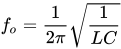
\omega_o = \sqrt{\frac{1}{LC}}


  • VL = ZC or VLZC = 0 or VC = − ZL

The voltage of the series LC keeps oscillating between inductor's voltage and capacitor's voltage between phase angle 0 - 180

Inductor's voltage completes one full cycle at angle 180 . At angle 180, the voltage inverts itself and travel back to origin at angle 0 . This process continues and produce voltage oscillation between phase angle 0 - 180

[edit] LC Parallel

At Resonance

  • \frac{1}{Z_L} = \frac{1}{Z_C}
\frac{1}{\omega L} = \omega C
\omega_o = \sqrt{\frac{1}{LC}}


  • IL = IC or ILIC = 0 or IC = − IL

The current of the series LC keeps oscillating between inductor's current and capacitor's current between phase angle 0 - 180

Inductor's current completes one full cycle at angle 180 . At angle 180, the current inverts itself and travel back to origin at angle 0 . This process continues and produce current oscillation between phase angle 0 - 180


[edit] Summary

Oscillation occurs in LC circuit when the frequency components cancels out ie

ZL = ZC or at oscillting frequency \omega_o = \sqrt{\frac{1}{LC}}
VL = − ZC or the two voltage is 180 degree out of phase