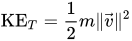
Kinetic energy is simply the capacity to do work by virtue of motion.
(Translational) kinetic energy is equal to one-half of mass times the square of velocity.
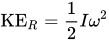
(Rotational) kinetic energy is equal to one-half of moment of inertia times the square of angular velocity.
Total kinetic energy is simply the sum of the translational and rotational kinetic energies. In most cases, these energies are separately dealt with. It is easy to remember the rotational kinetic energy if you think of the moment of inertia I as the rotational mass. However, you should note that this substitution is not universal but rather a rule of thumb.
Potential energy is simply the capacity to do work by virtue of position (or arrangement) relative to some zero-energy reference position (or arrangement).
Potential energy due to gravity is equal to the product of mass, acceleration due to gravity, and height (elevation) of the object.
Note that this is simply the vertical displacement multiplied by the weight of the object. The reference position is usually the level ground but the initial position like the rooftop or treetop can also be used.
Potential energy due to spring deformation is equal to one-half the product of the spring constant times the square of the change in length of the spring.
The reference point of spring deformation is normally when the spring is "relaxed," i.e. the net force exerted by the spring is zero. It will be easy to remember that the one-half factor is inserted to compensate for finite '"change in length" since one would want to think of the product of force and change in length directly. Since the force actually varies with , it is instructive to need a "correction factor" during integration.
Variables
K: Kinetic energy (J) m: mass (kg) v: velocity (m/s) I: moment of inertia, (kg·m2) ω: ("omega") angular momentum (rad/s) Ug: Potential energy (J) g: local acceleration due to gravity (on the earth’s surface, 9.8 m/s2) h: height of elevation (m) Ue: Potential energy (J) k: spring constant (N/m) Δx: change in length of spring (m)
Definition of terms
Energy: a theoretically indefinable quantity that describes potential to do work. SI unit for energy is the joule (J). Also common is the calorie (cal).
The joule: defined as the energy needed to push with the force of one newton over the distance of one meter. Equivalent to one newton-meter (N·m) or one watt-second (W·s).
1 joule = 1 J = 1 newton • 1 meter = 1 watt • 1 second
Energy comes in many varieties, including Kinetic energy, Potential energy, and Heat energy.
Kinetic energy (K): The energy that an object has due to its motion. Half of velocity squared times mass. Units: joules (J)
Potential energy due to gravity (UG): The energy that an object has stored in it by elevation from a mass, such as raised above the surface of the earth. This energy is released when the object becomes free to move. Mass times height time acceleration due to gravity. Units: joules (J)
Potential energy due to spring compression (UE): Energy stored in spring when it is compressed. Units: joules (J)
Heat energy (Q): Units: joules (J)
Spring compression (Dx): The difference in length between the spring at rest and the spring when stretched or compressed. Units: meters (m)
Spring constant (k): a constant specific to each spring, which describes its “springiness”, or how much work is needed to compress the spring. Units: newtons per meter (N/m)
Change in spring length (Δx): The distance between the at-rest length of the spring minus the compressed or extended length of the spring. Units: meters (m)
Moment of inertia (I): Describes mass and its distribution. (kg•m2)
Angular momentum (ω): Angular velocity times mass (inertia). (rad/s)