The following demonstrates what's a state function and what's not a state function.
 is not exact differential for a gas obeying van der Waals' equation, but
  is as demonstrated below:
![{\displaystyle dq_{rev}\;=\left({\frac {\partial U}{\partial T}}\right)_{v}dT+\left[P_{ext}+\left({\frac {\partial U}{\partial V}}\right)_{T}\right]dV}](https://wikimedia.org/api/rest_v1/media/math/render/svg/bd3c4c13bc8dc44be2e50a0bcb6a7f081295d405)
We assume quasistatic situation, so  .
.
![{\displaystyle dq_{rev}\;=\left({\frac {\partial U}{\partial T}}\right)_{v}dT+\left[P+\left({\frac {\partial U}{\partial V}}\right)_{T}\right]dV}](https://wikimedia.org/api/rest_v1/media/math/render/svg/e5ee7d833cc4f1b5540681ba819b35a38ac388cf)
![{\displaystyle =C_{v}dT+\left[P+\left({\frac {\partial U}{\partial V}}\right)_{T}\right]dV}](https://wikimedia.org/api/rest_v1/media/math/render/svg/acfae75f27073e0df4295b8058ec1cd085da8259)
![{\displaystyle =C_{v}dT+\left[P+\left({\frac {a}{{\overline {V}}^{2}}}\right)\right]dV}](https://wikimedia.org/api/rest_v1/media/math/render/svg/30b040b39f4a3adce2d77849457c34e35d0ee707)
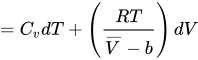
Now, you take the cross partial derivatives.
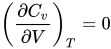
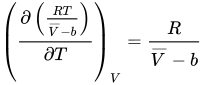
They are not equal; hence, is not exact differential (not a state function).
However, if we take it will be exact differential (a state function).
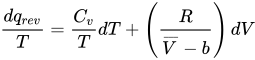
Take the cross partial derivatives.
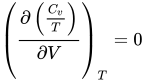
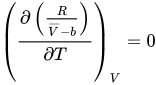
Both are equal making exact differential (a state function).
