Ordinary Differential Equations/Linear Equations
Linear Equations and Linear Operators[edit | edit source]
A general linear equation is of the form
,

where we will assume that the coefficient functions and Q(x) are continuous functions in an interval [a,b], and that for all . The existence theorem proves that a unique solution exists that passes through the point where , with continuous derivatives up to the n-1 order, and satisfies initial conditions for each of those derivatives at .


![{\displaystyle x\in [a,b]}](https://wikimedia.org/api/rest_v1/media/math/render/svg/026357b404ee584c475579fb2302a4e9881b8cce)


One can also write this as

where L is called a linear differential operator of order n.
A differential equation of the form L(y)=0 with the same linear differential operator as above is called a homogeneous equation corresponding to the above equation, and the reduced equation of the above equation.
We will now prove some properties about the linear differential operator.
The linear differential operator:
which is true because differentiation is linear. Thus, we can make the two following statements:

- If and are two solutions of the homogeneous equation, then is also a solution.
- If y is a solution to the homogeneous equation L(y)=0, and is a solution to the equation L(y)=Q(x), then is also a solution to the equation L(y)=Q(x).





Wronskian[edit | edit source]
Let L(y)=0 be a homogeneous equation of degree n, and let be linearly independent solutions of this equation.

The general solution is then .

Suppose instead that the solutions are not linearly independent. Then there exists values for not all zero such that =0.


Then the following equations also hold true:
...



When there is to be a non-trivial solution to this system of homogeneous linear equations, the column vectors corresponding to each coefficient are linearly dependent. This is equivalent to saying that the following determinant, called the Wronskian is 0:
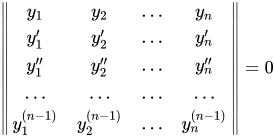
Thus, if the solutions are dependent, then their Wronskian is equal to 0, and conversely, and conversely if the Wronskian is equal to 0, then the columns of that matrix must be linearly dependent, indicating that the solutions are linearly dependent.