Let  be a
be a  -finite measure space. Suppose
  is a positive simple measurable function, with
 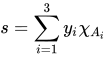 ;
;  are disjoint.
Define 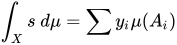
Let  be measurable, and let
  .
.
Define 
Now let  be any measurable function. We say that is integrable if
  and
and  are integrable and if
 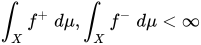 . Then, we write

The class of measurable functions on  is denoted by
For  , we define
  to be the collection of all measurable functions such that
A property is said to hold almost everywhere if the set of all points where the property does not hold has measure zero.
Let be a measure space and let  be measurable on . Then
- If
 , then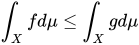
- If
 ,
,  , then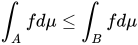
- If and
 then
then 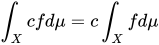
- If
 ,
,  , then
  , even if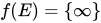
- If ,
 , then , even if
Proof
Monotone Convergence Theorem[edit | edit source]
Suppose  and
and  are measurable for all
  such that
 for every
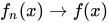 almost everywhere on
Then, 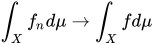
Proof
 is an increasing sequence in
  , and hence,
 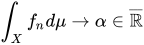 (say). We know that is measurable and that
  . That is,

Hence, 
Let ![{\displaystyle c\in [0,1]}](https://wikimedia.org/api/rest_v1/media/math/render/svg/02b2796dc5e3cb6527d1ac6e766dc1da2ef1e120)
Define  ;
;  . Observe that
  and
and 
Suppose . If  then
then  implying that
  . If
. If  , then there exists such that
 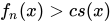 and hence,
  .
.
Thus, , therefore  . As this is true if , we have that
  . Thus, .
Let be measurable functions. Then,

Proof
For  define
 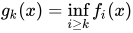 . Observe that
  are measurable and increasing for all
  .
.
As  ,
,  . By monotone convergence theorem,
 and as
  , we have the result.
Dominated convergence theorem[edit | edit source]
Let be a complex measure space. Let  be a sequence of complex measurable functions that converge pointwise to ;
 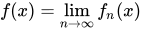 , with
Suppose 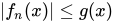 for some
  then
then
 and
and 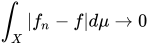 as
as 
Proof
We know that  and hence
 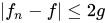 , that is,
Therefore, by Fatou's lemma, 

As  ,
, 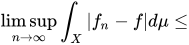 implying that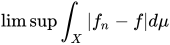
- Suppose
![{\displaystyle f:X\to [0,\infty ]}](https://wikimedia.org/api/rest_v1/media/math/render/svg/064ca972f4c8463eb49d68252fb3516fcb3b054d) is measurable, with
is measurable, with  such that . Then almost everywhere
- Let
 and let for every . Then,
  almost everywhere on
- Let and
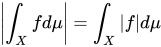 then there exists constant
  such that
  almost everywhere on
Proof
- For each
 define
 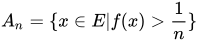 . Observe that
but  Thus
Thus  for all , by continuity, almost everywhere on
- Write
 , where
 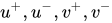 are non-negative real measurable.
Further as 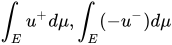 are both non-negative, each of them is zero. Thus, by applying part I, we have that
  vanish almost everywhere on . We can similarly show that
  vanish almost everywhere on .