Logic for Computer Scientists/Predicate Logic/SATCHMO
SATCHMO[edit | edit source]
The SATCHMO Theorem Prover was one of the first systems which used model generation, i.e. a bottom-up proof procedure. The prover was given by a small Prolog-program, which implements a tableau proof procedure. One restriction is that it requires range restricted formulae.
Definition 30[edit | edit source]
A first order clause is called range restricted if every variable which occurs in the head occurs in the body as well.



- Convert clauses to range restricted form:
- assert range-restricted clauses and dom clauses in Prolog database.
- Call satisfiable:

kill satisfiable :-    assume(X) :- asserta(X).
       (Head <- Body)            assume(X) :-
       Body, not Head, !,          retract(X), !, fail.
       component(HLit, Head),      component(E, (E ; _)).
       assume(HLit),               component(E, (_ ; R)) :-
       not false,                   !, component(E, R).
       satisfiable.                component(E, E).
  satisfiable.
First-Order completeness via Level-Saturation modification. This proof procedure implements Hyper Tableaux in the ground case.
Hyper Tableau - Ground Case[edit | edit source]

All open branches consist of positive literals only Take the following clause set as an example


Definition 31 (Literal tree, Clausal Tableau)[edit | edit source]
A literal tree is a pair consisting of a finite, ordered tree and a labeling function that assigns a literal to every non-root node of .


The successor sequence of a node in an ordered tree is the sequence of nodes with immediate predecessor , in the order given by .

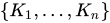
A (clausal) tableau of a set of clauses is a literal tree in which, for every successor sequence in labeled with literals , respectively, there is a substitution and a clause with for every . is called a tableau clause and the elements of a tableau clause are called tableau literals.





Definition 32 (Branch, Open and Closed Tableau, Selection Function)[edit | edit source]
A branch of a tableau is a sequence () of nodes in such that is the root of , is the immediate predecessor of for , and is a leaf of . We say branch is a prefix of branch , written as or , iff for some nodes , . The branch literals of branch are the set . We find it convenient to use a branch in place where a literal set is required, and mean its branch literals. For instance, we will write expressions like instead of .











In order to memorize the fact that a branch contains a contradiction, we allow to label a branch as either open or em closed. A tableau is closed if each of its branches is closed, otherwise it is open.
A selection function is a total function which maps an open tableau to one of its open branches. If we also say that is selected in by .


Note that branches are always finite, as tableaux are finite. Fortunately, there is no restriction on which selection function to use. For instance, one can use a selection function which always selects the "leftmost" branch.
Definition 33 (Hyper Tableau - Ground Case)[edit | edit source]
Let be a finite set of clauses and be a
selection function. Hyper tableaux for are inductively defined as follows:
Initialization step:
A one node literal tree is a hyper tableau for . Its single branch is marked as "open".

Hyper extension step: If
- is an open hyper tableau for , (i.e. is selected in by ) with open leaf node , and
- is a clause from (, ), called extending clause in this context, and
- such that (referred to as hyper condition)



then the literal tree is a hyper tableau for , where is obtained from by attaching child nodes to with respective labels




and marking every new branch with positive leaf as "open", and marking every new branch with negative leaf as "closed".


Minimal Model Reasoning[edit | edit source]
The clause set obviously has two different models: and . Under set inclusion these models can be compared and there are some tasks where it is appropriate to compute the (or in general a) smallest one. This is for example the case with



- Knowledge Representation, Circumscription
- Basis for default negation (GCWA)
- Applications: Deductive database updates, Diagnosis
There are basically two different methods to compute minimal models.
Minimal Model Reasoning – Niemel¨a’s Approach[edit | edit source]
Given a set of ground clauses the methods applies a model generating procedure, e.g. hyper tableau, which is able to generate all models.

Lemma 1: For every minimal model for there is a branch with literals .

Assume that is the set of atoms, which occur in the head of a clause from , than the following Lemma holds.

Lemma 2: is a minimal model for iff

This offers a general method: Generate model candidates, and test with Lemma 2.
is not a minimal model in our example from above, because iff is unsatisfiable, which is not the case, hence does not correspond to a minimal model and hence the branch is closed.



is minimal because iff is unsatisfiable. This is the case and hence is minimal and the branch remains open.



Properties: Soundness (by Lemma 2) Completeness (by Lemma 1), space efficiency.
Minimal Model Reasoning – Bry& Yayha‘s Approach[edit | edit source]
As an example we have the set


Lemma: With complement splitting, the leftmost open branch
is a minimal model for .
General method: Repeat: generate minimal model , add to . Properties: Soundness (by Lemma) Completeness as before, possibly exponentially many new clauses .
