Linear Algebra/Change of Basis

From Wikibooks, open books for an open world
< Linear Algebra
Jump to: navigation, search
← Inverses Change of Basis Changing Representations of Vectors →

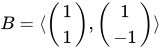
Representations, whether of vectors or of maps, vary with the bases. For instance, with respect to the two bases \mathcal{E}_2 and


B=\langle \begin{pmatrix} 1 \\ 1 \end{pmatrix},\begin{pmatrix} 1 \\ -1 \end{pmatrix} \rangle

for \mathbb{R}^2, the vector \vec{e}_1 has two different representations.


{\rm Rep}_{\mathcal{E}_2}(\vec{e}_1)=\begin{pmatrix} 1 \\ 0 \end{pmatrix}
\qquad
{\rm Rep}_{B}(\vec{e}_1)=\begin{pmatrix} 1/2 \\ 1/2 \end{pmatrix}

Similarly, with respect to \mathcal{E}_2,\mathcal{E}_2 and \mathcal{E}_2,B, the identity map has two different representations.


{\rm Rep}_{\mathcal{E}_2,\mathcal{E}_2}(\text{id})=
\begin{pmatrix}
1  &0  \\
0  &1
\end{pmatrix}
\qquad
{\rm Rep}_{\mathcal{E}_2,B}(\text{id})=
\begin{pmatrix}
1/2  &1/2  \\
1/2  &-1/2
\end{pmatrix}

With our point of view that the objects of our studies are vectors and maps, in fixing bases we are adopting a scheme of tags or names for these objects, that are convienent for computation. We will now see how to translate among these names— we will see exactly how representations vary as the bases vary.

← Inverses Change of Basis Changing Representations of Vectors →
Personal tools
Namespaces
Variants
Actions
Navigation
Community
Toolbox
Sister projects
Print/export