There are several ways of assigning coordinates to a system. Which one you choose depends on what is happening within the system.
Fixed Rectangular coordinates[edit | edit source]
In this coordinate system, vectors are expressed as an addition of vectors in the x, and y, direction from a non-rotating origin. Usually  is a unit vector in the x direction, and
  is a unit vector in the y direction.
The position vector,  (or
(or  ), the velocity vector,
  , and the acceleration vector,
  are expressed using rectangular coordinates in the following way:



Note:
 ,
, 
Unlike rectangular coordinates which are measured relative to an origin that is fixed and non rotating, the origin of these coordinates can rotate and translate - often following a particle on a body that is being studied.
This system of coordinates is based on three orthogonal unit vectors: the vector  , and the vector
  which form a basis for the plane in which the objects we are considering reside, and
  about which rotation occurs.
Derivatives of Unit Vectors[edit | edit source]
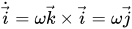
The position, velocity, and acceleration vectors of a given point can be expressed using these coordinate systems, but we have to be a bit more careful than we do with fixed frames of reference. Since the frame of reference is rotating, we must take the derivatives of the unit vectors into account when taking the derivative of any of these vectors. If the coordinate frame is rotating at a rate of  in the counterclockwise direction (that's
  using the right hand rule) then the derivatives of the unit vectors are as follows:

Position, Velocity, and Acceleration[edit | edit source]
Given these identities, we can now figure out how to represent the position, velocity, and acceleration vectors of a particle using this coordinate system.
Position is straightforward:
It's just the distance from the origin in the direction of each of the unit vectors.
Velocity is the time derivative of position:

By the chain rule, this is:

Which from the identities above we know to be:

or equivalently

where  is the velocity of the particle relative to the coordinate system.
Acceleration is the time derivative of velocity.
We know that:
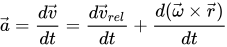
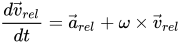
Consider the  part. has two parts we want to find the derivative of: the relative change in velocity (
 ), and the change in the coordinate frame (
 ).
).
Next, consider  . Using the chain rule:
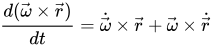
 we know from above:

So all together:

And collecting terms:
