Units of Measurement as Mathematical Constants[edit | edit source]
Physics and Mathematics begin with counting
1 apple, 2 apples, etc.
Thus an "apple" in our records is a unit of measurement, the quantity in question being "number of apples"
This evolves into simple arithmetic
1 apple added to 1 apple is 2 apples
10 apples subtracted from 30 apples is 20 apples
Introduction of shorthand notation
Mathematics can discard the physical objects in question and has the luxury of concerning itself with abstract concepts
Whereas in mathematics the constant represents a numerical constant, in physics this constant can represent a physical constant, thereby allowing physical objects to behave as mathematical entities in mathematical equations
Units of measurements are important in mathematical equations since they represent critical information and errors in calculations will result if these physical constants are neglected
is wrong in the sense that is the only answer allowed under the rules of mathematics
Also, care must be taken when we perform mathematical operations
represents 9 apples arranged in a square
creates a new physical quantity apple(orange) that is neither apples nor oranges! This is how new physical quantities, i.e. energy are created from lengths, times, and masses.
Shorthand notation for large or tiny numbers based on powers of 10
Large
Small
Système International d'Unités (International System of Units, aka SI)[edit | edit source]
Further simplification of written numbers
y
z
a
f
p
n
µ
m
c
d
da
h
k
M
G
T
P
E
Z
Y
The Mathematics of Conversion Between Units[edit | edit source]
In mathematical equations, units of measurement behave as constants
To convert from one unit of to another, we utilize an equation relating the two measurements
We can solve and substitute for the constant
The Mathematics of Conversion Between Units
  1. In mathematical equations, units of measurement behave as constants
         * (1\mbox{ m} + 2\mbox{ m})\times 4\mbox{ m} = 12\mbox{ m}^2
  2. To convert from one unit of to another, we utilize an equation relating the two measurements
         * 1\mbox{ km} = 1000\mbox{ m} \,
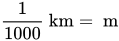
  3. We can solve and substitute for the constant m
         * \frac{1}{1000}\mbox{ km} = \mbox{ m}
         * \left[1\left(\frac{1}{1000}\mbox{ km}\right) + 2\left(\frac{1}{1000}\mbox{ km}\right)\right]\times 4\left(\frac{1}{1000}\mbox{ km}\right) = 12 \left(\frac{1}{1000}\mbox{ km}\right)^2
         * \left(1\times 10^{-3}\mbox{ km} + 2\times 10^{-3}\mbox{ km}\right)\times 4\times 10^{-3}\mbox{ km} = 12\times 10^{-6}\mbox{ km}^2

































![{\displaystyle \left[1\left({\frac {1}{1000}}{\mbox{ km}}\right)+2\left({\frac {1}{1000}}{\mbox{ km}}\right)\right]\times 4\left({\frac {1}{1000}}{\mbox{ km}}\right)=12\left({\frac {1}{1000}}{\mbox{ km}}\right)^{2}}](https://wikimedia.org/api/rest_v1/media/math/render/svg/b61615739e6fd4a44b2fa8d4ba36ab7271a2614b)
