Introduction to Mathematical Physics/Quantum mechanics/Postulates
secespetat
State space[edit | edit source]
The first postulate deal with the description of the state of a system.
Postulate: (Description of the state of a system) To each physical system corresponds a complex Hilbert space with enumerable basis.

The space have to be precised for each physical system considered.
Example: For a system with one particle with spin zero in a non relativistic framework, the adopted state space is . It is the space of complex functions of squared summable (relatively to Lebesgue measure) equipped by scalar product:

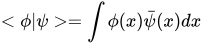
This space is called space of orbital states.\index{state space}
Quantum mechanics substitutes thus to the classical notion of position and speed a function of squared summable. A element of is noted using Dirac notations.


Example:
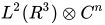
For a system constituted by a particle with non zero spin \index{spin}, in a non relativistic framework, state space is the tensorial product where . Particles with entire spin are called bosons;\index{bosons} Particles with semi-entire spin are called fermions.\index{fermions}


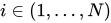
Example: For a system constituted by distinct particles, state space is the tensorial product of Hilbert spaces () where is the state space associated to particle .



exmppauli
Example: For a system constituted by identical particles, the state space is a subspace of where is the state space associated to particle . Let be a function of this subspace. It can be written:



where . Let be the operator permutation \index{permutation} from into defined by:



where is a permutation of . A vector is called symmetrical if it can be written:


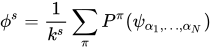
A vector is called anti-symetrical if it can be written:

where is the signature \index{signature} (or parity) of the permutation , being the number of transpositions whose permutation is product. Coefficients and allow to normalize wave functions. Sum is extended to all permutations of . Depending on the particle, symmetrical or anti-symetrical vectors should be chosen as state vectors. More precisely:


- For bosons, state space is the subspace of made by symmetrical vectors.
- For fermions, state space is the subspace of made by anti-symetrical vectors.
To present the next quantum mechanics postulates, "representations" ([#References|references]) have to be defined.
Schrödinger representation[edit | edit source]
Here is the statement of the four next postulate of quantum mechanics in Schrödinger representation.\index{Schrödinger representation}
Postulate:
(Description of physical quantities) Each measurable physical quantity can be described by an operator acting in . This operator is an observable.


Postulate: (Possible results) The result of a measurement of a physical quantity can be only one of the eigenvalues of the associated observable .
Postulate: (Spectral decomposition principle) When a physical quantity is measured in a system which is in state normed , the average value of measurement is :



where represents the scalar product in . In particular, if , probability to obtain the value when doing a measurement is:




Postulate: (Evolution) The evolution of a state vector obeys the Schrödinger\footnote{The Autria physicist Schrödinger first proposed this equation in 1926 as he was working in Zurich. He received the Nobel prize in 1933 with Paul Dirac for their work in atomic physics.} equation:

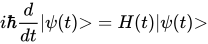
where is the observable associated to the system's energy.

Remark: State a time can be expressed as a function of state a time :



Operator is called evolution operator.\index{evolution operator} It can be shown that is unitary.\index{unitary operator}

Remark: When operator doesn't depend on time, evolution equation can be easily integrated and it yields:

with

When depends on time, solution of evolution equation
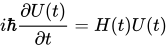
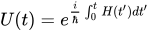
is not :
secautresrep
Other representations[edit | edit source]
Other representations can be obtained by unitary transformations.
Definition: By definition ([#References
Property: If is hermitic, then operator is unitary.

Proof: Indeed:



Property: Unitary transformations conserve the scalar product.
Proof: Indeed, if

then

Heisenberg representation[edit | edit source]
We have seen that evolution operator provides state at time as a function of state at time :

Let us write the state in Schrödinger representation and the state in Heisenberg representation. \index{Heisenberg representation} Heisenberg\footnote{Wener Heisenberg received the Physics Nobel prize for his work in quatum mechanics} representation is defined from Schrödinger representation by the following unitary transformation:


with

In other words, state in Heisenberg representation is characterized by a wave function independent on and equal to the corresponding state in Schrödinger representation for : . This allows us to adapt the postulate to Heisenberg representation:


Postulate: (Description of physical quantities) To each physical quantity and corresponding state space can be associated a function with self adjoint operators in values.


Note that if is the operator associated to a physical quantity in Schrödinger representation, then the relation between and is:



Operator depends on time, even if does not.
Postulate: (Possible results) Value of a physical quantity at time can only be one of the points of the spectrum of the associated self adjoint operator .

Spectral decomposition principle stays unchanged:
Postulate: (Spectral decomposition principle) When measuring some physical quantity on a system in a normed state , the average value of measurements is :



The relation with Schrödinger is described by the following equality:

As is unitary:

Postulate on the probability to obtain a value to measurement remains unchanged, except that operator now depends on time, and vector doesn't.
Postulate: (Evolution) Evolution equation is (in the case of an isolated system):
![{\displaystyle i\hbar {\frac {dA}{dt}}(t)=-(HA(t)-A(t)H)=-[H,A(t)]}](https://wikimedia.org/api/rest_v1/media/math/render/svg/0c8cbe5c874c994544c62a1e06bd2fd72ddf2bd7)
This equation is called Heisenberg equation for the observable.
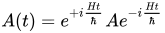
Remark: If system is conservative ( doesn't depend on time), then we have seen that

if we associate to a physical quantity at time operator identical to operator associated to this quantity in Schrödinger representation, operator is written:

Interaction representation[edit | edit source]
Assume that hamiltonian can be shared into two parts and . In particle, is often considered as a perturbation of and represents interaction between unperturbed states (eigenvectors of ). Let us note a state in Schrödinger representation and a state in interaction representation.\index{interaction representation}



with

Postulate: (Description of physical quantities) To each physical quantity in a state space is associated a function with self adjoint operators in values.


If is the operator associated to a physical quantity in Schrödinger representation, then relation between and is:


So, depends on time, even if does not. Possible results postulate remains unchanged.
Postulate:
When measuring a physical quantity for a system in state , the average value of is:

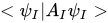
As done for Heisenberg representation, one can show that this result is equivalent to the result obtained in the Schrödinger representation. From Schrödinger equation, evolution equation for interaction representation can be obtained immediately:
Postulate: (Evolution) Evolution of a vector is given by:
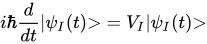
with

Interaction representation makes easy perturbative calculations. It is used in quantum electrodynamics ([#References|references]). In the rest of this book, only Schr\"odinge representation will be used.