Introduction to Mathematical Physics/Groups
Definition[edit | edit source]
In classical mechanics,\index{group} translation and rotation invariances correspond to momentum and kinetic moment conservation. Noether theorem allows to bind symmetries of Lagrangian and conservation laws. The underlying mathematical theory to the intuitive notion of symmetry is presented in this appendix.
Definition:
A group is a set of elements and a composition law that assigns to any ordered pair an element of . The composition law is



- associative
- has a unit element :
- for each of , there exists an element of such that:






Definition:
The order of a group is the number of elements of .
Representation[edit | edit source]
For a deeper study of group representation theory, the reader is invited to refer to the abundant literature (see for instance ([#References|references])).
Definition:
A representation of a group in a vectorial space on or is an endomorphism from into the group \footnote{ is the space of the linear applications from into . It is a group with respect to the function composition law.} {\it i.e }a mapping


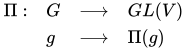
with

Definition:
Let be a representation of . A vectorial subspace of is called stable by if:



One then obtains a representation of in called subrepresentation of .
Definition:
A representation of a group is called irreducible if it admits no subrepresentation other than and itself.

Consider a symmetry group . let us consider some classical examples of vectorial spaces . Let be an element of .

Example:
exampgroupR
Let be a group of transformations of space . A representation of in is simply defined by:


To each element of , a mapping of is associated. This mapping can be defined by a matrix called representation matrix of symmetry operator .

Example:
Let us consider molecule as a solid of symmetry . The various symmetry operations that characterizes this group are:


- three reflexions ,, and .
- two rotations around the axis, of angle and noted and .
- rotation of angle is the identity and is noted .


In a any basis of , representation matrices of group symmetry operators are in general not block diagonal.
The tridimensional space can be shared into two invariant subspaces: a one-dimensional space spanned by vector of the axis, and a plane perpendicular to this vector. In chemistry books, representation on is called and representation on is called . They are both irreducible.


Remark:
For the study of the vibrations of a molecule, instead of considering the Euclidian space as state space, the space of the 's where the 's are the degree of freedom of the system has to be considered. The diagonalization of the coupling matrix problem can be tackled using symmetry considerations. Indeed, a vibratory system is invariant by symmetry , implies that its energy is invariant by :


Matrices being orthonormal, kinetic energy is also invariant.

Consider the following theorem:
Theorem:
theosymde
If operator is invariant by , that is or , the if is eigenvector of , is also eigenvector of .


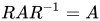


Proof:
It is sufficient to evaluate the action of on to prove this theorem.
This previous theorem allows to predict the eigenvectors and their degeneracy.
Example:
Consider the group introduced at example exampgroupR. A representation of in the space of summable squared can be defined by:



where is the matrix representation of transformation , element of . If is a basis of , then we have .



Example:
Consider the group introduced at example exampgroupR. A representation of in the space of linear operators of can be defined by:


where is the matrix representation, defined at prevoius example, of transformation , element of and is the matrix defining the operator

Relatively to the rotation group, scalar, vectorial and tensorial operators can be defined.
Definition:
A scalar operator is invariant by rotation:


An example of scalar operator is the hamiltonian operator in quantum mechanics.
Definition:
A vectorial operator is a set of three operators , , (the components of in spherical coordinates) that verify the commutation relations:

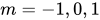
![{\displaystyle [X_{i},V_{m}]=\epsilon _{imk}V_{k}}](https://wikimedia.org/api/rest_v1/media/math/render/svg/151ccae2cb320e01485989c4e1bdd1e168402f7a)
More generally, tensorial operators can be defined:
Definition:
A tensorial operator of components is an operator whose transformation by rotation is given by:


where is the restriction of rotation to space spanned by vectors .



Another equivalent definition is presented in ([#References|references]). It can be shown that a vectorial operator is a tensorial operator with . This interest of the group theory for the physicist is that it provides irreducible representations of symmetry group encountered in Nature. Their number is limited. It can be shown for instance that there are only 32 symmetry point groups allowed in crystallography. There exists also methods to expand into irreducible representations a reducible representation (see ([#References|references])).

Tensors and symmetries[edit | edit source]
Let be a third order tensor. Consider the tensor:

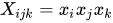
let us form the density:

is conserved by change of basis\footnote{ A unitary operator preserves the scalar product.} If by symmetry:

then
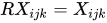
With other words ``X is transformed like ([#References|references])

Example: piezoelectricity. As seen at section secpiezo, there exists for piezoelectric materials a relation between the deformation tensor and the electric field


is called the piezoelectric tensor. Let us show how previous considerations allow to obtain following result:
Theorem:
If a crystal has a centre of symmetry, then it can not be piezoelectric.
Proof:
Let us consider the operation symmetry with respect to the centre, then

The symmetry implies
so that

which proves the theorem.