Introduction to Astrophysics/Laws and Formulae
Jump to navigation
Jump to search

Gravitation[edit | edit source]
Kepler's Laws[edit | edit source]
- The orbit of each planet is an ellipse which has the sun at one of its foci.
- Each planet moves in such a way that the line joining it to the sun sweeps out equal areas in equal times.
- The squares of the periods of revolution of the planets about the Sun are proportional to the cubes of their mean distance from it.
Newton's gravitational law[edit | edit source]

| F = | The gravitational force between two bodies. |
| G = | Universal gravity constant, 6.67 x 10⁻¹¹ N m2 kg−2 |
| m1 = | The mass of the first body. |
| m2 = | The mass of the second body. |
| r = | The distance between the centres of mass of two bodies. |
Black body radiation[edit | edit source]
Wein’s displacement law(only for black bodies)
λmax = W/T
Wein’s constant(W)= 2.90 × 10⁻³ m K
T= temperature of the black body
Stefan's Law[edit | edit source]

| E = | Rate of energy radiated from the surface of a black body per unit area. |
| σ = | Stefan's constant, 5.67 × 10⁻⁸ W m−2 K−4 |
| T = | Surface temperature of the black body. |
Stellar Magnitude[edit | edit source]
Apparent Magnitude[edit | edit source]

| m = | Apparent magnitude of star. |
| I = | Intensity of light received. |
| K = | a constant |
Pogson's Formula[edit | edit source]
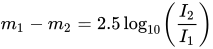
| m1 = | Apparent magnitude of first star. |
| m2 = | Apparent magnitude of second star. |
| I1 = | Intensity of light received from first star. |
| I2 = | Intensity of light received from second star. |
Absolute Magnitude[edit | edit source]
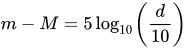
| m = | Apparent magnitude of star. |
| M = | Absolute magnitude of star. |
| d = | Distance to star in parsecs. |