IB Mathematics SL/Calculus
Introduction[edit | edit source]
Calculus is considered by many as being one the harder chapters of the IB SL Maths curriculum.
General Equations[edit | edit source]
Average Rate of Change (AROC) between x=a and x=b in f(X)
Average Rate of Change =

Instantaneous Rate of Change (IROC) at x=a is the slope of the line tangent at x=a:
Instantaneous rate of Change =
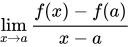
Definition of the derivative f'(x) of a function f(x) (First principles of calculus):
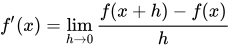
Basic Differentiation[edit | edit source]
The following formulas are shortcuts for finding the derivative
Derivative of a power function
,


Derivative of exponential function
,


Derivative of logarithmic function
,


Derivative of trigonometric functions
,
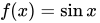
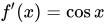
,
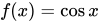

,
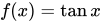

Derivatives of sum of two functions
,


Chain Rule
,


Product Rule
,


Quotient Rule
,

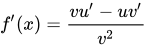
Applications to the derivative[edit | edit source]
The derivative is the slope at one point in a function. The slope is the rate of change. Ergo, with the derivative you can determine the rate of change at a given point. Given a displacement graph, where time is represented by x and position is represented by y, the derivative of any point on any function graphed will say the rate of change at that position; this is known as the velocity. The derivative of a velocity graph shows the acceleration.
Introduction to Integrals[edit | edit source]
Integrals find the area under the curve and are also known as the anti-derivative. This means that if the integral of the derivative is found, the original equation will be given but with an arbitrary constant c. A documented method of integration is the use of u-substitution.
Basic Integration[edit | edit source]
Integration (from the Latin integer, meaning whole or entire) generally means combining parts so that they work together or form a whole. In information technology, there are several common usages:
1) Integration during product development is a process in which separately produced components or subsystems are combined and problems in their interactions are addressed.
2) Integration is an activity by companies that specialize in bringing different manufacturers' products together into a smoothly working system.
3) In marketing usage, products or components said to be integrated appear to meet one or more of the following conditions:
A) They share a common purpose or set of objectives. (This is the loosest form of integration.)
B) They all observe the same standard or set of standard protocol or they share a mediating capability, such the Object Request Broker (ORB) in the Common Object Request Broker Architecture (CORBA).
C) They were all designed together at the same time with a unifying purpose and/or architecture. (They may be sold as piece-parts but they were designed with the same larger objectives and/or architecture.)
D) They share some of the same programming code.
E) They share some special knowledge of code (such as a lower-level program interface) that may or may not be publicly available. (If not publicly available, companies have been known to sue to make it available in order to make competition fair.)
Rules of Integration[edit | edit source]
Integration of logarithmic functions
Integration of Exponential functions
Integration of Trigonometric functions
Applications to integration[edit | edit source]
Area under a curve[edit | edit source]
Integration is primarily used to find the area under a curve.
Example[edit | edit source]
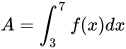
- Let
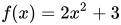
- Find the area under the curve from to .


Solution:

![{\displaystyle A=\left[{\frac {2(7)^{3}}{3}}\right]-\left[{\frac {2(3)^{3}}{3}}\right]}](https://wikimedia.org/api/rest_v1/media/math/render/svg/a502e9e5c28b1ca2ff674d2ee1643a9fbc9c0050)
![{\displaystyle A=\left[{\frac {686}{3}}\right]-\left[{\frac {54}{3}}\right]}](https://wikimedia.org/api/rest_v1/media/math/render/svg/efa6f6f7a43748ff5201fd7e6ae1e9f231bd76b1)

Total Distance traveled[edit | edit source]
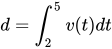
- Distance traveled on a velocity over time function can be found by evaluating the definite integral from the initial time to the final time.
Example:[edit | edit source]
- Let units per second be the velocity over time function for motion of a particle.
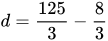
- Find the distance traveled by the particle from seconds to seconds.
- Solution:


- units
- seconds

- seconds

- units
- units

- units
![{\displaystyle d=\left[{\frac {(5)^{3}}{3}}\right]-\left[{\frac {(2)^{3}}{3}}\right]}](https://wikimedia.org/api/rest_v1/media/math/render/svg/bd6ee59e8e74876ed350d15a45ffedac71b26f9b)
- units
- units

- The particle traveled 39 units from 2 seconds to 5 seconds.
Solids of revolution[edit | edit source]

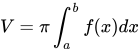
Picture a function, . Now rotate it about an axis to make a solid. Integration can be used to find the volume of this solid.

The formula used is:
- where a is the left limit and b is the right limit.
Example[edit | edit source]
Let . Find the volume of its solid of revolution from x = 2 to x = 4.

Solution


- cubic units
- cubic units
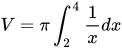
- cubic units
![{\displaystyle V=\pi \left(\left[\ln 4\right]-\left[\ln 2\right]\right)}](https://wikimedia.org/api/rest_v1/media/math/render/svg/e28eab86c2c82160d42edbe7072cfdef7705d165)
- cubic units

- cubic units

- cubic units

- cubic units (The IB instructs candidates to round calculated answers to three decimal points)
