IB Mathematics (HL)/Functions
Topic 2: Core - Functions and Equations[edit | edit source]
The Axis of Symmetry for the Graph of a Quadratic Function[edit | edit source]

The axis of symmetry is

Ex.

The axis of symmetry of the graph is

Solving Quadratics[edit | edit source]
Quadratic Equations are in the form or in the form . To be solved the equations either have to be factored or be solved using the quadratic formula :

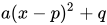
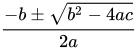
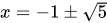
Ex. Since this cannot be factored, it is possible to use the quadratic formula

Discriminant[edit | edit source]
The discriminant of the equation is important in determining whether the equation has 2, 1, 0 roots The equation of the discriminant:

: The equation has 2 real roots
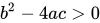
: The equation has 1 real root
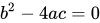
: The equation has 0 real roots
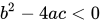
If the middle number is even in then the discriminant can be calculated as . The properties of this modified equation remain the same


Higher level Functions[edit | edit source]
These functions have a degree of two or higher and as a result have more than 2 roots. An example of a higher polynomial function is y = x3 − 2x. This is a cubic equation, with three roots. To find these roots just factor the equation. In this case, it becomes, x(x2−2). From here you can factor using the difference of squares (a2−b2). Thus the equation then becomes, y=x(x+√2)(x−√2). The roots of the equation then become 0,±√2.