High School Mathematics Extensions/Matrices/Solutions


| HSME |
| Content |
|---|
| Matrices |
| Recurrence Relations |
| Problems & Projects |
| Problem Set |
| Project |
| Soultions |
| Exercises Solutions |
| Problem Set Solutions |
| Misc. |
| Definition Sheet |
| Full Version |
Matrices[edit | edit source]
At the moment, the main focus is on authoring the main content of each chapter. Therefore this exercise solutions section may be out of date and appear disorganised.
If you have a question please leave a comment in the "discussion section" or contact the author or any of the major contributors.
Matrix Multiplication exercises[edit | edit source]






Multiplication of non-vector matrices exercises[edit | edit source]
1.
- a)
- b)


2.
- a)

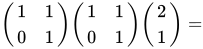
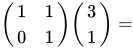

- b)

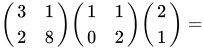

3.


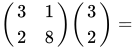
The important thing to notice here is that the 2x2 matrix remains the same when multiplied with the other matrix. The matrix with only 1s on the diagonal and 0s elsewhere is known as the identity matrix, called I, and any matrix multiplied on either side of it stays the same. That is

NB:The remaining exercises in this section are leftovers from previous exercises in the 'Multiplication of non-vector matrices' section
3.


The important thing to notice here is that the 1 to 9 matrix remains the same when multiplied with the other matrix. The matrix with only 1s on the diagonal and 0s elsewhere is known as the identity matrix, called I, and any matrix multiplied on either side of it stays the same. That is
4. a)



b)

c)


d)

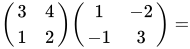

e) As an example I will first calculate A2






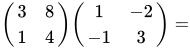

Now lets do the same simplifications I have done above with A5-



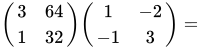
f)





Determinant and Inverses exercises[edit | edit source]
1.

The simultaneous equation will be translated into the following matrices Because we already know that
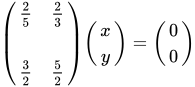
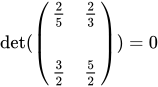
We can say that there is no unique solution to these simultaneous equations.
2. First calculate the value when you multiply the determinants



Now let's calculate C by doing the matrix multiplication first

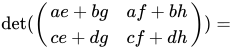



Which is equal to the value we calculated when we multiplied the determinants, thus
- det(C) = det(A)det(B)
for the 2×2 case.
3.
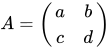




Thus det(A) = -det(A') is true.
4. a)
- as det(I) = 1.






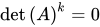
thus det(A) = det(B) b) if for some k it means that . But we can write , thus . This means that .



5. a)




b)
c)

d)
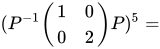


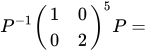
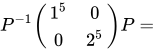
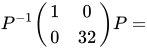
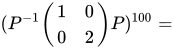
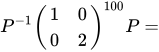
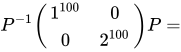
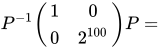
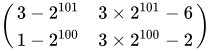
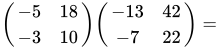
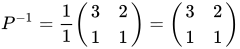
We see that P and it's inverse disappear when you raise the matrix to the fifth power. Thus you can see that we can calculate An very easily because you only have to raise the diagonal matrix to the n-th power. Raising diagonal matrices to a certain power is very easy because you only have to raise the numbers on the diagonal to that power.
e) We use the method derived in the exercise above.