HSC Extension 1 and 2 Mathematics/Integration
Jump to navigation
Jump to search

Area[edit | edit source]
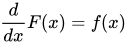
- Fundamental Theorem of Calculus: , where

Area between two curves[edit | edit source]
Volume of solids of revolution[edit | edit source]
Recall that the volume of a solid can be found by where is the cross-sectional area and is the depth of the solid, which is perpendicular to the cross-sectional area.


Similarly, the volume of solids with circular cross sections can be calculated by
- rotating a curve about an axis (generally or axis)
- integrating to sum the areas of the slices of circles


Since the area of a circle is , then the integral to evaluate the volume of a solid generated by revolving it around the -axis is


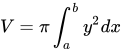
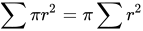
Notice this is a sum of areas of the "slices" of circular cross sections of the solid, i.e. .
Approximate integration[edit | edit source]
Trapezoidal rule[edit | edit source]
- One interval (2 function values):
- -intervals ( function values):
![{\displaystyle \int _{a}^{b}f(x)dx\approx {\frac {1}{2}}\times \overbrace {\frac {b-a}{n}} ^{=h}[f(a)+f(b)]}](https://wikimedia.org/api/rest_v1/media/math/render/svg/4fa994e33e0bf73d27307774401e7e3813d220cb)


![{\displaystyle \int _{a}^{b}f(x)dx\approx {\frac {h}{2}}\left[f(a)+2\sum f(x_{i})+f(b)\right]}](https://wikimedia.org/api/rest_v1/media/math/render/svg/5813d7e98cf1529185f1457f20325a467369ce1f)
Simpson's rule[edit | edit source]
![{\displaystyle \int _{a}^{b}f(x)dx\approx {\frac {b-a}{6}}\left[f(a)+4f\left({\frac {a+b}{2}}\right)+f(b)\right]}](https://wikimedia.org/api/rest_v1/media/math/render/svg/375b21e307f55db198ded66e158119e0a7282b2f)