General Chemistry/Diffusion and Effusion
Diffusion and Effusion[edit | edit source]
Diffusion[edit | edit source]

Diffusion is the process of a substance spreading out to evenly fill its container or environment. In a solution, a concentrated solute diffuses to spread evenly in its solvent. This is the process where the particles move from high concentration to low concentration. Diffusion explains why an open bottle of ammonia will fill an entire room with odor. The gas molecules escaping from the bottle spread out to fill their new container: the room. As a result, the whole room smells. Upon opening the windows, the gas will diffuse into the environment.
 | Diffusion occurs because the gas molecules are in continuous random motion. This motion is called Brownian Motion. The molecules will eventually reach anywhere they can. |
Diffusion is also the process of two gases mixing together, if both stored in the same container. They will spread out evenly, resulting in a solution (homogeneous mixture).
Effusion[edit | edit source]
Effusion is the process of gas molecules escaping from a small hole in the container. Effusion explains why fumes are noticeable near a leaky fuel pipe.
| Effusion is also explained by the continuous random motion of the molecules. The random motion prevents molecules from avoiding the small hole. Slowly but steadily, gas molecules will pass through the hole. |
Effusion obviously depends on the size of the hole. If small enough, effusion may not occur because, like a beach ball hitting a basketball hoop, the molecules can't fit. If the hole is large enough, the process may be considered diffusion instead of effusion.
Effusion can be seen with balloons. Effusion proves that the balloon has holes in it, even though it looks totally impassable. When left alone for several days, a balloon filled with helium will eventually deflate. If that balloon were filled with hydrogen, it would deflate in less time because the molecules are smaller and escape with ease. and you can try that
this is chemistry ks3
==
The more massive a gas is, the slower it effuses. The relationship is given by Graham's Law.
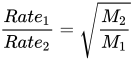
As an example, assume there are two identical containers with holes. Container A has hydrogen gas (M=2 g/mol) and Container B has helium gas (M=4 g/mol). If the hydrogen gas effuses at a rate of 4 mol/hr, the helium gas would effuse at a slower rate (being heavier). Using Graham's Law, we can see that it would effuse at a rate of about