Fractals/Multibrot sets
Julia sets for polynomial functions
-
 The elephants zone in z^2+z^3+c fractal
 -
roots

" The dynamics of polynomials is much better understood than the dynamics of general rational maps" due to the Bottcher’s theorem[1]
z(1 + z)^d[edit | edit source]
Map has d petals. "Although the parabolic point at z = 0 has only one petal, the map f also has a preparabolic critical point b = −1 of local degree d. Thus f has d petals at b. " [2]

For example "the filled Julia set of f (z) = z(1 + z) 3 has three petals at z = −1." ( Curtis T McMullen )
mz(1+z^(k*n))[edit | edit source]
"The condition

describes a set of lines through the origin. Note that the map g

leaves these lines invariant. Then

is the composition of g with the periodic rotation "[3]

z(1-z^q)[edit | edit source]
z^n+ z + c[edit | edit source]
Example
- f(z) = z^3 + z + 0.6*I[4]
- f(z) = z^6+A*z +c ; degree 6, A=(-34603008+0*i)*2^-25, c=(-262144+0i)*2^-25 from another parameter space slice showing 5 attracting period-2 cycles by marcm200[5]
- London towers" Period-3 cycle and Period-18 cycle , z^5+A*z+c c=(638976+7536640*i) * 2^-25 A=(37094161+719769*i) * 2^-25 by marcm200 [6]
z^n + c^p[edit | edit source]
Z = Zn + cp
L = (m - 1) * p
-
 Z = Z2 + C2
L = (2 - 1)* 2 = 2 -
 Z = Z2 + C3
L = (2 - 1)* 3 = 3 -
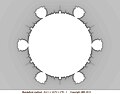 Z = Z2+C6 - 1
L = (2 - 1)* 6 = 6 -
 Z = Z3 + C2
L = (3 - 1)* 2 = 4 -
 Z = Z3 + C3
L = (3 - 1)* 3 = 6 -
 Z = Z4 + C4
L = (4 - 1)* 4 = 12


z^n + c = multibrot[edit | edit source]

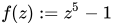
"the mulitbrot family, ... they all have a single critical point, namely the origin" Mark McClure [7]
L = m - 1
Compare with it's inverse parameter plane : Z^n + 1/c [12]
How to compute powers of z :
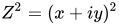


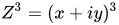


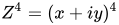


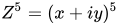


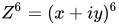


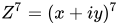


Fortan source code :
! Fortran program by P.M.J. Trevelyan
! http://philiptrevelyan.co.uk/
     PROGRAM FRACTAL
      IMPLICIT NONE
      INTEGER I,J,ITERATION,N,M
      PARAMETER(N=2000,M=50)
      REAL*8 U,V,X,Y,P,Q
      OPEN(99,FILE='Fractal_quad.dat')
 25   FORMAT(2F9.5,I3)
      DO 10, I=1,N
      DO 20, J=1,N
C Define first point z(n)=U+iV and k=X+iY
      U=0.D0
      V=0.D0
      X=I*3.2D0/(N-1.D0)-2.1D0
      Y=J*2.8D0/(N-1.D0)-1.4D0
      DO 30, ITERATION=1,M
C Calculate z(n+1) = z(n)**2 + k where z(n+1)=P+iQ
      P=U**2-V**2+X
      Q=2.D0*U*V+Y
      U=P
      V=Q
C If |z|>2 stop iterating
      If (U**2+V**2.GT.4.D0) GOTO 100
 30       CONTINUE
 100      WRITE(99,25) X,Y,ITERATION
 20     CONTINUE
 10   CONTINUE
      STOP
      END
Parameter planes for positive integer powers :
-
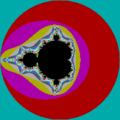 z2 + c
 -
 z3 + c
 -
 z4 + c
 -
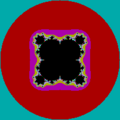 z5 + c
 -
 z6 + c


Negative powers
When d is negative the set surrounds but does not include the origin. There is interesting complex behaviour in the contours between the set and the origin, in a star-shaped area with (1 − d)-fold rotational symmetry. The sets appear to have a circular perimeter, however this is just an artifact of the fixed maximum radius allowed by the Escape Time algorithm, and is not a limit of the sets that actually extend in all directions to infinity.
-
 z−2 + c
 -
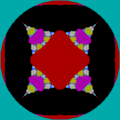 z−3 + c
 -
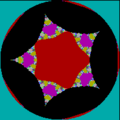 z−4 + c
 -
 z−5 + c
 -
 z−6 + c


z^2+c[edit | edit source]
See complex quadratic polynomials
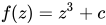
z^3 + c[edit | edit source]

It can be computed by :[13]


Examples:
- c= -0.040000000000000036 + I * -0.78[14]
-
Parameter plane and Mandelbrot set
-
 Dynamic plane and Julia set for where c = ?
 -
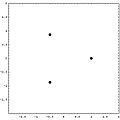 zeros of the function in the complex plane
 -
 complex color plot of the function in the complex plane
 -

-
 c = -0.4730679 -0.5625i



z^5 + c[edit | edit source]
-
Parameter plane and Mandelbrot set
-
 zeros of the function in the complex plane
 -
 complex color plot of the function in the complex plane
 -


z^10 + c[edit | edit source]
-
 Julia Set fractal using z = z^10 + c where c = -0.925 + 0.19i

zn + 1/c[edit | edit source]
It is an inverted parameter plain of z^n + c.
Number of vertices : V = (n - 1)
-
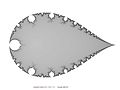 Z = Z2 + 1/C
 -
 Z = Z3 + 1/C
 -
 Z = Z4 + 1/C
 -
 Z = Z5 + 1/C
 -
 Z = Z6 + 1/C
 -
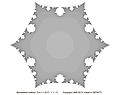 Z = Z7 + 1/C


z^n + m*z^(-d)[edit | edit source]
McMullen maps :

where : n and d are >=1
"These maps are known as `McMullen maps', since McMullen [15] first studied these maps and pointed out that when (n: d) = (2: 3) and m is small, the Julia set is a Cantor set of circles." [16]
z^n + m*z[edit | edit source]
z^2+m*z[edit | edit source]
See complex quadratic polynomial
z^3+m*z[edit | edit source]
dynamic planes[edit | edit source]
%3D_z%5E3%2B(1.0149042485835864102%2B0.10183008497976470119i)*z.png)
_%3D_z%5E3_%2Bz*(0.1008317508132964*i_%2B_1.004954206930806).png)
z^3 + z[edit | edit source]
It can be found using Maxima CAS :
(%i2) z:zx+zy*%i;
(%o2) %i*zy+zx
(%i6) realpart(z+z^3);
(%o6) -3*zx*zy^2+zx^3+zx
(%i7) imagpart(z+z^3);
(%o7) -zy^3+3*zx^2*zy+zy
Finding roots and its multiplicity :


so root z=0 has multiplicity 3.
(%i1) z1:z^3+z;
(%o1) z^3+z
(%i2) solve(z1=z);
(%o2) [z=0]
(%i3) multiplicities;
(%o3) [3]
It means that there is a flower with 2 petals around fixed point z=0.
Compare figures :
z^4 + mz[edit | edit source]
How to compute iteration :
(%i1) z:zx+zy*%i;
(%o1) %i*zy+zx
(%i2) m:mx+my*%i;
(%o2) %i*my+mx
(%i3) z1:z^4+m*z;
(%o3) (%i*zy+zx)^4+(%i*my+mx)*(%i*zy+zx)
(%i4) realpart(z1);
(%o4) zy^4-6*zx^2*zy^2-my*zy+zx^4+mx*zx
(%i5) imagpart(z1);
(%o5) -4*zx*zy^3+4*zx^3*zy+mx*zy+my*zx
See also f(z) = c(z^4-4z). It is a family 4.1 in program Mandel by Wolf Jung[21] ( see main menu / New / 4. Quartic polynomials / 4.1 )
Here c = -m/4 and Mandelbrot set is rotated by 180 degrees.
Parameter plane[edit | edit source]
_%3D_z%5E4_%2B_m*z.png)
Period 1 components[edit | edit source]
Maxima CAS code :
(%i1) f:z^4+m*z;
(%o1) z^4+m*z
(%i2) e1:f=z;
(%o2) z^4+m*z=z
(%i3) d:diff(f,z,1);
(%o3) 4*z^3+m
(%i4) e2:d=w;
(%o4) 4*z^3+m=w
(%i5) s:eliminate ([e1,e2], [z]);
(%o5) [-(m-w)*(w+3*m-4)^3]
(%i6) s:solve([s[1]], [m]);
(%o6) [m=-(w-4)/3,m=w]
It means that there are 2 period 1 components :
- one with radius = 1 and center =0 ( m=w )
- second with radius 1/3 and center=4/3 ( m=-(w-4)/3 )
Dynamic planes[edit | edit source]
z^4+z[edit | edit source]
_%3D_z%5E4_%2B_z.png)
Finding roots and its multiplicity :


so root z=0 has multiplicity 4.
(%i1) z1:z^4+z;
(%o1) z^4+z
(%i2) solve(z1=z);
(%o2) [z=0]
(%i3) multiplicities;
(%o3) [4]
It means that there are 3 petals around fixed point z=0 [22]
How to compute iteration :
(%i17) z:x+y*%i;
(%o17) %i*y+x
(%i18) realpart(z+z^4);
(%o18) y^4-6*x^2*y^2+x^4+x
(%i19) imagpart(z+z^4);
(%o19) -4*x*y^3+4*x^3*y+y
z^4-iz[edit | edit source]
%3Dz%5E4-iz.png)
First compute multiplier for internal angle=3/4 :
(%i1) m:exp(2*%pi*%i*3/4);
(%o1) -%i
Then find how to compute iteration :
(%i1) z:x+y*%i;
(%o1) %i*y+x
(%i2) z1:z^4-%i*z;
(%o2) (%i*y+x)^4-%i*(%i*y+x)
(%i3) realpart(z1);
(%o3) y^4-6*x^2*y^2+y+x^4
(%i4) imagpart(z1);
(%o4) -4*x*y^3+4*x^3*y-x
It is a parabolic Julia set with 12 petal flower [23]
Critical points :
(%i12) s:GiveListOfCriticalPoints(f(z))
(%o12) [0.31498026247372*%i-0.54556181798586,-0.62996052494744*%i,0.31498026247372*%i+0.54556181798586]
(%i13) multiplicities
(%o13) [1,1,1]
(%i14) length(s)
(%o14) 3
with arguments in turns :
[0.41666666666667,0.75,0.083333333333334] = [5/12 , 9/12, 1/12]
Attracting vectors
Multiplier of fixed point −i is a fourth root of unity ( q=4), thus we examine 4-th iteration :
(%i1) z1:z^4-%i*z;
(%o1) z^4-%i*z
(%i2) z2:z1^4-%i*z1;
(%o2) (z^4-%i*z)^4-%i*(z^4-%i*z)
(%i3) z3:z2^4-%i*z2;
(%o3) ((z^4-%i*z)^4-%i*(z^4-%i*z))^4-%i*((z^4-%i*z)^4-%i*(z^4-%i*z))
(%i4) z4:z3^4-%i*z3;
(%o4) (((z^4-%i*z)^4-%i*(z^4-%i*z))^4-%i*((z^4-%i*z)^4-%i*(z^4-%i*z)))^4-%i*(((z^4-%i*z)^4-%i*(z^4-%i*z))^4-%i*((z^4-%i*z)^4-%i*(z^4-%i*z)))
(%i6) taylor(z4,z,0,20);
(%o6)/T/ z+(-76*%i-84)*z^13+(-36*%i+720)*z^16+(1812*%i-2556)*z^19+...
Next term after z is a :
(-76*%i-84)*z^13
so here :
- k=13 and n=m*q = k-1 = 12
- a = -76*%i-84
Attracting vectors satisfy :

so here :

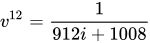
One can solve it in Maxima CAS :
(%i14) s:map('float,s);
(%o14) [1.007236559448514*%i+1.521106958434882,1.632845927320289*%i+0.81369898815363,
1.820935547602145*%i-0.11173896888541,1.521106958434882*%i-1.007236559448514,
0.81369898815363*%i-1.632845927320289,
-0.11173896888541*%i-1.820935547602145,-1.007236559448514*%i-1.521106958434882,
-1.632845927320289*%i-0.81369898815363,0.11173896888541-1.820935547602145*%i,
1.007236559448514-1.521106958434882*%i,
1.632845927320289-0.81369898815363*%i,0.11173896888541*%i+1.820935547602145]
With arguments in turns :
[0.093087406197659,0.17642073953099,0.25975407286433,0.34308740619766,0.42642073953099,0.50975407286433,
0.59308740619766,0.67642073953099,0.75975407286433,0.84308740619766,0.92642073953099,0.009754072864326]
different then arguments of critical points. Thus critical orbits form distorted 12-arms star
Find the fixed points :
(%i1) f:z^4-%i*z;
(%o1) z^4-%i*z
(%i2) s:solve(f=z);
(%o2) [z=((%i+1)^(1/3)*(sqrt(3)*%i-1))/2,z=-((%i+1)^(1/3)*(sqrt(3)*%i+1))/2,z=(%i+1)^(1/3),z=0]
(%i4) multiplicities;
(%o4) [1,1,1,1]
(%i3) s:map(rhs,s);
(%o3) [((%i+1)^(1/3)*(sqrt(3)*%i-1))/2,-((%i+1)^(1/3)*(sqrt(3)*%i+1))/2,(%i+1)^(1/3),0]
(%i5) s:map('float,s);
(%o5) [0.5*(%i+1.0)^(1/3)*(1.732050807568877*%i-1.0),-0.5*(%i+1.0)^(1/3)*(1.732050807568877*%i+1.0),(%i+1.0)^(1/3),0.0]
(%i6) s:map(rectform,s);
(%o6) [0.7937005259841*%i-0.7937005259841,-1.084215081491351*%i-0.29051455550725,0.29051455550725*%i+1.084215081491351,0.0]
Compute the multiplier of fixed points :
(%i7) d:diff(f,z,1);
(%o7) 4*z^3-%i
Check the stability of fixed points :
(%i9) for z in s do disp(abs(ev(d)));
4.999999999999998
5.0
4.999999999999999
1
(%o9) done
Point z=0 is a parabolic point.
z^4 -z[edit | edit source]
%3Dz%5E4-z.png)
_%3D_z%5E4_-_z.png)
_%3D_z%5E4_-_z_with_various_number_of_star_branches.gif)
It is a special case of polynomial from family :

Here
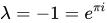
so internal angle is :


(%i2) m:exp(2*%pi*%i/2);
(%o2) -1
Because :

it is a parabolic Julia set. Point is between two period one components ( root point ).
Periodic points
Point z=0 is a root of multiplicity seven

for equation :

One can check it in Maxima CAS using numerical :
(%i1) z1:z^4-z;
(%o1) z^4-z
(%i2) z2:z1^4-z1;
(%o2) (z^4-z)^4-z^4+z
(%i3) eq2:z2-z=0;
(%o3) (z^4-z)^4-z^4=0
(%i4) allroots(eq2);
(%o4) [z=0.0,z=0.0,z=0.0,z=0.0,z=0.0,z=0.0,z=0.0,z=1.259921049894873,
z=0.7937005259841*%i-0.7937005259841,z=-0.7937005259841*%i-0.7937005259841,
z=1.084215081491351*%i-0.29051455550725,z=-1.084215081491351*%i-0.29051455550725,
z=0.29051455550725*%i+1.084215081491351,
z=1.084215081491351-0.29051455550725*%i,z=1.091123635971722*%i-0.62996052494744,
z=-1.091123635971722*%i-0.62996052494744]
(%i5) expand(eq2);
(%o5) z^16-4*z^13+6*z^10-4*z^7=0
(%i6) factor(eq2);
(%o6) z^7*(z^3-2)*(z^6-2*z^3+2)=0
and symbolic methods :
(%i1) z1:z^4-z;
(%o1) z^4-z
(%i2) solve(z1=z);
(%o2) [z=(2^(1/3)*sqrt(3)*%i-2^(1/3))/2,z=-(2^(1/3)*sqrt(3)*%i+2^(1/3))/2,z=2^(1/3),z=0]
(%i3) multiplicities;
(%o3) [1,1,1,1]
(%i4) z2:z1^4-z1;
(%o4) (z^4-z)^4-z^4+z
(%i5) solve(z2=z);
(%o5) [z=(2^(1/3)*sqrt(3)*%i-2^(1/3))/2,z=-(2^(1/3)*sqrt(3)*%i+2^(1/3))/2,z=2^(1/3),z=((%i+1)^(1/3)*(sqrt(3)*%i-1))/2,z=-((%i+1)^(1/3)*(sqrt(3)*%i+1))/2,z=(%i+1)^(1/3),z=(sqrt(3)*(1-%i)^(1/3)*%i-(1-%i)^(1/3))/2,z=-(sqrt(3)*(1-%i)^(1/3)*%i+(1-%i)^(1/3))/2,z=(1-%i)^(1/3),z=0]
(%i6) multiplicities;
(%o6) [1,1,1,1,1,1,1,1,1,7]
Number of petals = 6 [24]

Atracting vectors Denominator of internal angle is so one have to check second iteration of function :

(%i5) z1:z^4-z;
(%o5) z^4-z
(%i6) z2:z1^4-z1;
(%o6) (z^4-z)^4-z^4+z
(%i8) expand(z2);
(%o8) z^16-4*z^13+6*z^10-4*z^7+z
Next term after z is a -4z^7. Then :
- k = 7 and n=m*q = k-1 = 6
- a = -4
Attracting vectors satisfy :
so here :


One can solve it using Maxima CAS :
(%i10) s:solve(z^6=1/24);
(%o10) [z=(sqrt(3)*%i+1)/(2^(3/2)*3^(1/6)),z=(sqrt(3)*%i-1)/(2^(3/2)*3^(1/6)),z=-1/(sqrt(2)*3^(1/6)),z=-(sqrt(3)*%i+1)/(2^(3/2)*3^(1/6)),z=-(sqrt(3)*%i-1)/(2^(3/2)*3^(1/6)),z=1/(sqrt(2)*3^(1/6))]
(%i11) s:map(rhs,s);
(%o11) [(sqrt(3)*%i+1)/(2^(3/2)*3^(1/6)),(sqrt(3)*%i-1)/(2^(3/2)*3^(1/6)),-1/(sqrt(2)*3^(1/6)),-(sqrt(3)*%i+1)/(2^(3/2)*3^(1/6)),-(sqrt(3)*%i-1)/(2^(3/2)*3^(1/6)),1/(sqrt(2)*3^(1/6))]
(%i12) s:map('float,s);
(%o12) [0.29439796075012*(1.732050807568877*%i+1.0),0.29439796075012*(1.732050807568877*%i-1.0),-0.58879592150024,-0.29439796075012*(1.732050807568877*%i+1.0),-0.29439796075012*(1.732050807568877*%i-1.0),0.58879592150024]
(%i13) s:map(rectform,s);
(%o13) [0.50991222566388*%i+0.29439796075012,0.50991222566388*%i-0.29439796075012,-0.58879592150024,-0.50991222566388*%i-0.29439796075012,0.29439796075012-0.50991222566388*%i,0.58879592150024]
(%i14) s:map(carg_t,s);
(%o14) [0.5235987755983/%pi,1.047197551196598/%pi,1/2,1-1.047197551196598/%pi,1-0.5235987755983/%pi,0]
(%i15) s:map('float,s);
(%o15) [0.16666666666667,0.33333333333333,0.5,0.66666666666667,0.83333333333333,0.0]
So critical points lie on attracting vectors. Thus critical orbits tend straight to the origin under the iteration[25]
How to compute :

(%i2) z:x+y*%i;
(%o2) %i*y+x
(%i3) realpart(z^4-z);
(%o3) y^4-6*x^2*y^2+x^4-x
(%i4) imagpart(z^4-z);
(%o4) -4*x*y^3+4*x^3*y-y
Critical points :
s:GiveListOfCriticalPoints(f(z))
(%o8) [0.54556181798586*%i-0.31498026247372,-0.54556181798586*%i-0.31498026247372,0.62996052494744]
These points has arguments in turns : 1/3, 2/3, 0
z^5 + m*z[edit | edit source]
dynamic planes[edit | edit source]
z^5 + z[edit | edit source]

Finding roots and its multiplicity :


so root z=0 has multiplicity 5. It means that there is a flower with 4 petals [26]
around fixed point z=0.
It How to compute :
(%i23)  z:x+y*%i;
(%o23) %i*y+x
(%i24) realpart(z+z^5);
(%o24) 5*x*y^4-10*x^3*y^2+x^5+x
(%i25) imagpart(z+z^5);
(%o25) y^5-10*x^2*y^3+5*x^4*y+y
In c programs one must use temporary variable so it can be :
tempx = 5*x*y*y*y*y-10*x*x*x*y*y + x*x*x*x*x + x ; // temporary variable
y = y*y*y*y*y -10*x*x*y*y*y + 5*x*x*x*x*y + y ;
x=tempx;
It can be optimized
"...an escape time algorithm would take forever to generate that type of image, since the dynamics are so slow there. If you want resolution of 1/100, it would take roughly 2*10^8 iterates to move the point z0=0.01 to z=2 by iterating f(z)=z+z^5." ( Mark McClure [27]
"This picture shows the Julia Set of f(z) = z + z^5 which has an indifferent fixed point at z = 0. ( f(0) = 0 and f ' (0) = 1 .)
The 4 lines :
Re z = 0 and Im z = 0 and Re z = Im z and Re z = -Im z
are invariant under iteration of f.
On Im z = 0: f(x) = x + x^5
On Re z = 0: f(ix) = ix + (ix)^5 = ix + i^5 x^5 = i(x+x^5)
On Re z = Im z , f(z) = r e^(i pi/4) + r^5 e^(i 5 pi/4) = e^ (i pi/4)(r - r^5)
On Re z = -Im z, f(z) = = r e^(i 3pi/4) + r^5 e^(i 15 pi/4) = e^ (i 3pi/4)(r - r^5)
Using one dimensional analysis it is easily shown that f(x) = x + x^5 has a repelling fixed point at x = 0 and f(x) = x - x^5 has an attracting fixed point at x = 0. Thus along the four invariant lines 0 is attracting on the first two and repelling on the second two. The points repelled from 0 are shown in shades of blue, while those attracted to 0 are shown in shades of brown. 0 has four attracting petals, which are in shades of brown. (A simply connected region C is a petal for an indifferent fixed point p if p is contained in the boundary of C and for each z in C,
F^n(z) -> p (see Devaney - 1987)" [28]
6 degree[edit | edit source]
general case[edit | edit source]
z^6+A*z+c[edit | edit source]
c=(-6145144-20171676*i) * 2^-25 = (-6145144 - 20171676 i)/2^25 = -0.1831395626068115234375 - 0.60116279125213623046875 i
Critical points:
-
![Julia set for fc(z)= z^6+A*z+c where c = 4.6875e-1 - 5.703125e-1 *I and A = 6.96854889392852783203125e-2 - 1.07958018779754638671875e-1*I.png]]](//upload.wikimedia.org/wikipedia/commons/thumb/a/a9/Julia_set_for_fc%28z%29%3D_z%5E6%2BA%2Az%2Bc_where_c_%3D_4.6875e-1_-_5.703125e-1_%2AI_and_A_%3D_6.96854889392852783203125e-2_-_1.07958018779754638671875e-1%2AI.png/120px-Julia_set_for_fc%28z%29%3D_z%5E6%2BA%2Az%2Bc_where_c_%3D_4.6875e-1_-_5.703125e-1_%2AI_and_A_%3D_6.96854889392852783203125e-2_-_1.07958018779754638671875e-1%2AI.png) Julia set for fc(z)= z^6+A*z+c where c = 4.6875e-1 - 5.703125e-1 *I and A = 6.96854889392852783203125e-2 - 1.07958018779754638671875e-1*I.png]]
Julia set for fc(z)= z^6+A*z+c where c = 4.6875e-1 - 5.703125e-1 *I and A = 6.96854889392852783203125e-2 - 1.07958018779754638671875e-1*I.png]] -

![Julia set for fc(z)= z^6+A*z+c where c = 4.6875e-1 - 5.703125e-1 *I and A = 6.96854889392852783203125e-2 - 1.07958018779754638671875e-1*I.png]]](/wiki/File:Julia_set_for_fc(z)%3D_z%5E6%2BA*z%2Bc_where_c_%3D_4.6875e-1_-_5.703125e-1_*I_and_A_%3D_6.96854889392852783203125e-2_-_1.07958018779754638671875e-1*I.png)
*z%5E2%2B(-0.75%2B0.20988371968269348145i).png)
List:
z = -0.454407 + 0.0918858 I
z = -0.227808 - 0.403772 I
z = -0.0530308 + 0.460561 I
z = 0.313614 - 0.341431 I
z = 0.421632 + 0.192756 I
Higher precision
+0.4216319827875524	+0.1927564710317439*%i
-0.4544068504035357	+0.09188580053693407*%i
-0.2278080284907348 	-0.4037723222177803*%i
+0.3136137458861571	-0.3414308193839966*%i
-0.05303084977943909	+0.4605608700330989*%i
z^6+m*z[edit | edit source]
dynamical plane
z6+z on plane [-1.2;1.2]x[-1.2;1.2]. It has 5 petals [29]
z^14 + m*z[edit | edit source]
dynamic plane[edit | edit source]
z^14 - z[edit | edit source]
%3D_z%5E14-z.png)
_%3D_z%5E14_-_z.png)
How to compute iteration :
/* Maxima CAS session */
(%i1) z:x+y*%i;
(%o1) %i*y+x
(%i2) z1:z^14-z;
(%o2) (%i*y+x)^14-%i*y-x
(%i3) realpart(z1);
(%o3) -y^14+91*x^2*y^12-1001*x^4*y^10+3003*x^6*y^8-3003*x^8*y^6+1001*x^10*y^4-91*x^12*y^2+x^14-x
(%i4) imagpart(z1);
(%o4) 14*x*y^13-364*x^3*y^11+2002*x^5*y^9-3432*x^7*y^7+2002*x^9*y^5-364*x^11*y^3+14*x^13*y-y
f(z)=z^14-z, on [-1,2;1,2]x[-1,2;1,2] has 26 petals. Compare with image by Michael Becker.[30]
How to find fixed points :
(%i1) z1:z^14-z;
(%o1) z^14-z
(%i2) solve(z1=z);
(%o2) [z=2^(1/13)*%e^((2*%i*%pi)/13),z=2^(1/13)*%e^((4*%i*%pi)/13),
     z=2^(1/13)*%e^((6*%i*%pi)/13),z=2^(1/13)*%e^((8*%i*%pi)/13),
     z=2^(1/13)*%e^((10*%i*%pi)/13),z=2^(1/13)*%e^((12*%i*%pi)/13),
     z=2^(1/13)*%e^(-(12*%i*%pi)/13),z=2^(1/13)*%e^(-(10*%i*%pi)/13),
     z=2^(1/13)*%e^(-(8*%i*%pi)/13),z=2^(1/13)*%e^(-(6*%i*%pi)/13),
     z=2^(1/13)*%e^(-(4*%i*%pi)/13),z=2^(1/13)*%e^(-(2*%i*%pi)/13),
     z=2^(1/13),z=0]
(%i3) multiplicities;
(%o3) [1,1,1,1,1,1,1,1,1,1,1,1,1,1]
(%i4) z2:z1^14-z1;
(%o4) (z^14-z)^14-z^14+z
(%i5) solve(z2=z);
(%o5) [z=2^(1/13)*%e^((2*%i*%pi)/13),z=2^(1/13)*%e^((4*%i*%pi)/13),
   z=2^(1/13)*%e^((6*%i*%pi)/13),z=2^(1/13)*%e^((8*%i*%pi)/13),
   z=2^(1/13)*%e^((10*%i*%pi)/13),z=2^(1/13)*%e^((12*%i*%pi)/13),
   z=2^(1/13)*%e^(-(12*%i*%pi)/13),z=2^(1/13)*%e^(-(10*%i*%pi)/13),
   z=2^(1/13)*%e^(-(8*%i*%pi)/13),z=2^(1/13)*%e^(-(6*%i*%pi)/13),
   z=2^(1/13)*%e^(-(4*%i*%pi)/13),z=2^(1/13)*%e^(-(2*%i*%pi)/13),
   z=2^(1/13),z=0,0=z^78-7*z^65+21*z^52-35*z^39+35*z^26-21*z^13+7,
   0=z^78-5*z^65+11*z^52-13*z^39+9*z^26-3*z^13+1]
(%i6) multiplicities;
(%o6) [1,1,1,1,1,1,1,1,1,1,1,1,1,27,1,1]
z^15 +m*z[edit | edit source]
dynamic plane[edit | edit source]
z^15-z[edit | edit source]
%3D_z%5E15-z.png)
_%3D_z%5E15_-_z.png)
How to compute iterations :
/* Maxima CAS session */
(%i1) z:x+y*%i;
(%o1) %i*y+x
(%i2) z1:z^15-z;
(%o2) (%i*y+x)^15-%i*y-x
(%i3) realpart(z1);
(%o3) -15*x*y^14+455*x^3*y^12-3003*x^5*y^10+6435*x^7*y^8-5005*x^9*y^6+1365*x^11*y^4-105*x^13*y^2+x^15-x
(%i4) imagpart(z1);
(%o4) -y^15+105*x^2*y^13-1365*x^4*y^11+5005*x^6*y^9-6435*x^8*y^7+3003*x^10*y^5-455*x^12*y^3+15*x^14*y-y
Critical points :
(%i1) m:-1;
f:z^15+ m*z;
d:diff(f,z,1);
s:solve(d=0,z)$
s:map(rhs,s)$
s:map(rectform,s)$
s:map('float,s);
multiplicities;
(%o1) -1
(%o2) z^15-z
(%o3) 15*z^14-1
(%o7)
[0.35757475986465*%i+0.74251163973317,
0.64432745317147*%i+0.51383399763062,
0.80346319222004*%i+0.1833852305369,
0.80346319222004*%i-0.1833852305369,
0.64432745317147*%i-0.51383399763062,
0.35757475986465*%i-0.74251163973317,
-0.8241257452789,
-0.35757475986465*%i-0.74251163973317,
-0.64432745317147*%i-0.51383399763062,
-0.80346319222004*%i-0.1833852305369,
0.1833852305369-0.80346319222004*%i,
0.51383399763062-0.64432745317147*%i,
0.74251163973317-0.35757475986465*%i,
0.8241257452789]
(%o8) [1,1,1,1,1,1,1,1,1,1,1,1,1,1]
It means that here are 14 critical points and 14 critical orbits.
Fixed points :
kill(all);
remvalue(all);

/*------------- functions definitions ---------*/

/* function */
f(z):=z^15 -z;

/* find fixed points  returns a list */
GiveFixedPoints():= block
(
  [s],
  s:solve(f(z)=z),
  /* remove "z="  from list s */
  s:map('rhs,s),
  s:map('rectform,s),
  s:map('float,s),
  return(s)
)$

compile(all);

ff:GiveFixedPoints();
multiplicities;
length(s);

for i:1 thru length(ff) step 1 do
  (z:ff[i],
   disp("z= ",z, " abs(d(z))= ",abs(15*z^14-1)));
Result is :
(%i12) ff:GiveFixedPoints()
(%o12) [0.45590621928146*%i+0.94669901916834,0.82151462051137*%i+0.65513604843564,1.024411975933374*%i+0.23381534859391,
1.024411975933374*%i-0.23381534859391,0.82151462051137*%i-0.65513604843564,0.45590621928146*%i-0.94669901916834,-1.050756638653219,-
0.45590621928146*%i-0.94669901916834,-0.82151462051137*%i-0.65513604843564,-1.024411975933374*%i-0.23381534859391,0.23381534859391-
1.024411975933374*%i,0.65513604843564-0.82151462051137*%i,0.94669901916834-0.45590621928146*%i,1.050756638653219,0.0]
(%i13) multiplicities
(%o13) [1,1,1,1,1,1,1,1,1,1,1,1,1,1,1]
(%i14) length(s)
(%o14) 14
(%i15) for i thru length(ff) do (z:ff[i],disp("z= ",z," abs(d(z))= ",abs(15*z^14-1)))
z= 0.45590621928146*%i+0.94669901916834 ; abs(d(z))= 28.99999999999996
z= 0.82151462051137*%i+0.65513604843564 ; abs(d(z))= 28.99999999999998
z= 1.024411975933374*%i+0.23381534859391 ; abs(d(z))= 28.99999999999999
z= 1.024411975933374*%i-0.23381534859391 ; abs(d(z))=  28.99999999999997
z= 0.82151462051137*%i-0.65513604843564 ; abs(d(z))= 29.00000000000001
z= 0.45590621928146*%i-0.94669901916834 ; abs(d(z))=  28.99999999999995
z= -1.050756638653219 ;                   abs(d(z))= 29.00000000000003
z=  -0.45590621928146*%i-0.94669901916834; abs(d(z))= 28.99999999999995
z= -0.82151462051137*%i-0.65513604843564; abs(d(z))=  29.00000000000001
z= -1.024411975933374*%i-0.23381534859391 ; abs(d(z))= 28.99999999999997
z= 0.23381534859391-1.024411975933374*%i abs(d(z))= 28.99999999999999
z= 0.65513604843564-0.82151462051137*%i ; abs(d(z))= 28.99999999999998
z= 0.94669901916834-0.45590621928146*%i ; abs(d(z))=  28.99999999999996
z= 1.050756638653219 ;                    abs(d(z))= 29.00000000000003
z= 0.0 ;                                   abs(d(z))= 1.0
So only z=0 is parabolic fixed points, the rest of them are repelling
Other[edit | edit source]
z^5+m*z^4+z[edit | edit source]
dynamica plane[edit | edit source]
m = 08+0.8i[edit | edit source]
_%3Dz%5E5_%2B(0.8%2B0.8)*z%5E4_%2B_z.png)
Description[33]
- map :
- coefficients in ascending order ( from ao to an): 0,1,0,0, 0.8+0.8i, 1
- ListOfCriticalPoints [(- 0.7558074500261052 %i) - 0.7558074500261052, 0.2793534499540583 %i - 0.5310341598343944, 0.2793534499540583 - 0.5310341598343943 %i, 0.3674881599064412 %i + 0.3674881599064413]
- fixed points : [(- 0.8 %i) - 0.8, 0.0] with stability : [0.6384000000000008, 1.0]

m=0.8+0.4i[edit | edit source]
-
 Parabolic Julia set for f(z)=z^5+m*z^4+z where m = 0.8+0.4*i
 -
 critical orbits
%3Dz%5E5%2Bm*z%5E4%2Bz_where_m_%3D_0.8%2B0.4*i.png)
_%3Dz%5E5_%2B(0.8%2B0.4)*z%5E4_%2B_z.svg)
Inside dynamics under generalized power setting[edit | edit source]
The orbit dynamics of the set can become more complex when the power is something other than 2.0. The iterated function can become multivalued and the structure of the set is then affected by the 'arbitrary' choice of which value is chosen.
See also[edit | edit source]
- commons:Category:Complex polynomial maps
- Derivative of iterated fuction
- Mark McClure : visualization of polynomial_julia_sets, coefficients a0, a1, a2, a3, .... for f(z) = an*z^n+ ... + a2*z^2 + a1*z + a0, example : 1.42+0.37i,-1.5,0,1
- Exploring the 4-Dimensional Mandelbrot Set
- Elliptic curve julia sets by Clifford A. Reiter
- FF: Julia sets: True shape and escape time
References[edit | edit source]
- ↑ ON THE NOTIONS OF MATING by CARSTEN LUNDE PETERSEN AND DANIEL MEYER
- ↑ dimension and conformal dynamics II: Geometrically finite rational maps by Curtis T McMullen
- ↑ COMPLEX ANALYTIC DYNAMICS ON THE RIEMANN SPHERE BY PAUL BLANCHARD
- ↑ Inverse Iteration Algorithms for Julia Sets by Mark McClure
- ↑ fractalforums.org: julia-sets-true-shape-and-escape-time
- ↑ fractalforums.org: julia-sets-true-shape-and-escape-time
- ↑ Mark McClure - comment
- ↑ wikipedia : Multibrot_set
- ↑ High-Order Mandelbrot and Julia Sets Written by Christopher Thomas. Images and Perl program
- ↑ Stephen Haas : The Hausdorff Dimension of the Julia Set of Polynomials of the Form z^d+c
- ↑ video on youtube by rrwick
- ↑ Desenvolupament_de_fractals_mitjan
- ↑ De la génération des fractales Théorie et Applications John Bonobo
- ↑ wolfram : julia-set-explorations
- ↑ C. McMullen, Automorphisms of rational maps. In `Holomorphic Functions and Moduli I', 31-60, Springer-Verlag, 1988.
- ↑ Hyperbolic components of McMullen maps Weiyuan Qiu, Pascale Roesch, Xiaoguang Wang, Yongcheng Yin
- ↑ "Visualizing the complex dynamics of families of polynomials with symmetric critical points" by Ning Chena, Jing Suna, Yan-ling Suna, Ming Tangb. Chaos, Solitons & Fractals. Volume 42, Issue 3, 15 November 2009, Pages 1611–1622
- ↑ A topological characterisation of holomorphic parabolic germs in the plane Fr ́ed ́eric Le Roux
- ↑ One approach to the digital visualization of hedgehogs in holomorphic dynamics Alessandro Rosa, fig 5.13 page 26
- ↑ A parabolic Pommerenke-Levin-Yoccoz inequality by Xavier Buff and Adam L. Epstein, fig 1 page 4
- ↑ Mandel: software for real and complex dynamics by Wolf Jung
- ↑ Complex dynamics, Lennart Carleson, Theodore W. Gamelin, Springer, 1993, ISBN 978-0-387-97942-7. Page 40, Figure 2.
- ↑ F. Bracci, Local holomorphic dynamics of diffeomorphisms in dimension one. Contemporary Mathematics 525, (2010), 1-42. Notes of the PhD course given in A.A 2007/08.
- ↑ Complex dynamics, Lennart Carleson, Theodore W. Gamelin, Springer, 1993, ISBN 978-0-387-97942-7. Page 41
- ↑ Mark McClure in stackexchange questions : what-is-the-shape-of-parabolic-critical-orbit
- ↑ One approach to the digital visualization of hedgehogs in holomorphic dynamics Alessandro Rosa
- ↑ stackexchange questions : what-is-the-shape-of-parabolic-critical-orbit
- ↑ Fractals by Anne Burns, Department of Mathematics, C.W. Post Campus, Long Island University
- ↑ Some Julia sets 2 by Michael Becker
- ↑ Fixpunkte und Periodische Punkte by Michael Becker
- ↑ multibrot by Claude
- ↑ z^2 +cz^5
- ↑ math.stackexchange question: whats-the-difference-between-a-total-basin-of-attraction-and-an-immediate-basin