FHSST Physics/Newtonian Gravitation/Comparative Problems
Comparative problems[edit | edit source]
Here always work with multiplicative factors to find something new in terms of something old.
Worked Example 57 Comparative Problem 1[edit | edit source]
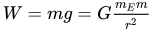
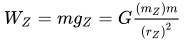
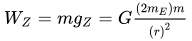
Question: On Earth a man weighs 700 N. Now if the same man was instantaneously beamed to the planet Zirgon, which has the same size as the Earth but twice the mass, what would he weigh?
Answer:
Step 1 :
We start with the situation on earth:
|
(9.13) |
Step 2 :
Now we consider the provje
|
(9.14) |
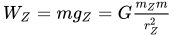
but we know that and we know that rZ = r so we could write the equation again and substitute these relationships in:

Step 3 :
|
(9.15) |
Step 4 :
|
(9.16) |
|
(9.17) |

Step 5 :
|
(9.18) |
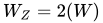
so on Zirgon he weighs 1400 N.
Principles[edit | edit source]
- Write out first case
- Write out all relationships between variable from first and second case
- Write out second case
- Substitute all first case variables into second case
- Write second case in terms of first case

|
The acceleration due to gravity at the Earth's surface is, by
convention, equal to 9.80665 ms−2. (The actual value varies slightly over the surface of the Earth). This quantity is known as g. The following is a list of the gravitational accelerations (in multiples of g) at the surfaces of each of the planets in our solar system:
Note: The "surface" is taken to mean the cloud tops of the gas giants (Jupiter, Saturn, Uranus and Neptune) in the above table. |
Worked Example 58 Comparative Problem 2[edit | edit source]
Question: On Earth a man weighs 70 kg. On the planet Beeble how much will he weigh if Beeble has mass half of that of the Earth and a radius one quarter that of the earth.
Answer:
Step 1 :
We start with the situation on earth:
|
(9.19) |
Step 2 :
Now we consider the provje
|
(9.20) |

but we know that and we know that so we could write the equation again and substitute these relationships in:


Step 3 :
|
(9.21) |
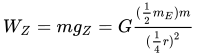
Step 4 :
|
(9.22) |
|
(9.23) |
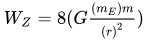
Step 5 :
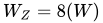
But although the man exerts 8 times as much force due to gravity, he still weighs 70 kg on Beeble!
|
|
Did you know that the largest telescope in the Southern Hemisphere is the South African Large Telescope (SALT) which came online in 2004 outside Sutherland in the Karoo. |