Engineering Analysis/Minimization
Jump to navigation
Jump to search

 | Before reading this chapter, the student should know what minimization is, and how to minimize a function. Students should also know partial differentiation, and how to solve systems of equations. |
Khun-Tucker Theorem[edit | edit source]
The Khun-Tucker Theorem is a method for minimizing a function f(x) under the constraint g(x). We can define the theorem as follows:

Where Λ is the lagrangian vector, and < , > denotes the scalar product operation. We will discuss scalar products more later. If we differentiate this equation with respect to x first, and then with respect to Λ, we get the following two equations:
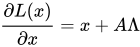
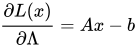
We have the final result:
![{\displaystyle x=A^{T}[AA^{T}]^{-1}b}](https://wikimedia.org/api/rest_v1/media/math/render/svg/b4c0fd0eb5a1d3264dda9d4d48a3cbd3352148d2)