Engineering Analysis/Linear Independence and Basis
 | Before reading this chapter, students should know how to take the transpose of a matrix, and the determinant of a matrix. Students should also know what the inverse of a matrix is, and how to calculate it. These topics are covered in Linear Algebra. |
Linear Independence[edit | edit source]
A set of vectors are said to be linearly dependent on one another if any vector v from the set can be constructed from a linear combination of the other vectors in the set. Given the following linear equation:


The set of vectors V is linearly independent only if all the a coefficients are zero. If we combine the v vectors together into a single row vector:
![{\displaystyle {\hat {V}}=[v_{1}v_{2}\cdots v_{n}]}](https://wikimedia.org/api/rest_v1/media/math/render/svg/dd34b1e316acad95c054d2ab6ca7961efe0689ff)
And we combine all the a coefficients into a single column vector:
![{\displaystyle {\hat {a}}=[a_{1}a_{2}\cdots a_{n}]^{T}}](https://wikimedia.org/api/rest_v1/media/math/render/svg/917010b08f21b36059c1d6ecedb1dd8b950080c3)
We have the following linear equation:

We can show that this equation can only be satisifed for , the matrix must be invertable:


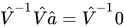
Remember that for the matrix to be invertable, the determinate must be non-zero.
Non-Square Matrix V[edit | edit source]
If the matrix is not square, then the determinate can not be taken, and therefore the matrix is not invertable. To solve this problem, we can premultiply by the transpose matrix:

And then the square matrix must be invertable:


Rank[edit | edit source]
The rank of a matrix is the largest number of linearly independent rows or columns in the matrix.
To determine the Rank, typically the matrix is reduced to row-echelon form. From the reduced form, the number of non-zero rows, or the number of non-zero columns (whichever is smaller) is the rank of the matrix.
If we multiply two matrices A and B, and the result is C:

Then the rank of C is the minimum value between the ranks A and B:
![{\displaystyle \operatorname {Rank} (C)=\operatorname {min} [\operatorname {Rank} (A),\operatorname {Rank} (B)]}](https://wikimedia.org/api/rest_v1/media/math/render/svg/5947d2b53c377bc9733210e4f27a7c1d433dca67)
Span[edit | edit source]
A Span of a set of vectors V is the set of all vectors that can be created by a linear combination of the vectors.
Basis[edit | edit source]
A basis is a set of linearly-independent vectors that span the entire vector space.
Basis Expansion[edit | edit source]
If we have a vector , and V has basis vectors , by definition, we can write y in terms of a linear combination of the basis vectors:



or

If is invertable, the answer is apparent, but if is not invertable, then we can perform the following technique:
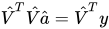
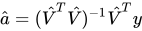
And we call the quantity the left-pseudoinverse of .

Change of Basis[edit | edit source]
Frequently, it is useful to change the basis vectors to a different set of vectors that span the set, but have different properties. If we have a space V, with basis vectors and a vector in V called x, we can use the new basis vectors to represent x:

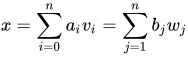
or,

If V is invertable, then the solution to this problem is simple.
Grahm-Schmidt Orthogonalization[edit | edit source]
If we have a set of basis vectors that are not orthogonal, we can use a process known as orthogonalization to produce a new set of basis vectors for the same space that are orthogonal:
- Given:
- Find the new basis
- Such that
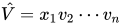


We can define the vectors as follows:

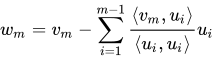
Notice that the vectors produced by this technique are orthogonal to each other, but they are not necessarily orthonormal. To make the w vectors orthonormal, you must divide each one by its norm:

Reciprocal Basis[edit | edit source]
A Reciprocal basis is a special type of basis that is related to the original basis. The reciprocal basis can be defined as:
![{\displaystyle {\hat {W}}=[{\hat {V}}^{T}]^{-1}}](https://wikimedia.org/api/rest_v1/media/math/render/svg/67ad2fd0e0ab3a878c4df68ff8e1d7817f8b0656)