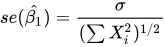
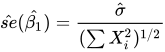
A t-test involves the computation of a t-statistic, which is then compared to the critical values of a t-distribution for a given significance level.
A t-test is essentially the Z-statistic of a variable divided by the square root of an independent chi-square distribution divided by its own degrees-of-freedom. The resulting value is the t-statistic with the same degrees-of-freedom as the chi-squared distribution.
Therefore, the t-statistic of would be:
Numerator:
Denominator:
We know (as an implication of the last assumption of the CLRM) that

![{\displaystyle t={\frac {Z}{\sqrt {V/m}}}\sim t[m]}](https://wikimedia.org/api/rest_v1/media/math/render/svg/526ae4f0390ed2bf9f6c7a870650562dc0e20b26)


![{\displaystyle {\frac {(N-2){\hat {\sigma ^{2}}}}{\sigma ^{2}}}\sim \chi ^{2}[N-2]}](https://wikimedia.org/api/rest_v1/media/math/render/svg/df198978c9e4770d17468d7c6bf63720c4a7bdc2)
![{\displaystyle {\frac {\hat {\sigma ^{2}}}{\sigma ^{2}}}\sim {\frac {\chi ^{2}[N-2]}{[N-2]}}\Rightarrow {\sqrt {\frac {\chi ^{2}[N-2}{[N-2]}}}\sim {\frac {\hat {\sigma }}{\sigma }}}](https://wikimedia.org/api/rest_v1/media/math/render/svg/6d1c867a46d6e3a01344f827485bd90e14ed3f0b)
![{\displaystyle t({\hat {\beta _{1}}})={\frac {Z({\hat {\beta _{1}}})}{{\hat {\sigma }}/\sigma }}={\frac {({\hat {\beta _{1}-\beta _{1}}})(\sum X_{i}^{2})^{1/2}/\sigma }{\sigma ^{2}/\sigma }}={\frac {{\hat {\beta _{1}}}-\beta _{1}}{{\hat {\sigma }}/(\sum X_{i}^{2})^{1/2}}}={\frac {{\hat {\beta _{1}}}-\beta _{1}}{{\hat {se}}({\hat {\beta _{1}}})}}\sim t[N-2]}](https://wikimedia.org/api/rest_v1/media/math/render/svg/c893f1a410214abee7d5449d595e0fe109dfc3a0)