Cultural Anthropology/Production, Inequality and Development
Adaptive Strategies[edit | edit source]
People all over the world rely on modes of production, distribution, and consumption in order to provide food and other commodities necessary in life. These modes differ based on culture in the ways that humans relate to and make use of the natural environment, how humans relate to each other, and how the institutions of society and federal states cause change. Production is the various forms of transformation of nature's raw materials into a form more suitable for human use. Distribution is the transport of produced goods whether that be by land, air, or sea to the consumer. Consumption is the buying or use of a good, food, material or service that has been previously produced and distributed. This section discusses specific aspects of the different strategies for these concepts that have been used over time and that continue to be used in different cultures worldwide.
Modes of Production[edit | edit source]
Modes of production are the various ways in which societies gather or produce the items they need in order to survive and prosper. The five most common modes of production are foraging, horticulture, pastoralism, agriculture, and industrialism. Although historically about 90% of human production was based on foraging, in the present day the number is less than 1%, due to globalization, industrialization, and population increase, and more intensive forms such as industrialized agriculture have taken its place. In some modes of production the environment is also put at risk to produce at such a high level.This section reviews the way these modes have been used in the past as well as the ways cultures around the world continue to use them to this day.
Foraging[edit | edit source]

There are several correlates, or regular features, of foraging societies. They live in small groups called "bands," comprised of 30 to 50 people that are mobile according to seasonal rounds, moving from place to place to utilize different resources and assure their resources are not completely consumed. However, the largest foraging bands can reach around 120 people (Dunbar's Number). When hunting and gathering, groups make sure that they don't become too attached to a piece of land because that could prevent them from moving on after the season has passed. When they have gathered their resources they bring all of their goods together as a group to guarantee that the entire group is fed properly; if they held resources individually, not one person would get the nutrition needed to survive. Even though they tend to have all the resources they need, the ability to store goods is limited so they only take what they can eat; nothing is wasted. In most foraging societies, the large majority of their caloric intake comes from foraged plants, nuts, and seeds, rather than hunted animals. There are however exceptions, such as the Inuit people in Alaska and Northern Canada, who live in an extreme environment with little available plant life. A common factor in many of these societies is that they utilize egalitarian sharing; everyone in the community has a right to eat as long as contributions are being made by everyone that can perform work. When an individual fails to share or contribute in a meaningful way, the community uses shame and ostracization to promote the desired behaviors, and eventually, if the individual continues to act in a selfish manner they will be ejected from the society completely.

Within these groups, the political and social organization is very simple. Some bands have no political leader but instead look to elders who hold more prestige than others due to their age and experience. Such individuals do not have power over other members of the band. In other cases, a band may have a headman who leads by example rather than by force. There tends to be very little conflict between people because of the small group size and due to the fact that bands are kin-based units.

Pacific Northwest Native American history has shattered stereotypes that previously insisted on the necessity of farming and agricultural practices in order to develop complex, structured societies rich in culture. With over 39 different languages and 11 distinct language families, Northwestern coastal Natives were “the most socially complex hunting and gathering societies known to earth.” Prior to the arrival of European explorers 250 years ago and the practice of written documentation, they had no form of written language; history was recorded orally, and Native families were not dependent on a monetary system. Natives of the Pacific Northwest had a unique hierarchical system dependent on slavery and with hereditary chiefs. Their potlatch ceremonies served as a redistribution of wealth and unquestionably displayed their affluence and abundance of natural resources, art, and culture.[2] Economies were based on generating heaps of processed and stored foods. Pacific Northwest Coast peoples' diets generally consisted of berries, bulbs, shoots, waterfowl, land mammals, shellfish, chitons, sea urchins, crabs, seaweeds and, most importantly, salmon. They hunted and gathered only what was available, with great respect to life and the interconnection of nature, believing that all living things possessed a spirit, presented themselves as food willingly and had to be honored accordingly. It was believed that “Bears, whales, thunderbirds, wolves, or salmon -and supernatural beings- had their own villages, chiefs, and structured societies.” When food was scarce, it was a result of disrespect or broken taboos.[3]
Horticulture[edit | edit source]
Horticulture can be defined as the practice of garden cultivation (preparing land for farming) and maintaining, characterized by a crop or forest rotation with long fallow periods [1]. Horticulturist societies generally have around 160 people per square kilometer [2]. The main crops they produce are vegetables, grains and roots [3]. The success of a society surviving on horticulture requires communal involvement in sharing the work load, and the work is distributed by sex and age group [4].Children have an important role in a horticultural society because they weed and plant seeds, and collect water and firewood[5].
Slash and burn agriculture, also known as "shifting cultivation," has been found in many parts of the globe, although it is nowadays mostly associated with horticultural cultivation in tropical rainforests.[6] The process of slashing and burning involves two important components, the first being cutting down trees and right before the rainy season, burning them to produce a nutrient rich ash. Secondly, after the fields productivity has declined, it is abandoned and allowed to return to a natural state. Given enough time, fields that have been burnt can return to a "predisturbance" state, and can be used by humans for food and other resources. These fields typically retain a large amount of plant species useful for humans.[7] This is done because so many of the fields are so overused to the point where all the nutrients are stripped and this helps restore a great amount of nutrients back into the soil.
Today slash and burn cultivation is practiced by 200 to 500 million or more people worldwide.[8]When done improperly, slashing and burning can degrade large amounts of forests which will not recover. Because of this, it sparked a debate whether or not it should be continued or not. However, if done properly, slashing and burning can provide a small group of people with a secure food source and has been shown to be sustainable over time.[9]

The Yanamamo are a population living in the Amazon Rainforest in the hills between Brazil and Venezuela. They are the largest population of native people in South America, and because of the remoteness of their location they managed to remain uncontacted by outsiders until the mid-20th century. The village stays within the shabono, which are oval shaped houses that are around 100 yards long. Everyone lives in the same Shabono, which they build out of materials found in the jungle. They primarily harvest bananas through slash and burn horticulture. They have one of the lowest levels of blood pressure of any human population due to diets extremely low in salt and saturated fats and high in fruit, vegetables and roots.[4][10]
Pastoralism[edit | edit source]

Pastoralism is defined as the herding of domesticated or partially domesticated animals. The basis for pastoralism is mobility. Some pastoralists move throughout the year, while others have a permanent or semi-permanent base camp where women and children remain throughout the year while men move herds to remote pastures. Their main concern is the care, tending, and use of livestock. Pastoral groups occupy large spaces of marginal lands which can be sustainable if the land is allowed to replenish itself. The animals in their herds are able to live off marginal lands which humans may not be able to utilize directly because of insufficient nutrients or rainfall. Living in tents, yurts or teepees allows pastoralists to have mobile homes so they can utilize seasonal sources of water and pasture. Pastoralists were the first to have signs of inheritance of land, and could achieve a population density up to 10 people per square kilometer in order to make room for their herds. Almost 50% of their diet came from meat from their own herd.
The Maasai tribes of East Africa are a modern example of a pastoralist society. They inhabit parts of Kenya and Northern Tanzania. They rely predominately on the herding of goats, sheep, and cattle as their main source of food. Cattle are held in high regards among the Maasai. In fact, the size of a man’s cattle is often considered a measure of his wealth. One example of this is from Richard Borshay Lee's article, "Eating Christmas in the Kalahari" when he states, " I determined to slaughter the largest, meatiest ox that money could buy." The Maasai people also consume food such as maize, rice, cabbage, and potatoes. The Maasai tribes still continue their culture and traditions today.[5]
Agriculture[edit | edit source]
Agriculture is the production of food and goods by means of forestry, farming, utilizing machinery, irrigation systems, and fertilization. Its defining feature is land ownership (and if not ownership, then very detailed and socially enforced use rights) in addition to water rights. One significant result of agriculture is that it led to the development of large populations. Domesticated animals were kept and permanent crops were maintained; this, in turn, created food surpluses that paved the way to more stratified societies with larger populations. This created a need for a higher level rule enforcement through social institutions, private property, and stored wealth. Agricultural production created land ownership and lots of resources in a limited space.
There are three types of agriculture: family farms, collectivized agriculture, and industrialized agriculture. Each culture that employes agriculture uses one of these three types. The "family farm" run by a household has largely been replaced by industrialized farms. However, industrialized farms are not without controversy, due to their use of potentially dangerous chemicals, inhumane treatment of animals, monocropping, and increasing reliance on genetically modified organisms.
Family farming is the means of agricultural farming in which the operator and the operator's relatives (through blood, marriage, or adoption) own the majority of the farm.[6] In both developed and developing countries family farming use to be the most common type of agriculture in food production. There are many factors into running a successful family farm. This includes variables such as ecological condition, access to natural resources and access to finances. Nearly 90% of the world's farms are small, run by families, and found in rural areas of developing nations.[7] The United States is an exception; family farms range significantly in size and capital. Small family farms have a gross cash farm income (GCFI) less than $350,000; midsize family farms have GCFI between $350,000 to $999,999; and large family farms have a minimum GCFI of $1 million.[6]
Collectivized agriculture includes a number of farm households or villages working together under state control. The government typically requires routine deliveries of certain crops at a fixed price and agrees to purchase all remaining produce, often at a higher price.[8] The net income of the farm is then divided among the collective's members.[8] There are many varieties of collective farming, which vary by location. Collective agriculture was never popular in the U.S. However many countries such as China, Vietnam, and Russia uses some form of collective agriculture. Reasons for collectivization include achieving greater production and sales through the use of large-scale farming, modernization of agriculture, and the government's ability to finance industrialization through the acquisition of crops at low prices.[8]
Industrial agriculture, being the most extreme form of agriculture, aims to produce the highest quantity of yields on the smallest amount of land. Developed in the ages after World War 2 industrial agriculture is an intense form of farming meant to create a higher output than input. Many industrial farms consist of huge single production crop farms and animal production facility. At first industrial agriculture was seen as a great way to feed the increasing population but the long lasting impact on the environment and rural areas has made it become to be seen as unstable. One core principle of industrial agriculture lies in increased specialization.[9] This often results in genetic modification - when genetic material (DNA) has been altered in a way that does not occur naturally by mating or natural recombination - of plants and soils by breeding selectively for the hardiest, resilient, high-yielding varieties. Corn, also known as maize, is a common genetically modified crop. Corn was derived from a plant called teosinte. This plant had an “ear” that was roughly an inch long. through careful cross-breeding and selection, scientists and farmers have been able to engineer the modern day corn that we see today. Modern day corn has been engineered to taste sweeter, grow faster, grow bigger, and produce more with less space. Consequently, these varieties of seed are infertile, which causes farmers to buy new seed annually. Industrial farmers commonly streamline their efforts and produce a mono-crop rather than a rotation of crops to optimize efficiency.Mono-crops can be bad for the environment. If the community only has the mono-crop to rely on as the main food source, then if a disease or adrought happens and kills the crop or makes it inedible then that community is left without there main food source. Industrial agriculture requires more inputs—land, labor, seeds, water, pesticides, fertilizers, fossil fuels, seen as commodities in this style of practice[10]—than previous modes of production, which requires increased mechanization to keep up with increased productivity. The influxes in yields come at a cost; industrial farming has attributed to human and environmental threats. Recent advancements in technology, specifically computers, has resulted in fewer jobs for human workers. Environmental hazards stem from increases in synthetic pesticide and fertilizer use and declines in soil quality (decreases in nutrient and topsoil availability from increased soil aeration and erosion) and water quality and availability.[9] Over the past century, industrialism has spread over the globe, replacing the more self-reliant and independent sources of production, like foraging and horticulture[33].
Reference: http://www.fao.org/family-farming-2014/home/what-is-family-farming/en/ Reference: http://www.ucsusa.org/our-work/food-agriculture/our-failing-food-system/industrial-agriculture#.WD3nNhSRFSU Reference: http://www.encyclopedia.com/plants-and-animals/agriculture-and-horticulture/agriculture-general/collective-farm
The Green Revolution
A crossroads between scientific research and industrial agriculture occurred after World War II and lead to a spike in crop yields. This is now referred to as the Green Revolution. The Green Revolution was an international campaign carried out by the Rockefeller and Ford Foundations that aimed to alleviate hunger by increasing food production.[11]
The Indian state of Punjab is a prominent example of the Green Revolution.[12] In 1950-60s, India relied on importing food grains, depleting its foreign reserves.[13] By implementing industrialized practices, the objective was to help Punjab produce enough food to wean the state away from importing grain, leading to economic independence and food security. Prior to the Green Revolution, “41 varieties of wheat, 37 varieties of rice, four varieties of maize, three varieties of bajra, 16 varieties of sugarcane, 19 varieties of pulses, nine varieties of oil seeds and 10 varieties of cotton”[12] were grown in Punjab. After the introduction of technology, the motley of crops was reduced to monocultures of wheat and rice.[11][13]
The shift from indigenous varieties of seeds to the Green Revolution varieties involved a shift from a farming system controlled by peasants to one controlled by chemical and seed corporations and other farming infrastructure e.g. banks, utilities, etc.[14] There became only two central bodies related to food production, procurement, and distribution: the Food Corporation of India and the Agricultural Price Commission (Shiva). The main bank was also centralized and nationalized.[14] The government subsidized inputs, funded large infrastructure projects to provide water for irrigation, and promoted the purchase, planting, and growth of HYV wheat.[13] This helped offset costs, but it further removed power from the farmers and allowed the government to control the allocation of inputs and thus farm economies.
In addition to the divide between the government and farmers, there also became a divide within the farming community.[14] Larger harvests, made possible by HYV seed, drove down the prices for crops while the costs of inputs skyrocketed, narrowing profit margins.[11] In 1974, small farmers had an annual per capita loss of Rs 125 while farmers with 5-10 acres of land had a per capita profit of Rs 50 and farmers with over 20 acres had per capita profits of Rs 1,200.[14] Small-scale farmers also often found themselves competing for credit or irrigation facilities with agriculturists who have city houses and political connections and the local elite who make up the village committees that allocate the credit.[15]
Violence and conflict emerged over river waters, societal class, pauperization of the lower peasantry, and the mechanization of labor.[14] The small farming community was riddled with large debts incurred in buying into the Green Revolution, which often ended in unemployment.[13] A combination of these problems led to increased amounts of conflict and violence.[14] More than 15,000 people lost or claimed their own lives between 1985 and 1991.[14] While the Green Revolution intended to create a peaceful and positive political and economic transformation in Punjab, it generated violence and bloodshed instead.[14]

Post-Industrial/Information[edit | edit source]
The term Post-Industrial economy refers to a period in which an already industrialized economy or nation begins to experience a decrease in relative importance of manufacturing and an increase in relative importance to service, research, and information-based aspects of the economy. The general shift away from blue-collar manufacturing jobs is coupled with the dominance in the service sectors. The largest of these service sectors include education, healthcare, research, and government services. Examples of Post-Industrial Societies include the United States, Canada, Japan, and most of Western Europe.
Common Characteristics of a Post-Industrial Economy:
• Decline in Manufacturing Sector of economy
• Reliance on overseas outsourcing of manufactured goods
• Increase in Service Sector of economy
• Increase in amount of information technology
The economic transition from Industrial to Post-industrial modes of production have had tremendous effects on people’s employment and lifestyles. As the United States began a transition toward fewer manufacturing jobs, especially in the steel and automotive industries, thousands of workers were left without jobs. There are few examples that illustrate this evolution better than the transition of the United States’ “Manufacturing-Belt”, to the United States’"Rust-Belt". The geographic location of this area encompasses Pennsylvania, West Virginia, and the industrial Midwest, and was once the source of a very large part of the manufactured goods in the United States. The region had a booming manufacturing based economy for much of the 19th and 20th centuries, but by the 1980s, it had become known as the “Rust-Belt”. Several factors, including overseas competition, made manufacturing steel and other goods unprofitable in the region. As a result, many jobs were outsourced, and unemployment grew rapidly. For many years cities such as Pittsburg and Cleveland faced outward migrations because it no longer made economic sense for these people to live in the region. These people often moved to areas still involved in manufacturing goods in other parts of the country, and many retrained for different employment. More recently, much of the region is experiencing growth in the service sectors and in technology intensive manufacturing. This migration and move away from manufacturing as a way of making a living had significant effects on the culture in the region as people had to adapt their way of life and thinking in order to cope with and adapt to the changing economic environment. Today, politicians visiting cities in the “Rust-Belt” often emphasize their belief in the importance of a strong economy because it is a value that many people in the region believe is important.[16] [17]
Consumption[edit | edit source]
Consumption is defined as the use of a food, good, material, or service, while a consumer can be defined as the person or entity that uses the product. Most anthropologists agree on the fact that consumption is the third subdivided phase of economic activity, the first two being production and distribution. It has been suggested that the priorities of consumption determine the production and exchange patterns, not the other way around. There are two types of consumption: personalized consumption is knowing the person who produces the goods to meet your needs, and depersonalized consumption is when a vaguely understood global system produces goods that meet your needs. There is also the difference in market and non-market based consumption. A market based consumption creates perceived needs and wants for what the market has to offer. A non-market based consumption targets satisfying minimum needs or requirements for survival. Picture

Some economists define consumption much more broadly, as the aggregate of all economic activity that does not entail the design, production and marketing of goods and services (e.g. "the selection, adoption, use, disposal and recycling of goods and services").[11]. America is the world's largest consumer in regards to an individual's consumption rates. In fact the world’s richest 20% account for 76.6% of total private consumption, while the poorest 20% account for 1.5% of total private consumption.[18] These statistics clearly indicate that wealthier individuals have more disposable income, allowing them to consume in larger volumes.
Ecology and consumption[edit | edit source]
Ecology is defined as the way a species can correspond to each other and their surroundings. These surroundings are separated into different ecozones that represent the different plants and animals that live in the area. To adapt to an ecozone, species have to create an econiche. These are the plants and animals that the species live on. People called socioecologists are the ones that study and explore the ecozones. They try to clarify why animals act the way they do in each different environment. An example would be how deer from different area act differently than others, especially the group that lives near humans.
"Cultural ecology", a section of consumption ecology, is where anthropologists try to use socioecology to explain humans within their societies. The cultural ecologists can find patterns within humans and their consumption along with the production and distribution. These can be explained through the attributes of the ecozones they live in. All humans need to learn to use the different resources that are accessible in their ecozone in order to survive. Ecology is directly related to consumption in that the ecology of different species affects the consumption of that species. So, different species and even humans in different areas consume differently depending on where they are or where they are from.
A form of agriculture known as agroecolgy implements the ideals of ecology into the science of agriculture. They prioritize keeping the process of growing and producing as natural as possible. This, however, doesn't mean that an agrocologist wants to remove all technology from agriculture, but rather an balance of technology. This would mean using technology, yet still preserving the natural process of growth. By understanding that there is no one true way to grow agriculture, agroecology allows for context based solutions, varying widely. This has led to disputes among agroecologists over what the real meaning of agroecology is.
Agroecology is partly responsible for the recent boom in popularity for sustainable agriculture. This accounts for naturally grown food, organic food, and locally grown food, all focusing on environmental health, and economic productivity. The rise of sustainable agriculture started in the past few decades, with many farmer's markets arising in towns, supporting suburban areas with food while also supporting local farmers. Also, with the prominence of industrial agriculture in modern society, people wanted an alternative to genetically modified foods. While sustainable agriculture has gotten more attention in the last decade, the agriculture sector is still the most energy hungry sector in the world. Farming will not be able to support our population if our food production does not double up by the time of 2050.
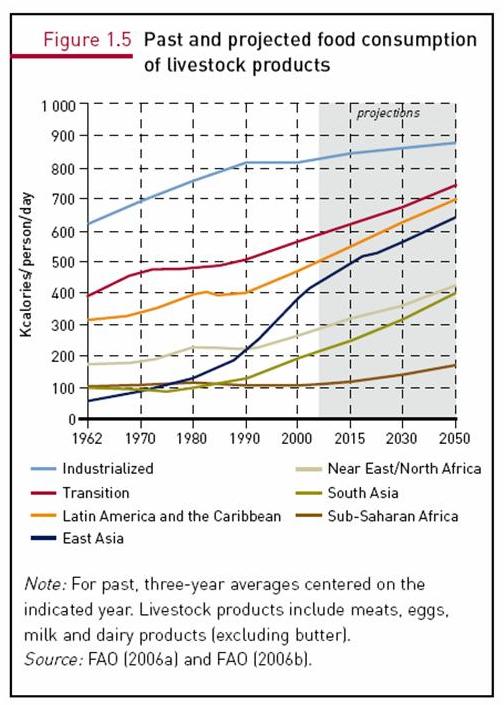
[Graph of Calories consumed in different countries: http://inbalance.files.wordpress.com/2008/01/meat-livestock-food-consumption.jpg]
Why Do People Consume What They Do?[edit | edit source]

Consumption is usually referred to as the using up of material goods, and materials necessary for human survival. At a minimum these goods are food, drink, clothing, and shelter. Anthropologists have typically dismissed the study of consumption saying that there are no interesting questions to be asked about it. Even though this consumption of goods is the main drive of economy, it may not be in anthropologists' best interest to study it. The reasons for consumption are simple: either people need something—food and drink—or they want something—like material possessions. Both of these, they thought, weren’t likely to reveal any interesting patterns. However, for the few anthropologists who did look at consumption across different cultures, they found distinct patterns in the way humans consume.
One approach they have taken to try and understand these patters is the Internal Explanation. This explanation comes from the work done by Bronislaw Malinowski. He believed that every social practice a society had was done to support the basic human needs. Malinowski said that basic human needs could be biological or psychological. He proposed them to be nourishment, reproduction, bodily comforts, safety, movement, growth, and health. In order to satisfy each human needs proposed, corresponding practice such as food-gathering techniques, kinship, shelter, etc are essential.
The last key point in Malinowski’s explanation was that humans are solely dependent on the physical world to survive. Even though westerners see the way more primitive cultures utilize the physical world as bizarre, they are still using the same physical world we are using, just in different ways. Unfortunately, Malinowski’s explanation falls short because it doesn’t explain why all societies don’t share the same consumption patterns and why some people eat wild berries and some eat processed wheat. Cultural ecology, the study of human adaptations to social and physical environments takes over and explains why these differences exist.
Product consumption is also associated with social norms and values. If society is saying that in order to be happy, you need this, then people will follow suit and buy the product. People want to have it all and be happy, and so they willingly put their trust in the social media telling them what to buy. On the other hand, in rural areas, people consume what the social norm is. If a woman in a rural area has the norm of extravagant beads and dresses, then that is what they will get or make. Also to get people to buy products in certain areas companies will market their products to the people they want to sell their product to. They will often include the people they are marketing to in their marketing to get people to think that they are more included. For example kids cereal brands include kids eating their cereal. It is often happy children and they love the cereal. This often makes children who see the ad want to eat the cereal and ask their parents for it.
Modes of Exchange[edit | edit source]
The idea of exchange was first explained by Marcel Mauss in terms of two types of exchange: non-capitalist gift exchanges (which have to do with social relations and building, which require a gift for exchange), and impersonal commodity exchanges. Impersonal commodity exchanges are more common in Capitalist societies which don’t link those who are exchanging with one another, aside through the use of cash. These aspects are also characteristic of egalitarian societies. Later, Marshall Sahlins used the work of Karl Polanyi to develop the idea of three modes of exchange, which could be identified throughout more specific cultures than just Capitalist and non-capitalist. These are reciprocity, redistribution, and market exchange. Although these modes of exchanges are drastically different, aspects of more than one mode may be present in any one society.
Reciprocity[edit | edit source]
The oldest mode of exchange is Reciprocity which is used in egalitarian societies, like that of the Ju/’hoansi. There are three different types of reciprocity: generalized, balanced, and negative reciprocity.
- Generalized reciprocity is an exchange where return isn't expected right away and the value of this return isn’t specified. This is based on the assumptions that all exchange balances out, like that between family members. This is largely based on trust as social situations can become hostile as an individual could use an exchange to build a debt in their favor.
- Balanced reciprocity (or also known as Symmetrical reciprocity) is when exchange is made with the expectations that those who give an amount will get the same in return. This, unlike generalized reciprocity, has a specified time limit as to when the return should be made. The Ju/’hoansi, who use reciprocity in their societies in all forms, use balanced reciprocity. They distinguish between what they barter, which requires immediate balanced exchange (this is similar to our shopping experiences, where it's expected that money will be immediately exchanged for goods). Within the Ju/'hoansi, this also includes hxaro, which establishes that this exchange entitles obligations between the two in the future.
- Negative reciprocity is when a party tries to exchange without having to give up any value, which is the opposite of balanced exchange. "This can range from haggling prices to outright seizure." [12]
Reciprocity, the most ancient mode of exchange, is the exchange of goods and services of equal value. Generalized reciprocity can be defined as when the individuals involved just assume that the exchange will balance out. Nothing is expected immediately and a value of return is not established before the exchange is made. This type of reciprocity occurs often between parents and children. Balanced reciprocity, the opposite of generalized, is when a specific value of return and under an established time limit is expected. This exchange can be found between those in relationships. For example, when boyfriends and girlfriends exchange gifts of equal value and expect the same in return at Christmas. Negative reciprocity is the exchange of goods or services when at least one party attempts receive something for nothing in return without suffering consequences. This type of reciprocity can involve haggling or in some cases seizure.
Redistribution[edit | edit source]
Redistribution is a mode of exchange that involves some sort of centralized social organization. Members of a group contribute items such as food, money, clothing, etc. to the central organization, and the organization then redistributes the items to the members of the group. An example of this on a humanitarian level could be Goodwill, a food bank, etc.
Redistribution can occur on a small scale or a very large scale. A small scale example of redistribution is a class party. Each person is assigned something to bring – chips, salsa, pop, brownies, napkins, utensils, etc. On the day of the party, everyone brings in their items to share with each other. The Salvation Army is a good example of a rather medium-sized scale of redistribution. The Salvation Army collects money, clothing, household goods, cars, and even airline miles to redistribute to those in need. A large scale example of redistribution is the Internal Revenue Service. The IRS collects taxes from citizens and redistributes the money throughout our governmental system, to education, post offices, road construction, and the like.
.jpg)
One widespread local example of redistribution is church potlucks. For special events, several churches hold potlucks, (potlucks with noteworthy Native American origins). Every family contributes to the meal. All the contributions are placed in a central area, and when everyone has arrived, the congregation can eat a meal together from the assortment of dishes.
Another example of this is under Big Man/Big Woman political groupings in the South Pacific where the leader, chosen by favor, is in charge of general affairs, and collects a certain sum (i.e. a pig) from their group and redistributes it. This gives the Big Man/Big Woman the label of generous, although they personally don’t give any more than anyone else. This is also an example of the tradition of potlatch, where group members all give goods to one, who evenly distributes these goods among the community. The main point of this is to redistribute wealth.
Redistribution requires some form of centralized social organization. Those who own the central position of the organization receive economic contributions from all members of the group. With the contributions they receive from all members of the group they redistribute those goods to all the members of the groups in fair amounts to meet the needs of every member of the group. A potlatch is a good example of redistribution. When people go an event and are provided with food they then take that food and redistribute it to all members of their family or some kind of group they belong to. An example of this is the indigenous Americans of the northwest coast of North America. This is a very common mode of exchange among tribes and groups in all part of the world. It is a fair and normally well organized mode of exchange and valued by the members of most tribes and groups.
Potlatching[edit | edit source]
Potlatches are ceremonies held by First Nations peoples on the Pacific Northwest coast of the United States and Canadian province of British Columbia such as the Haida, Tlingit, Salish and Kwakiutl (Kwakwaka'kawakw). The potlatch takes the form of a ceremonial feast traditionally featuring seal meat or salmon. In it, hierarchical relations between groups were observed and reinforced through the exchange of gifts and other ceremonies. The potlatch is an example of a gift economy, whereby the host demonstrates their wealth and prominence through giving away their possessions and thus prompt participants to reciprocate when they hold their own potlatch. Although this sort exchange is widely practiced across the planet (consider, for example, the Western practice of buying one's friends rounds of drinks), the Northwest Coast potlatch is of a massive scale, and also served to redistribute goods from coastal to inland ecological zones.
The native peoples of the Northwest Coast of North America institutionalized this ceremonial redistribution of food and gifts. The southern Kwakiutl people were the most elaborative on this custom until 1904 when the potlatch was outlawed, however the ceremony did continue to be practiced in many societies. In 2004, the Tlingit clan members re-enacted the ritual in Sitka, Alaska, for the 100th Anniversary Commemoration of "The Last Potlatch". The clan members dressed in traditional Tlingit attire and practiced Tlingit traditions for the two day long celebration. Watercolour by James Gilchrist Swan (1818-1900) of the Klallam people of chief Chetzemoka (nicknamed 'the Duke of York'), with one of Chetzemoka's wives (nicknamed 'Jenny Lind') distributing 'potlatch' at Port Townsend, Washington, USA

Market Exchange[edit | edit source]
Market Exchange is used in Capitalist societies and relies on private trade of goods and services. Value is assigned based on a standard symbol, typically money. Although trade and money were developed independently, they are used together to create market exchange. This is the dominant mode of exchange in Western Societies.
Market Exchange was invented by the capitalist society that uses an economic system in which wealth are privately owned rather than commonly, publicly, or state-owned. It is where currency exchange takes place. It is where banks and other official institutions facilitate the buying and selling of foreign currencies. Trade, money, and market institutions developed independently and were not invented to work together. Capitalism is unique because the three (trade, money, and market) ended up working together. This was first done in the societies of early modern Europe. It is said that different modes of exchange often co-exist within a single society meaning that each society has their own way of operating and exchanging good in their day-to-day lives.
For example, in the United States we use the market mode or exchange, but you can still find redistribution and reciprocity. Reciprocity if you recall is the most ancient mode of exchange, was the exchange of goods and services of equal value and redistribution requires some form of centralized social organization. In families in the U.S., most parents have an income and then redistribute that income to their children and loved ones. Parents using their income to buy their children food and clothing without expecting return is an example of reciprocity. Some people believe that you cannot properly understand the exchange process without first fully understanding the production process.
Currency[edit | edit source]
Currency is a system of money that is used as a medium of exchange such as banknotes, coins, or digital currency. Systems of currency, such as the Euro, U.S. dollar, bitcoin, etc., are often produced and monitored by governments. Governments often give value to banknotes, referred to by some as fiat currency. The values of the independent currencies are often influenced by the economy in a global market driven by trade and foreign exchange markets. Usually monetary values remain within the boundaries of its intended nations and states.
Alternative Currency[edit | edit source]
Some forms of currency are given value by the global market and have no tie to a state, namely commodities such as gold, silver, and oil as well as stocks, bonds, derivatives, and cryptocurrencies. These currencies can be traded on the global markets, some being traded at every hour of the day. Physical commodities are given value by their practical uses, appearance, and even superstitions, regardless, they are transacted with and accepted as payment.
Bitcoin is a form of cryptocurrency and it is given value via the inherent principle of scarcity programmed at its core. Bitcoin is limited by computing power of its competitive network and the collaborative confirmation by the millions of nodes in its network of every single transaction. Each in every bitcoin transaction is in a sense, public information.
A more familiar type of alternative currency is currency that can only be used within a certain brand or company such a "Starbucks Stars". This is an example of currency brought about by a nation recently formed in the Pacific Northwest. Not all forms of currency are ancient and currency that begins from a company can be recognized worldwide.
Economizing[edit | edit source]
Economizing is a term that describes the practice of minimizing the economic cost of living. An example of this would be reducing waste and expenditures. Economizing is used most often when the cost of living is too high compared the individual's, or family's, income. This practice used by people everyday all around the world. Culture influences what people purchase and thus economizing changes between cultures because different cultures see different expenditures as mandatory.
A way to make sure that you economize effectively is to set a budget. Everyone that economizes has a budget, whether they have specifically made it or whether it is imposed by their income determines how necessary it is to economize. By setting a budget correctly you will avoid overspending completely if you stay under budget. However, the difficulty in having a budget is remaining under it. Economizing as a practice helps with this because it minimizes the cost of daily and necessary expenditures. Some common and effective ways to economize in the United States are to grow your own vegetables in your backyard, buy generic household brands, avoid deviating from grocery list, use public transportation as much as possible, cut costs on air conditioning by adding blinds to windows and buy non-perishable items in bulk. However, many of this strategies do not work for other cultures. A common example of a strategy to economize is to eat less. If you eat less you have to buy less food and because of how simple this strategy is it is used widely. This can lead to widespread hunger if many people do not have enough money to purchase items essential to living.
Microfinance[edit | edit source]

The Grameen Bank is a microfinance institution which distributes loans to people who, under normal circumstances, would never be able to open a line of credit. In any normal bank the lender requires the borrower to enter into a legally binding contract which guarantees the repayment of the given loan. If the borrower fails to repay the loan then their personal property is offered as collateral. The Grameen bank however requires no collateral and gives loans to those in the lowest socio-economic classes. The GB offers loans almost exclusively to women. Their current membership of 7.71 million is comprised of 97% women.[13] In order to raise the status of poor women, loans are almost always granted to them so that those who build new homes with their loans will have ownership of assets where traditionally women have had none. Instead of a contract the Grameen Bank requires users to apply for loans in groups of five or more. Although no one is responsible for the repayment of a loan other than the actual borrower herself, the other members of her group are there to help encourage her to repay her loan. Before a new group member can receive a loan, the other members loan must be paid off first. This creates strong peer pressure to pay back loans as quickly as possible. If someone is struggling to repay her loan, the GB will help them overcome their struggles and get back on their feet rather than take away the only source of income they have (traditional banking method). This unique perspective on lending inspires the attitude that all humans have great potential, that they only need the initial resources to show it. The Grameen Bank believes that the ability to receive credit is a human right, and that "these millions of small people with their millions of small pursuits can add up to create the biggest development wonder."[14]

Due to the success of the Grameen Bank the first Grameen based pilot program has begun in the US in Queens NY. Since its opening in January 2008 it has lent over 1 million US dollars to over 400 members. It is owned and operated by the international affiliate of the Grameen Bank in Bangladesh. Also, in 1997 the Grameen Foundation was created as a global non-profit organization which works around the globe to create microfinance institutions based on the Grameen model using a network of partner microfinance institutions.
There is criticism of microfinance as a solution to poverty. While microcredit institutions often report extremely successful stories of alleviating poverty in developing countries, some recent studies are presenting a different story. One research project conducted on women in Bangladesh found that only about 51 percent of the recipients of microcredit aid were regularly able to make their weekly payments. It also found that about one fourth of the loan recipients lied about the purposes for which they took out the loan.[15] One of the major problems is that many people take out loans for consumption purposes, such as marriage or medical expenses, rather than for investment in income generating activities.[20]
Glossary of Key Terms[edit | edit source]
- Economic anthropology: defined by Wilk in 1996 as "the part of the discipline [of anthropology] that debates issues of human nature that relate directly to the decisions of daily life and making a living."
- Production: the process by which natural resources are converted into a more useable form for humans.
- Distribution: the movement of goods and services from the place of manufacture or production to the place of consumption.
- Consumption: the taking in or using up of materials needed for humans to survive.
- Modes of exchange: the patterns by which distribution happens, including reciprocity, redistribution, and market exchange.
- Reciprocity: trading goods and services that are of the same value; the three anthropological types of this are generalized, balanced, and negative.
- Redistribution: secondary distribution so that every member of a group contributes economically and then receives the amount of goods that they need.
- Market Exchange: exchanging goods in terms of monetary value and continuing through a supply and demand price mechanism.
- Labor: the work that connects human groups to the environment around them.
- Modes of Production: the grouping of social relations through which labor is used to harness energy from the environment in the forms of tools, skills, organization, and knowledge.
- Means of Production: the actual tools, skills, organization, and knowledge used to take energy from nature.
- Relations of Production: the social relations which connect people who use a certain means of production in the context of a certain mode of production.
- Affluence: the state of more than the amount necessary to fulfill consumption needs.
-Economizing: to practice economically advantageous practices such as avoiding waste, reducing expenditures, or to make economic use of something.
-Animal Husbandry: to create a land to human means by domesticating animals and breeding them to fulfill the need in communities.
Chapter Glossary of Key Terms[edit | edit source]
References[edit | edit source]
- ↑ African Bushmen Tour U.S. to Fund Fight for Land
- ↑ Ames, Kenneth, and Herbert Maschner. "Peoples of the Northwest Coast." Thames & Hudson.
- ↑ Stewart, Hillary. "Spiritual Realms." Indian Fishing. Early Methods of the Northwest Coast.
- ↑ http://ije.oxfordjournals.org/content/31/2/320.full
- ↑ Encyclopedia of World Cultures. . Retrieved November 30, 2016 from Encyclopedia.com: http://www.encyclopedia.com/humanities/encyclopedias-almanacs-transcripts-and-maps/bedouin.
- ↑ a b United States Department of Agriculture's News Release: Family Farms are the Focus of New Agriculture Census Data
- ↑ Food and Agriculture Organization of the United Nations: Smallholder family farms
- ↑ a b c Pryor, Frederic L. The Red and the Green: The Rise and Fall of Collectivized Agriculture in Marxist Regimes. Princeton, NJ: Princeton UP, 1992. Print.
- ↑ a b Matson, P. A., W. J. Parton, A. G. Power, and M. J. Swift. "Agricultural Intensification and Ecosystem Properties." Science 277.5325 (1997): 504-09. Web. 28 Nov. 2016.
- ↑ Welsch, Robert Louis, and Luis Antonio Vivanco. "Foodways: Finding, Making, and Eating Food." Cultural Anthropology: Asking Questions About Humanity. New York: Oxford UP, 2015. 157-83. Print.
- ↑ a b c Lappé, Frances Moore, Peter Rosset, and Joseph Collins. World Hunger: Twelve Myths. 2nd ed. New York: Grove, 1998. Print.
- ↑ a b Tiwana, N.S., Neelima Jerath, S.S. Ladhar, Gurharminder Singh, Rajesh Paul, D.K. Dua, and H.K. Parwana. State of Environment Punjab-2007. Rep. no. 81-88362-19-0. N.p.: Punjab State Council for Science & Technology, 2007. Web. 28 Nov. 2016.
- ↑ a b c d Thottathil, Sapna E. India's Organic Farming Revolution: What It Means for Our Global Food System. Iowa City: U Of Iowa, 2014. ProQuest Ebrary. Web. 28 Nov. 2016.
- ↑ a b c d e f g h Shiva, Vandana. The Violence of the Green Revolution: Third World Agriculture, Ecology, and Politics. London: Zed, 1991. Print
- ↑ Pearse, Andrew. "Seeds of Plenty, Seeds of Want: Social and Economic Implications of the Green Revolution." 2015. Revisiting Sustainable Development. Comp. Peter Utting. N.p.: Clarendon, 1980. 139-57. Print.
- ↑ http://en.wikipedia.org/wiki/Rust_Belt
- ↑ http://www.encyclopedia.com/doc/1E1-RustBelt.html
- ↑ AnupShah.http://www.globalissues.org/issue/235/consumption-and-consumerism
- ↑ http://www.investortrip.com/images/kuwait-stock-market.jpg
- ↑ Islam Molla,Rafiqul, M. Mahmudul Alam, Abu N. M. Wahid 2008 Questioning Bangladesh's Microcredit. "Challenge" 51(6) November - December 2008:113 - 121 [URL:http://mesharpe.metapress.com/openurl.asp?genre=article&id=doi:10.2753/0577-5132510608]

^ Hill, Kim. Altruistic Cooperation During Foraging by the Ache, and the Evolved Human Predisposition to Cooperate. Human Nature 13 (2000): 105-28.
^ Lavenda, R.H., E. Schultz. 2009. Cultural anthropology: A perspective on the human condition. New York: Oxford University Press, Inc.
^ Sahlins, Marshall David. Stone Age Economics. Chicago: Aldine-Atherton, 1972.
^ Grameen Communications. "Grameen Bank | Banking for the poor - About Us." Grameen Bank | Banking for the poor - Home. 02 Mar. 2009. 03 Mar. 2009 <http://www.grameen-info.org/index.php?option=com_content&task=blogsection&id=5&Itemid=164>.
^ "Grameen Bank -." Wikipedia, the free encyclopedia. Mar. 2004. 03 Mar. 2009 <http://en.wikipedia.org/wiki/Grameen_Bank>.
^ "Huaoroni" -. "Wikipedia, the free encyclopedia. Feb. 2008. 05 Mar. 2009 <http://en.wikipedia.org/wiki/Huaorani>
^ Wikipedia, the free encyclopedia. Nov. 2006. 02 Mar. 2009 <http://en.wikipedia.org/wiki/Black_Gold_(film)>.
^ Lavenda, R.H., E. Schultz. 2009. Cultural anthropology: A perspective on the human condition. New York: Oxford University Press, Inc.
^ Black Gold. Dir. Mark Francis. Perf. Tadesse Meskela. DVD. 2006.
^ Can Microcredit Alleviate Rural Poverty? A Case Study of Bangladesh. Haque, Muhammad Sayeedul. WASET.org. 2008.
^ Questioning Bangladesh's Microcredit. Molla, Rafiqul Islam. M.E. Sharpe, inc. 2008
^ James, Paul. "Modes of Production." Western Washington University, Bellingham. 10 Feb. 2009.
^ Norton, Joe. "Basic Anthropology - Modes of Production: Foraging, Horticulturalist, Pastoralist - Associated Content." Associated Content - associatedcontent.com. 3 Mar. 2007. Associated Content Society. 03 Mar. 2009 <https://archive.is/20130628112008/www.associatedcontent.com/article/189596/basic_anthropology_modes_of_production_pg2.html?cat=49>.
^ "Pastoralism -." Wikipedia, the free encyclopedia. 27 Feb. 2009. 04 Mar. 2009 <http://en.wikipedia.org/wiki/Pastoralist>.
^ James, Paul. "Modes of Production." Western Washington University, Bellingham.
^ <www.mumbainet.com/template1.php?CID=15>.
^ "Means of Production-." Wikipedia, the free encyclopedia. 05 Mar. 2009 http://en.wikipedia.org/wiki/Means_of_production
^ "Agriculture in India-." Wikipedia, the free encyclopedia. 06 Mar. 2009 http://en.wikipedia.org/wiki/Agriculture_in_India
^ "Ya̧nomamö -." Wikipedia, the free encyclopedia. 2 Mar. 2009. 05 Mar. 2009 <http://en.wikipedia.org/wiki/Ya%CC%A7nomam%C3%B6>.
^ James, Paul. "Modes of Production." Western Washington University, Bellingham, WA. 12 Feb. 2009.
^ "Making a Living: Getting Food" http://classes.uleth.ca/200701/anth1000y/PDF%20BY%206/getting_food.pdf
Template:Potlatch bambooweb, http://www.bambooweb.com/articles/p/o/Potlatch.html
^ Cornell, Joseph D. "Slash and Burn." The Encyclopedia of Earth. 1 Feb. 2007. <http://www.eoearth.org/article/Slash_and_burn>.
^ "Slash and Burn." Wikipedia. 9 Mar. 2009. <http://en.wikipedia.org/wiki/Slash_and_burn>.
^ Hooker, Richard. "The Mayas." Civilizations in America. 1996. Washington State University. <http://www.wsu.edu/~dee/CIVAMRCA/MAYAS.HTM>.
^ "Maya civilization." 8 Mar. 2009. Wikipedia. <http://en.wikipedia.org/wiki/Maya_civilization>.
^ "Physical Distribution Management Transportation." 27 Feb. 2010. Biz-encyclopedia. <http://www.enotes.com/biz-encyclopedia/physical-distribution-management-transportation>}}
^ "Microloans and Microfinance." 27 Feb. 2010. <http://www.worldconcern.org/microloans/>.