Control Systems/System Representations
System Representations[edit | edit source]
This is a table of times when it is appropriate to use each different type of system representation:
| Properties | State-Space Equations |
Transfer Function |
Transfer Matrix |
|---|---|---|---|
| Linear, Distributed | no | no | no |
| Linear, Lumped | yes | no | no |
| Linear, Time-Invariant, Distributed | no | yes | no |
| Linear, Time-Invariant, Lumped | yes | yes | yes |
General Description[edit | edit source]
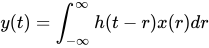
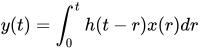
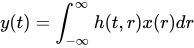
These are the general external system descriptions. y is the system output, h is the system response characteristic, and x is the system input. In the time-variant cases, the general description is also known as the convolution description.
| General Description | |
|---|---|
| Time-Invariant, Non-causal | |
| Time-Invariant, Causal | |
| Time-Variant, Non-Causal | |
| Time-Variant, Causal | |

State-Space Equations[edit | edit source]
These are the state-space representations for a system. y is the system output, x is the internal system state, and u is the system input. The matrices A, B, C, and D are coefficient matrices.
[Analog State Equations]
| State-Space Equations | |
|---|---|
| Time-Invariant |
|
| Time-Variant |
|




These are the digital versions of the equations listed above. All the variables have the same meanings, except that the systems are digital.
[Digital State Equations]
| State-Space Equations | |
|---|---|
| Time-Invariant |
|
| Time-Variant |
|
![{\displaystyle x'[t]=Ax[t]+Bu[t]}](https://wikimedia.org/api/rest_v1/media/math/render/svg/96c9bb4a5c7de3cd5cc4e8cd7e1918b929fb2d4b)
![{\displaystyle y[t]=Cx[t]+Du[t]}](https://wikimedia.org/api/rest_v1/media/math/render/svg/a693829a3890a121c299963d4a80d4af64ac1c12)
![{\displaystyle x'[t]=A[t]x[t]+B[t]u[t]}](https://wikimedia.org/api/rest_v1/media/math/render/svg/4650e82120f9b61badbfa572264a77149807ee4a)
![{\displaystyle y[t]=C[t]x[t]+D[t]u[t]}](https://wikimedia.org/api/rest_v1/media/math/render/svg/8a3b4e2adcb61cdc6d41a7a7d964d06bd1e2920f)
Transfer Functions[edit | edit source]
These are the transfer function descriptions, obtained by using the Laplace Transform or the Z-Transform on the general system descriptions listed above. Y is the system output, H is the system transfer function, and X is the system input.
[Analog Transfer Function]
| Transfer Function | |
|---|---|

[Digital Transfer Function]
| Transfer Function | |
|---|---|

Transfer Matrix[edit | edit source]
This is the transfer matrix system description. This representation can be obtained by taking the Laplace or Z transforms of the state-space equations. In the SISO case, these equations reduce to the transfer function representations listed above. In the MIMO case, Y is the vector of system outputs, X is the vector of system inputs, and H is the transfer matrix that relates each input X to each output Y.
[Analog Transfer Matrix]
| Transfer Matrix | |
|---|---|

[Digital Transfer Matrix]
| Transfer Matrix | |
|---|---|
