Complex Analysis/Complex Numbers/Introduction
This book assumes you have some passing familiarity with the complex numbers. Indeed much of the material in the book assumes your already familiar with the multi-variable calculus. If you have not encountered the complex numbers previously it would be a good idea to read a more detailed introduction which will have many more worked examples of arithmetic of complex numbers which this book assumes is already familiar. Such an introduction can often be found in an Algebra (or "Algebra II") text, such as the Algebra wikibook's section on complex numbers.
Intuitively a complex number z is a number written in the form:
- ,

where x and y are real number and i is an imaginary number that satisfies . We call x the real part and y the imaginary part of z, and denote them by and , respectively. Note that for the number , , not . Also, to distinguish between complex and purely real numbers, we will often use the letters z and w for the complex numbers. It is useful to have a more formal definition of the complex numbers. For example, one frequently encounters treatments of the complex numbers that state that is the number so that , and we then operate with using many of our usual rules for arithmetic. Unfortunately if one is not careful this will lead to difficulties. Not all of the usual rules for algebra carry through in the way one might expect. For example, there is a flaw in the following calculation: , but is very difficult to point out the flaw without first being clear about what a complex number is, and what operations are allowed with complex numbers.






Mathematically the complex numbers are defined as an ordered pair, endowed with algebraic operations.
- Definition
A complex number z is an ordered pair of real numbers. That is where x and y are real numbers. The collection of all complex numbers is denoted by the symbol .


The most immediate consequence of this definition is that we may think of a complex number as a point lying the plane. Comparing this definition with the intuitive definition above, it is easy to see that the imaginary number i simply acts as a place holder for denoting which number belongs in the second coordinate.
- Definition
We define the following two functions on the complex plane. Let be a complex number. We define the real part is as function given by . Similarly we define the imaginary part as a function given by .


We say two complex numbers are equal if and only if they are equal as ordered pairs. That is if and then z = w if and only if x = u and y = v. Put more succinctly, two complex numbers are equal iff their real parts and imaginary parts are equal.

If complex numbers were simply ordered pairs there would not really be much to say about them. But the complex numbers are ordered pairs together with several algebraic operations, and it is these operations that make the complex numbers so interesting.
- Definition
Let z = (x, y) and w = (u, v) then we define addition as:
- z + w = (x + u, y + v)
and multiplication as:
- z · w = (x · u − y · v, x · v + y · u)
Of course, we can view any real number r as being a complex number. Using our intuitive model for the complex numbers it is clear that the real number r should correspond to the complex number (r, 0), and with this identification the above operations correspond exactly to the usual definitions of addition and multiplication of real numbers. For the remainder of the text we will freely refer to a real number r as being a complex number, where the above identification is understood.
The following facts about addition and multiplication follow easily from the corresponding operators for the real numbers. Their verification is left as an exercise to the reader. Let z, w and v be complex numbers, then:
| • z + (w + v) = (z + w) + v | (Associativity of addition); |
| • z · (w · v) = (z · w) · v | (Associativity of multiplication); |
| • z + w = w + z | (Commutativity of addition); |
| • z · w = w · z | (Commutativity of multiplication); |
| • z · (w + v) = z · w + z · v | (Distributive Property). |
One nice feature of complex addition and multiplication is that 0 and 1 play the same role in the real numbers as they do in the complex numbers. That is 0 is the additive identity for the complex numbers (meaning z + 0 = 0 + z = z) and 1 is the multiplicative identity (meaning z · 1 = 1 · z = z).
Of course it is natural at this point to ask about subtraction and division. But stating the formula's for subtraction and division outright, we instead follow the usual course for other subjects of algebra and first discuss inverses.
- Definition
Let z = (x, y) be any complex number, then we define the additive inverse −z as:
- −z = (−x, −y)
Then it is immediate to verify that z + −z = 0.
Now for any two complex numbers z and w we define z − w to be z + −w. We now turn to doing the same for multiplication.
- Definition
Let z = (x, y) be any non-zero complex number, then we define the multiplicative inverse, as:

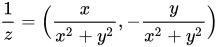
It is left to the reader to verify that .

We may now of course define division as . Just as with the real numbers, division by zero remains undefined. In order for this last definition to make more sense it helps to introduce two more operations on the complex numbers. The first is the absolute value.

- Definition
Let z = (x, y) be any complex number, then we define the complex absolute value, denoted |z| as:
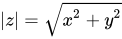
Notice that |z| is always a real number and |z| ≥ 0 for any z.
Of course with this definition of the absolute value, if z = (x, y) then |z| is exactly the same as the norm of the vector (x, y).
Before introducing the second definition, notice that our intuitive definition simply required us to find a number whose square was −1. Of course i2 = (−i)2 = −1, so for a starting point one could have chosen -i as the most basic imaginary number. This idea motivates the following definition.
- Definition
Let z = (x, y) be any complex number, then we define the conjugate of z, denoted as:


With this definition it is an easy exercise to check that , so dividing both sides by |z|2 we arrive at . Compare this with the definition of the multiplicative inverse above.


Recall that, every point in the plane can be written using rectangular coordinates such as (x, y) where of course the numbers denote the distance from the x and y axes respectively. But the point could equally well be described using polar coordinates (r, θ), where the first number represents the distance from the origin, and the second is the angle that is made with the positive x axis when you connect the origin and the point with a line segment. Since complex numbers may be thought of simply as points in the plane, we can immediately derive a polar representation of a complex number. As usual we can let a point z = (x, y) = (r cos θ, r sin θ) where . The choice of θ is not unique because sine and cosine are 2π periodic. A value θ for which z = (r cos θ, r sin θ) is called an argument of z. If we restrict our choice of θ so that 0 ≤ θ < 2π then the choice of θ is unique provided that z ≠ 0. This is often called the principle branch of the argument.
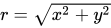
As a shorthand, we may write , so . This notation simplifies multiplication and taking powers, because




![{\displaystyle =r_{1}r_{2}\left[\left(\cos \theta _{1}+i\sin \theta _{1}\right)\left(\cos \theta _{2}+i\sin \theta _{2}\right)\right]}](https://wikimedia.org/api/rest_v1/media/math/render/svg/007831e4e47fbafc653bc35a589d1a6f6dc8f8c3)
![{\displaystyle =r_{1}r_{2}\left[\left(\cos \theta _{1}\cos \theta _{2}-\sin \theta _{1}\sin \theta _{2}\right)+i\left(\sin \theta _{1}\cos \theta _{2}+\cos \theta _{1}\sin \theta _{2}\right)\right]}](https://wikimedia.org/api/rest_v1/media/math/render/svg/adf12e6aa262c886ac5d92b8b46906cd2f662c6b)


by elementary trigonometric identities. Applying this formula can therefore simplify many calculations with complex numbers.
Using induction we can show that
- ,

holds for all positive integers .

Now that we have set up the basic concept of a complex number, we continue to topological properties of the complex plane.
Exercises[edit | edit source]
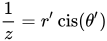
- Determine in terms of and .
- Determine in terms of and .
- Show that the absolute value on the complex plane obeys the triangle inequality. That is show that:
- Show that the absolute value on the complex plane obeys the reverse triangle inequality. That is show that:
- Given a non-zero complex number determine and so that .
- Determine formulas for and in terms of and .
- Find distinct complex numbers , so that . Hint: Use the formula given above for and the periodicity of and .