Complex Analysis/Complex Functions/Complex Functions
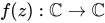
A complex function is one that takes complex values and maps them onto complex numbers, which we write as . Unless explicitly stated, whenever the term function appears, we will mean a complex function. A function can also be multi-valued – for example, has two roots for every number. This notion will be explained in more detail in later chapters.


A complex function will sometimes be written in the form , where are real-valued functions of two real variables. We can convert between this form and one expressed strictly in terms of through the use of the following identities:


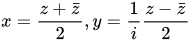
While real functions can be graphed on the x-y plane, complex functions map from a two-dimensional to a two-dimensional space, so visualizing it would require four dimensions. Since this is impossible we will often use the three-dimensional plots of , and to gain an understanding of what the function "looks" like.


For an example of this, take the function . The plot of the surface is shown to the right.

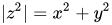
Another common way to visualize a complex function is to graph input-output regions. For instance, consider the same function and the input region being the "quarter disc" obtained by taking the region


(i.e. is the first quadrant)


and intersecting this with the disc of radius 1:


If we imagine inputting every point of into , marking the output point, and then graphing the set of output points, the output region would be where


( is called the upper half plane).


So, the squaring function "rotationally stretches" the input region to produce the output region. This can be seen using the polar-coordinate representation of , . For example, if we consider points on the unit circle (i.e. the set "") with then the squaring function acts as follows:






(here we have used ). We see that a point having angle is mapped to the point having angle . If is small, meaning that the point is close to , then this means the point doesn't move very far. As becomes larger, the difference between and becomes larger, meaning that the squaring function moves the point further. If (i.e. ) then (i.e. ).


