Complex Analysis/Complex Functions/Analytic Functions
From our look at complex derivatives, we now examine the analytic functions, the Cauchy-Riemann Equations, and Harmonic Functions.
- 2.4.1 Holomorphic functions
Note: Holomorphic functions are sometimes referred to as analytic functions. This equivalence will be shown later, though the terms may be used interchangeably until then.
Definition: A complex valued function is holomorphic on an open set if it has a derivative at every point in .


Here, holomorphicity is defined over an open set, however, differentiability could only at one point. If f(z) is holomorphic over the entire complex plane, we say that f is entire. As an example, all polynomial functions of z are entire. (proof)
- 2.4.2 The Cauchy-Riemann Equations
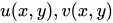
The definition of holomorphic suggests a relationship between both the real and imaginary parts of the said function. Suppose is differentiable at . Then the limit


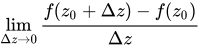
can be determined by letting approach zero from any direction in .


If it approaches horizontally, we have . Similarly, if it approaches vertically, we have . By equating the real and imaginary parts of these two equations, we arrive at:


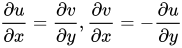
These are known as the Cauchy-Riemann Equations, and leads us to an important theorem.
Theorem: Let a function be defined on an open set containing a point, . If the first partials of exist in and are continuous at and satisfy the Cauchy-Riemann equations, then f is differentiable at . Furthermore, if the above conditions are satisfied, is analytic in . (proof).


- 2.4.3 Harmonic Functions
Now we move to Harmonic functions. Recall the Laplace equation,
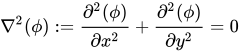
Definition: A real valued function is harmonic in a domain if all of its second partials are continuous in and if at each point in , is analytic in a domain , then both are harmonic in . (proof)