Circuit Theory/LC Tuned Circuits
Jump to navigation
Jump to search

Series LC[edit | edit source]
A circuit of one Capacitor and one inductor connected in series
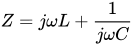
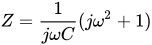
Circuit Impedance[edit | edit source]


Natural Response[edit | edit source]
At equilibrium , the total voltage of the two components are equal to zero
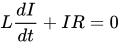

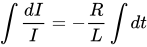
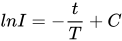
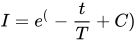
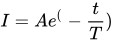
The Natural Response of the circuit is a Exponential Decrease in time
Resonance Response[edit | edit source]
- .




In Resonance, Impedance of Inductor and Capacitance is equal and the sum of the Capacitor and Inductor's voltage are equal result in Standing Wave Oscillation . Therefore, Lossless LC series can generate Standing Wave Oscillation
LC in Parallel[edit | edit source]
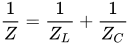
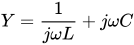
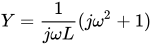
A circuit of one Capacitor and one inductor connected in parallel