Chemical Sciences: A Manual for CSIR-UGC National Eligibility Test for Lectureship and JRF/Triatomic molecule

From Wikibooks, open books for an open world
Jump to: navigation, search
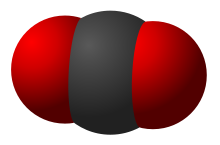
Carbon dioxide

Triatomic molecules are formed by three atoms. Examples include H2O, CO2, HCN etc.

[edit] Molecular vibrations

The vibrational modes of a triatomic molecule can be determined in specific cases.

[edit] Symmetric linear molecules

A symmetric linear molecule ABA can perform:

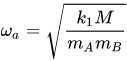
  • Antisymmetric longitudinal vibrations with frequency
\omega_a=\sqrt{\frac{k_1M}{m_Am_B}}
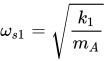
  • Symmetric longitudinal vibrations with frequency
\omega_{s1}=\sqrt{\frac{k_1}{m_A}}
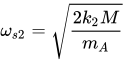
  • Symmetric transversal vibrations with frequency
\omega_{s2}=\sqrt{\frac{2k_2M}{m_A}}

In the previous formulas, M is the total mass of the molecule, mA and mB are the masses of the elements A and B, k1 and k2 are the spring constants of the molecule along its axis and perpendicular to it.

[edit] Types

Trihydrogen cation
Ozone

Ozone, O3 is an example of a triatomic molecule with all atoms the same. Triatomic hydrogen, H3, is unstable and breaks up spontaneously. H3+, the trihydrogen cation is stable by itself and is symmetric.
Personal tools
Namespaces

Variants
Actions
Navigation
Community
Toolbox
Sister projects
Print/export