Cellular Automata/Neighborhood
1D neighborhood[edit | edit source]
Since in 1D there are no shapes, the definition of the neighborhood is usually very simple.
Radial neighborhood[edit | edit source]

Usually the neighborhood in 1D is described by its radius , meaning the number of cell left and right from the central cell that are used for the neighborhood. The output cell is positioned at the center.

- Formal definition
Formally the radial neighborhood is the set of neighbors

or simply the neighborhood size with the output cell at the center .


- Symmetries
- reflection symmetry
Stephen Wolfram's notation[edit | edit source]
In Wolframs's texts and many others the number of available cell states and the radius are combined into a pair


- See also
- Stephen Wolfram, Statistical Mechanics of Cellular Automata (1983)
Brickwall neighborhood[edit | edit source]

An unaligned neighborhood, usually the smallest possible . The output cell is positioned at between the two cells of the neighborhood. It is usually processed by alternatively shifting the output cell between and .


2D neighborhood[edit | edit source]
von Neumann neighborhood[edit | edit source]

It is the smallest symmetric 2D aligned neighborhood usually described by directions on the compass sometimes the central cell is omitted.

- Formal definition
Formally the von Neumann neighborhood is the set of neighbors

or a subset of the rectangular neighborhood size with the output cell at the center .


- Symmetries
- reflection symmetry
- rotation symmetry 4-fold
- See also
Moore neighborhood[edit | edit source]

Is a simple square (usually 3×3 cells) with the output cell in the center. Usually cells in the neighborhood are described by directions on the compass sometimes the central cell is omitted.

- Formal definition
Formally the Moore neighborhood is the set of neighbors

or simply a square size with the output cell at the center .
- Symmetries
- reflection symmetry
- rotation symmetry 4-fold
- See also
- [mathworld] - [Moore Neighborhood]
Margolus neighborhood[edit | edit source]
reversible
see also [1]
Unaligned rectangular neighborhood[edit | edit source]

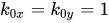
An unaligned (brickwall) rectangular neighborhood, usually the smallest possible . The output cell is positioned at between the four cells of the neighborhood. It is usually processed by alternatively shifting the output cell to and .



Hexagonal neighborhood[edit | edit source]
Hexagonal neighborhood[edit | edit source]

- Symmetries
- reflection symmetry
- rotation symmetry 6-fold
Small unaligned hexagonal neighborhood[edit | edit source]

- Formal definition
Formally the small (3-cell) unaligned hexagonal neighborhood represented on a rectangular lattice is the set of neighbors

- Symmetries
- reflection symmetry
- rotation symmetry 3-fold
References[edit | edit source]
- [mathworld] - [Neighborhood]