The method of Lagrange multipliers solves the constrained optimization problem by transforming it into a non-constrained optimization problem of the form:

Then finding the gradient and Hessian as was done above will determine any optimum values of  .
.
Suppose we now want to find optimum values for  subject to
  from [2].
Then the Lagrangian method will result in a non-constrained function.

The gradient for this new function is



Finding the stationary points of the above equations can be obtained from their matrix from.
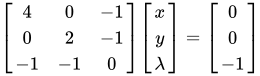
This results in  .
.
Next we can use the Hessian as before to determine the type of this stationary point.
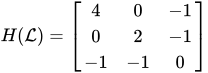
Since  then the solution
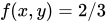
 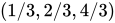 minimizes subject to with
  .
.